
Ameerega hahneli
Ameerega hahneli is a diurnal frog species found in the Amazonian lowlands of South America. Its distinctive appearance includes a brown back and limbs often marked with black spots, a black flank bordered by a white dorsolateral line, and a blue venter with black reticulations. This species is named after Paul Hahnel, who collected the initial specimens.
Key Facts
- ›Found in the Amazonian lowlands across multiple South American countries.
- ›Males are smaller than females, measuring 17-19 MM and 19-22 MM respectively.
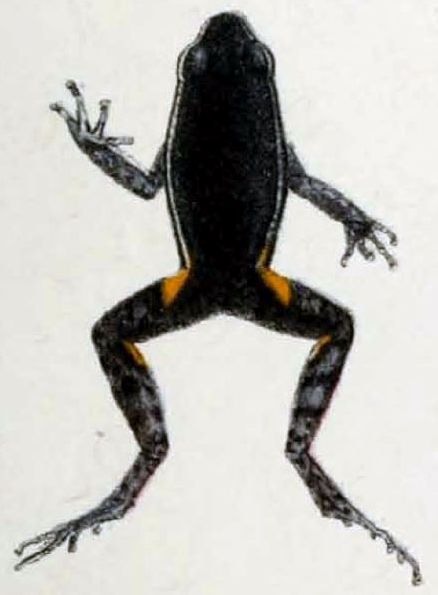
- ›Distinctive markings include a white dorsolateral line, a white labial stripe, and yellow-orange spots on the ventral surfaces of limbs.
- ›Males are territorial and communicate with distinct calls for territorial defense and courtship.
- ›Females lay eggs on leaf litter, and the father carries hatched tadpoles to running water.
- ›Active during the day and hides in low vegetation at night.
Tropical Rainforest, Forest Floor
Brazil, Bolivia, Peru, Ecuador, Colombia, Venezuela, Guyana, French Guiana, Suriname
- Narrow, White Or Cream-Colored Dorsolateral Line Bordering Black Flanks
- White Or Cream-Colored Labial Stripe
- Blue Venter With Black Reticulations
- Yellow-Orange Oval Spots On Ventral Surfaces of Arms, Inner Shanks, and Groin
About Ameerega hahneli
Ameerega hahneli is a species of frog belonging to the family Dendrobatidae, commonly found in the Amazonian lowlands of South America. Named in honor of Paul Hahnel, who collected the type series, this species is known for its distinctive coloration and diurnal habits.
Description and Appearance
Adult males of Ameerega hahneli typically measure between 17 and 19 mm in snout-vent length, while females are slightly larger, ranging from 19 to 22 mm. The frog's back and limbs are characterized by a fine granulation and a brown coloration, which may or may not be accompanied by black spots. A notable feature is the black flank, sharply delineated above by a narrow, white or cream-colored dorsolateral line that extends from the tip of the snout to the groin. A similar white or cream-colored stripe runs along the lip (labial stripe) but does not extend onto the arm. The ventral side of the frog is blue and marked with black reticulations. Additionally, distinct yellow-orange oval spots are present on the ventral surfaces of the arms, the inner surfaces of the shanks, and in the groin region. The iris of the eye is a dark brown.
Habitat and Distribution
Ameerega hahneli inhabits the forest floor within tropical rainforest environments. It is commonly found in association with natural forest debris such as fallen palm fronds and branches, as well as in small clearings. While common throughout much of its range, it is noted as uncommon in the Guianas. The species is distributed across the Amazonian lowlands of Brazil, Bolivia, Peru, Ecuador, Colombia, Venezuela, Guyana, French Guiana, and Suriname.
Behavior and Reproduction
This species is active during the day and seeks shelter in low vegetation at night. Males are territorial and employ specific vocalizations to assert their territory and attract mates. The territorial call is a prolonged series of short "peep" sounds, whereas the courtship call is a shorter, three-note variation. Reproduction involves the female laying between 6 and 33 pigmented eggs on the leaf litter. Following hatching, which occurs within 4 to 16 days, the male carries the tadpoles on his back to a nearby creek. The tadpoles require flowing water for their development and typically metamorphose after approximately two months.
Conservation Status
Ameerega hahneli is considered a common species and its total population is stable, therefore it is not currently listed as threatened. While habitat loss is a potential concern, it is not viewed as a significant threat to the species' overall survival. Legal captive breeding for the international pet trade is also not considered a threat by scientists.
Source: Wikipedia ↗
Frequently Asked Questions
What is Ameerega hahneli?
Ameerega hahneli is a species of frog belonging to the family Dendrobatidae. It is native to the Amazonian lowlands of South America and is known for its distinct coloration and diurnal activity.
Where is Ameerega hahneli found?
This frog species is widely distributed in the Amazonian lowlands, inhabiting countries such as Brazil, Bolivia, Peru, Ecuador, Colombia, Venezuela, Guyana, French Guiana, and Suriname.
What does Ameerega hahneli look like?
Ameerega hahneli has a brown back and limbs, often with black spots, and black flanks bordered by a white dorsolateral line. It also features a white labial stripe and a blue venter with black reticulations, along with yellow-orange spots on its ventral limb surfaces.
How does Ameerega hahneli reproduce?
Males are territorial and use specific calls for defense and courtship. Females lay eggs on leaf litter, which are then transported by the father to streams with running water for tadpole development.
What is the habitat of Ameerega hahneli?
Ameerega hahneli resides on the forest floor within tropical rainforests. It is often found near fallen palm fronds, branches, and in small clearings, and it hides in low vegetation at night.
Is Ameerega hahneli endangered?
The species is considered common in most of its range and its total population is stable, meaning it is not currently threatened. While habitat loss is a potential concern, it does not pose a significant threat to the overall species population.
Related Frogs
Agalychnis saltator
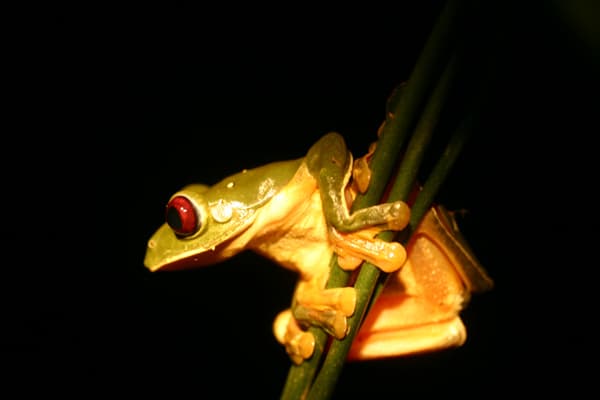
Agalychnis saltator, also known as the parachuting red-eyed leaf frog or misfit leaf frog, is a species of frog found in the humid and wet forests of Central America, from Honduras to Costa Rica. This arboreal and nocturnal species is distinctive for its bright red eyes with vertical pupils and its ability to 'parachute' by spreading webbing between its limbs and toes to glide between trees.

Amietia angolensis
Amietia angolensis, also known as the Angola river frog or common river frog, is a widespread frog species found across southern and eastern Africa. It inhabits a diverse range of environments, from forests and savannas to grasslands and various freshwater bodies. This species is not considered threatened by the IUCN.
Amolops larutensis
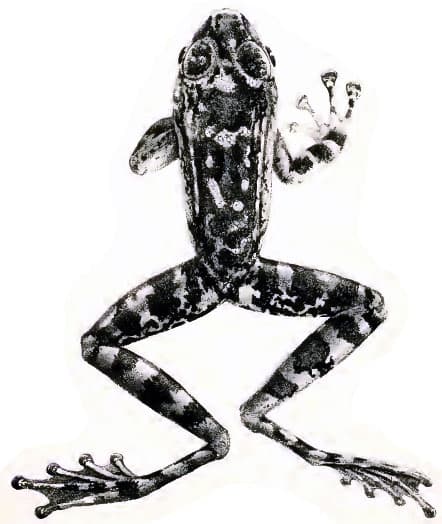
Amolops larutensis, also known as the Larut sucker frog, is a species of frog native to the Malay Peninsula, found from southernmost Thailand to Malaysia. It is distinctive for its large adhesive discs on its fingertips and smaller ones on its toe tips, which aid in clinging to rocky surfaces in its fast-flowing stream habitat.