
Amolops larutensis
Amolops larutensis, also known as the Larut sucker frog, is a species of frog native to the Malay Peninsula, found from southernmost Thailand to Malaysia. It is distinctive for its large adhesive discs on its fingertips and smaller ones on its toe tips, which aid in clinging to rocky surfaces in its fast-flowing stream habitat.
Key Facts
- ›Found in fast-flowing, clear-water forest streams.
- ›Males reach 35–45 MM snout-to-vent length; females are larger, 53–75 MM.
- ›Possesses large adhesive discs on finger tips and smaller ones on toe tips.
- ›Tadpoles have large ventral suckers for attachment to rocks.
- ›Common and abundant in its preferred habitat.
- ›Conservation status is not considered threatened.
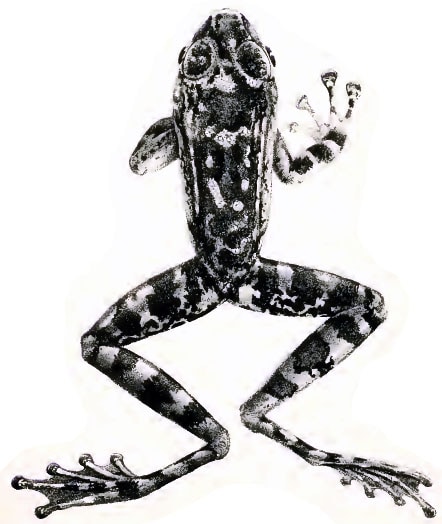
Larut Sucker Frog, Larut Hill Cascade Frog, Southern Pad-Discked Frog
Forest Streams, Lowlands, Highlands
Malaysia, Thailand
Large Adhesive Discs On Finger Tips, Smaller Adhesive Discs On Toe Tips, Granular Skin, Pale Yellowish-Green Back With Dark Blotches, White Underside
About Amolops larutensis
Amolops larutensis, commonly referred to as the Larut sucker frog, is a species of frog native to the Malay Peninsula. Its range extends from the southernmost parts of Thailand down into Malaysia. This species is well-adapted to its specific environment, making it a notable inhabitant of its native region.
Description and Adaptations
The physical characteristics of Amolops larutensis include distinct sexual dimorphism in size, with males measuring between 35–45 mm in snout-to-vent length and females being considerably larger, reaching 53–75 mm. A defining feature of this frog is the presence of large adhesive discs on the tips of its fingers and smaller ones on its toes. These specialized pads are crucial for its survival, enabling it to firmly grip surfaces in its challenging habitat. The frog's skin is granular, and its upper body typically displays a pale yellowish-green hue overlaid with dark blotches, while its underside is white.
Habitat and Ecology
Amolops larutensis is a common and abundant species, predominantly found in and along fast-flowing, clear-water forest streams. It inhabits rocky substrates, including boulders and bedrock, within both lowland and highland areas. The species is so prevalent in these environments that it may be the most common frog found in forest boulder streams throughout the Malay Peninsula. Its tadpoles possess large ventral suckers, which they utilize to adhere to rocky surfaces, an essential adaptation for surviving in strong currents.
Conservation Status
The International Union for Conservation of Nature (IUCN) does not currently consider Amolops larutensis to be a threatened species, indicating a stable population within its natural range.
Source: Wikipedia ↗
Frequently Asked Questions
What are the common names for Amolops larutensis?
Amolops larutensis is commonly known by several names, including the Larut sucker frog, Larut Hill cascade frog, and the southern pad-discked frog.
What is the size of Amolops larutensis?
Male Amolops larutensis typically grow to a snout-to-vent length of 35–45 mm, while females are larger, ranging from 53–75 mm.
Where is Amolops larutensis found?
This species is found in the Malay Peninsula, with its distribution extending from southernmost Thailand down to Malaysia. Records further north likely refer to a different species.
What is the habitat of Amolops larutensis?
Amolops larutensis inhabits boulders and bedrock in and along fast-flowing, clear-water forest streams, found in both lowland and highland areas.
How do the tadpoles of Amolops larutensis survive in fast water?
The tadpoles of Amolops larutensis are equipped with large ventral suckers. These specialized structures allow them to firmly attach themselves to rocky surfaces, preventing them from being swept away by strong currents.
Related Frogs
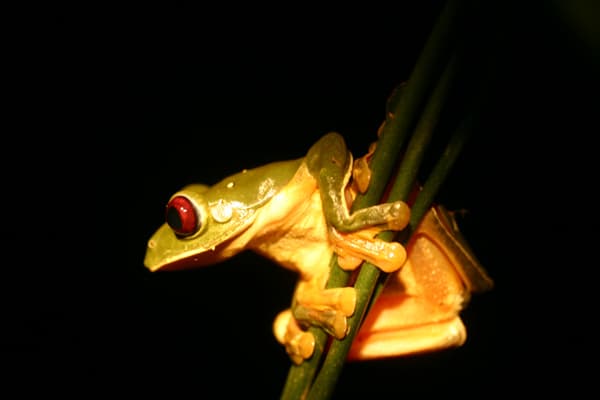
Agalychnis saltator
Agalychnis saltator, also known as the parachuting red-eyed leaf frog or misfit leaf frog, is a species of frog found in the humid and wet forests of Central America, from Honduras to Costa Rica. This arboreal and nocturnal species is distinctive for its bright red eyes with vertical pupils and its ability to 'parachute' by spreading webbing between its limbs and toes to glide between trees.
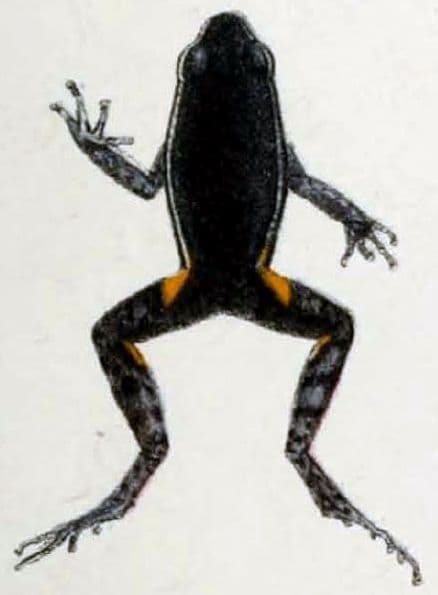
Ameerega hahneli
Ameerega hahneli is a diurnal frog species found in the Amazonian lowlands of South America. Its distinctive appearance includes a brown back and limbs often marked with black spots, a black flank bordered by a white dorsolateral line, and a blue venter with black reticulations. This species is named after Paul Hahnel, who collected the initial specimens.

Amietia angolensis
Amietia angolensis, also known as the Angola river frog or common river frog, is a widespread frog species found across southern and eastern Africa. It inhabits a diverse range of environments, from forests and savannas to grasslands and various freshwater bodies. This species is not considered threatened by the IUCN.