
American bullfrog
The American bullfrog (Lithobates catesbeianus) is a large true frog native to eastern North America, known for its deep, bellowing call that resembles a bull. These adaptable amphibians inhabit permanent water bodies like swamps, ponds, and lakes, and are significant predators with a varied diet. Due to their voracious appetite and prolific egg-laying, they have been introduced globally and are considered invasive in many regions, posing a threat to native ecosystems.
Key Facts
- ›Native to eastern North America, found in states east of the Mississippi River and parts of Canada.
- ›Recognizable by its large size, olive-green to grayish-brown dorsal surface, and off-white to yellow ventral surface.
- ›Males are sexually dimorphic, smaller than females, and possess yellow throats and tympana larger than their eyes.
- ›Generalist carnivores with a diet including small mammals, birds, reptiles, fish, and a wide range of invertebrates.
- ›Considered highly invasive in many introduced regions due to their broad diet and high reproductive output.
- ›Adult size ranges from 9 to 15 CM (snout-to-vent length), with some individuals reaching up to 20 CM.

Bullfrog
Wetlands, Freshwater, Lakes, Ponds, Swamps
Alabama, Arkansas, Connecticut, Delaware, Florida, Georgia, Idaho, Illinois, Indiana, Iowa, Kansas, Kentucky, Louisiana, Maine, Maryland, Massachusetts, Michigan, Minnesota, Mississippi, Missouri, Montana, Nebraska, New Hampshire, New Jersey, New Mexico, New York, North Carolina, Ohio, Oklahoma, Oregon, Pennsylvania, Rhode Island, South Carolina, South Dakota, Tennessee, Texas, Utah, Vermont, Virginia, Washington, West Virginia, Wisconsin, Wyoming, Colorado, Nevada, Arizona, California
- Https://En.Wikipedia.Org/Wiki/American_bullfrog#/Media/File:Rana_catesbeiana_-_head_shot.Jpg
- Https://En.Wikipedia.Org/Wiki/American_bullfrog#/Media/File:Lithobates_catesbeianus_male_throat.Jpg
- Https://En.Wikipedia.Org/Wiki/American_bullfrog#/Media/File:Rana_catesbeiana_-_full_body.Jpg
- Https://En.Wikipedia.Org/Wiki/American_bullfrog#/Media/File:American_bullfrog_lithobates_catesbeianus.Jpg
Alligators, Snakes, Birds, Herons, North American River Otters, Predatory Fish
- Large Size For A True Frog In North America
- Olive-Green To Grayish-Brown Dorsal Coloration
- Off-White Ventral Coloration With Yellow Or Gray Blotches
- Males Have Yellow Throats and Tympana Larger Than Their Eyes
- Prominent Eyes With Horizontal, Almond-Shaped Pupils
- Distinctive Deep, Bellowing Call
About American bullfrog
The American bullfrog, scientifically known as Lithobates catesbeianus (and sometimes referred to as Rana catesbeiana), is the largest true frog species native to eastern North America. Its common name is derived from the deep, bellowing call made by males, which is reminiscent of a bull's vocalization. This species is characterized by its considerable size, reaching snout-to-vent lengths typically between 9 to 15 cm, with some individuals growing up to 20 cm and weighing as much as 500 grams or more.
Description and Habitat
Distinguished by its olive-green to grayish-brown upper body, often with mottling or banding, and an off-white belly blotched with yellow or gray, the American bullfrog possesses prominent eyes with horizontal, almond-shaped pupils. Males can be identified by their yellow throats and tympana (eardrums) that are larger than their eyes, a trait not seen in females. They are primarily aquatic, favoring large, permanent bodies of freshwater such as swamps, ponds, and lakes. Their adaptability also allows them to thrive in artificial habitats like canals, ditches, and reservoirs.
Diet and Ecology
As generalist carnivores, American bullfrogs consume a vast array of prey, including small mammals, birds, reptiles, fish, and a wide range of invertebrates. Their voracious appetite and broad dietary habits contribute to their ecological impact, especially when introduced outside their native range. They are themselves prey for animals such as alligators, snakes, and large birds like herons.
Reproduction and Behavior
The breeding season typically spans two to three months during the summer. Males establish territories and vocalize to attract females and deter rivals, engaging in complex mating behaviors. Females lay thousands of eggs in shallow water, which hatch within a few days. Males exhibit sexual dimorphism, with forelimb muscles adapted for clasping females during mating. The species is known for its skittish nature, making capture difficult.
Invasive Species and Conservation
Introduced to over 40 countries, the American bullfrog is considered an invasive species in many regions due to its aggressive predation and high reproductive rates, which can disrupt native ecosystems and threaten native amphibian populations. They are also noted for their relative immunity to the chytrid fungus, a pathogen devastating to many frog species, potentially acting as asymptomatic carriers. Despite their invasive status in some areas, they are a Least Concern species overall by the IUCN, partly due to their widespread distribution and adaptability.
Source: Wikipedia ↗
Frequently Asked Questions
What is the scientific name of the American bullfrog?
The scientific name of the American bullfrog is Lithobates catesbeianus. Some authorities also use the name Rana catesbeiana. The specific name 'catesbeianus' honors the English naturalist Mark Catesby.
What does the American bullfrog eat?
American bullfrogs are generalist carnivores, consuming a wide variety of prey. Their diet includes rodents, small lizards and snakes, other frogs, small birds, crayfish, and numerous invertebrates like snails and insects. They are also known to eat aquatic animals such as fish and tadpoles.
Where are American bullfrogs found?
The American bullfrog is native to eastern North America, commonly found in every U.S. state east of the Mississippi River and extending into parts of Canada. They have also been introduced to over 40 countries worldwide.
How large can American bullfrogs get?
Adult American bullfrogs typically measure between 9 to 15 cm (3.6 to 6 inches) in snout-to-vent length. However, larger individuals have been recorded, reaching up to 20 cm (8 inches) and weighing as much as 500g (1.1 lb), with some exceptional cases reaching 800g (1.8 lb).
Why are American bullfrogs considered invasive?
American bullfrogs are considered invasive due to their voracious appetite and high reproductive rates, which negatively impact native amphibians, insects, and other fauna. They can outcompete native species for food and habitat, and are relatively immune to the chytrid fungus, potentially spreading it to susceptible native frogs.
What are the distinguishing features of male bullfrogs?
Male American bullfrogs are sexually dimorphic, being smaller than females. They are distinguished by their yellow throats and tympana (eardrums) that are larger than their eyes. Dominant males often display brightly colored yellow gular sacs.
Related Frogs

American green frog
The American green frog (*Lithobates clamitans*) is a species of true frog native to eastern North America, known for its green head and prominent dorsolateral ridges. It is a mid-sized amphibian that inhabits shallow freshwater bodies and is recognized for its territorial behavior, particularly among males who use vocalizations and physical displays to defend their breeding grounds. The species has two recognized subspecies: the bronze frog and the northern green frog.

American green treefrog
The American green tree frog (Dryophytes cinereus) is a common, moderately-sized arboreal frog native to the central and southeastern United States. It is distinguished by its bright green to reddish-brown coloration, long legs, and a slender build, often featuring small golden spots on its dorsum. This nocturnal insectivore prefers habitats with permanent water sources and abundant vegetation, and plays a role as a bioindicator for aquatic contamination.
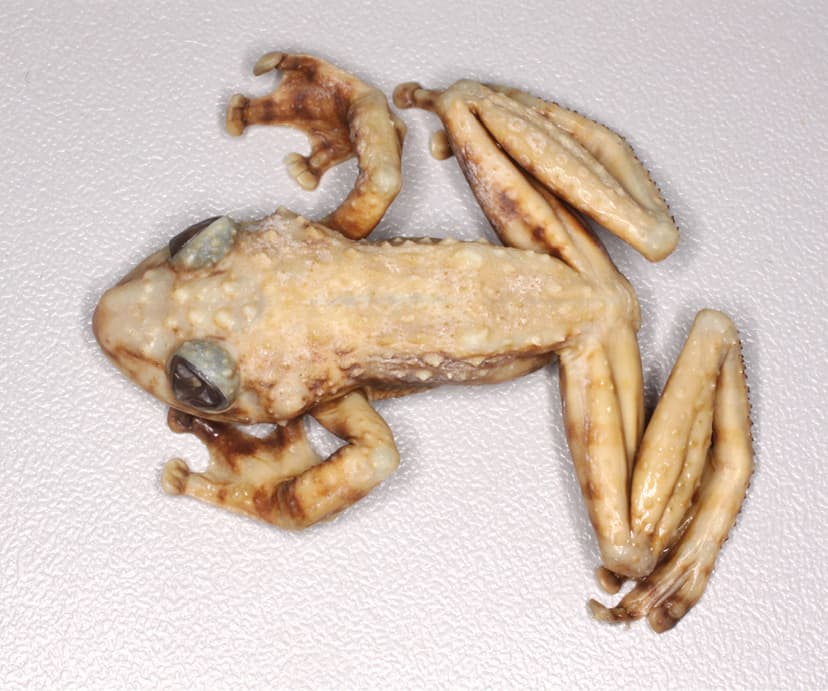
Acanthixalus spinosus
Acanthixalus spinosus, commonly known as the African wart frog, is a species of frog native to Africa, found from southeastern Nigeria to Gabon and the Democratic Republic of the Congo. It is distinctive for its warty, black or brownish-to-olive dorsum with an hourglass pattern, and the males' unique possession of strong tarsal spines and larger digital discs. This species primarily inhabits lowland rainforests, dwelling in water-filled tree holes and exhibiting predominantly aquatic behavior.