
Anomaloglossus baeobatrachus
Anomaloglossus baeobatrachus is a frog species native to the rainforests of northern Brazil, French Guiana, Suriname, and Guyana. This diurnal species is distinguished by its habitat on forest leaf litter and its unique breeding behavior where males call from elevated perches.
Key Facts
- ›Found in northern Brazil, French Guiana, Suriname, and Guyana.
- ›Inhabits leaf litter in primary and secondary forests.
- ›Active during the day (diurnal).
- ›Males call to females from perches above the leaf litter.
- ›Eggs are laid on dead leaves, and tadpoles develop in a nest.
- ›Classified as Least Concern by the IUCN due to its large range and infrequent human visitation.
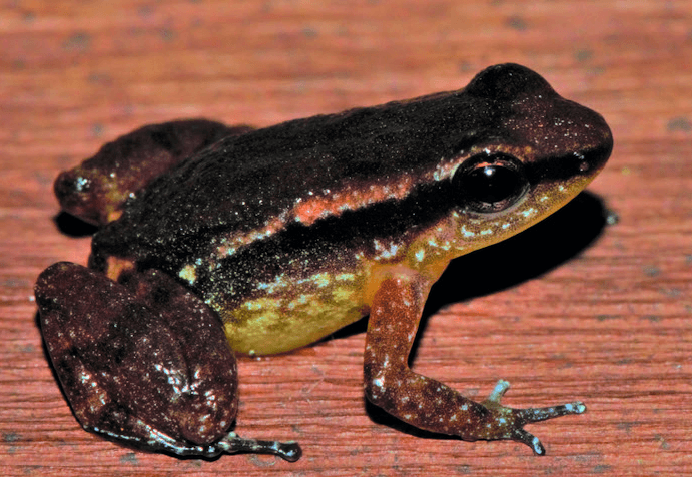
Rainforest, Forest
Brazil, French Guiana, Suriname, Guyana
About Anomaloglossus baeobatrachus
Anomaloglossus baeobatrachus is a species of frog belonging to the Aromobatidae family. It is found across a significant range in South America, encompassing northern Brazil, French Guiana, Suriname, and Guyana.
Habitat and Behavior
This species is diurnal, meaning it is active during daylight hours. Its preferred habitat is the leaf litter found within primary and secondary forests, typically at elevations between 10 and 800 meters above sea level. While Anomaloglossus baeobatrachus may be more commonly observed on slopes and plateaus, it can also be found near various types of water bodies, indicating a degree of habitat adaptability.
Reproduction
The breeding behavior of Anomaloglossus baeobatrachus involves males gathering in groups of two or more. These males perch on leaves or branches slightly above the forest floor to vocalize and attract females. The reproductive cycle continues with the female laying her eggs on dead leaves, and the subsequent development of the tadpoles occurs within a nest.
Conservation Status
Anomaloglossus baeobatrachus is currently classified as 'Least Concern' by the International Union for Conservation of Nature (IUCN). This status reflects its extensive geographical distribution and the fact that its habitat is rarely visited by humans, suggesting a low immediate threat of extinction.
Source: Wikipedia ↗
Frequently Asked Questions
Where is Anomaloglossus baeobatrachus found?
Anomaloglossus baeobatrachus is found in northern Brazil, extending south to Manaus, as well as in French Guiana, Suriname, and Guyana.
What is the habitat of Anomaloglossus baeobatrachus?
This frog lives on the leaf litter within primary and secondary forests. It can be found at elevations between 10 and 800 meters above sea level and may be present near various bodies of water.
How does Anomaloglossus baeobatrachus reproduce?
Male Anomaloglossus baeobatrachus frogs form groups and call to females from perches on leaves or branches slightly above the forest floor. Females lay their eggs on dead leaves, and the tadpoles mature within this nest.
What is the conservation status of Anomaloglossus baeobatrachus?
The IUCN classifies Anomaloglossus baeobatrachus as Least Concern for extinction. This status is attributed to its extensive geographical range and the limited human presence in its habitat.
Is Anomaloglossus baeobatrachus active at night?
No, Anomaloglossus baeobatrachus is a diurnal frog, meaning it is active during the daytime.
Related Frogs
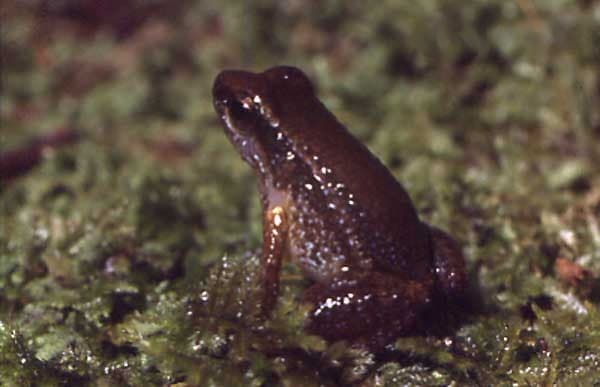
Anomaloglossus stepheni
Anomaloglossus stepheni, also known as Stephen's rocket frog, is a small terrestrial frog native to French Guiana, Suriname, and Brazil. Distinctive for its brown coloration with dark side stripes and bluish-white speckling, it exhibits unique parental care where males guard eggs laid in curled fallen leaves, with tadpoles developing entirely on land.
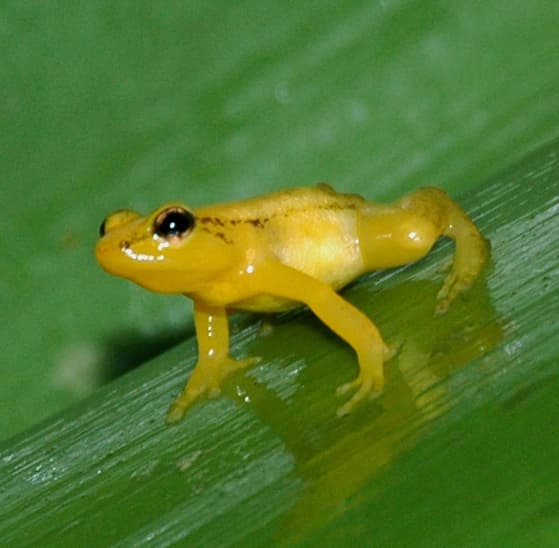
Anomaloglossus beebei
Anomaloglossus beebei, also known as the golden rocket frog, is a small frog species endemic to Guyana's Kaieteur National Park. It is uniquely adapted to living within the phytotelmata, the water-filled leaf axils of the giant bromeliad *Brocchinia micrantha*. This species exhibits reverse sexual dichromatism, with females being more brightly colored than males, and males play a significant role in parental care, defending territories and transporting tadpoles.
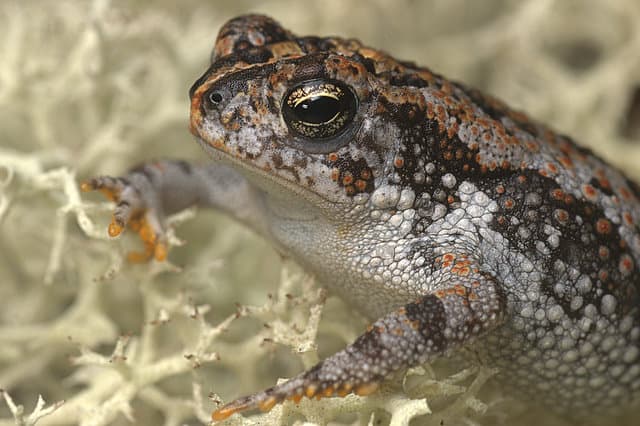
Anaxyrus quercicus
The oak toad (Anaxyrus quercicus) is the smallest toad species in North America, endemic to the coastal regions of the southeastern United States. It is distinguished by its light mid-dorsal stripe, variable spots, and large parotoid glands, and it primarily inhabits sandy pine flatwoods and oak scrub. This species is mostly diurnal and known for its burrowing behavior and a distinctive chirping call produced by males during the breeding season.