
Anomaloglossus stepheni
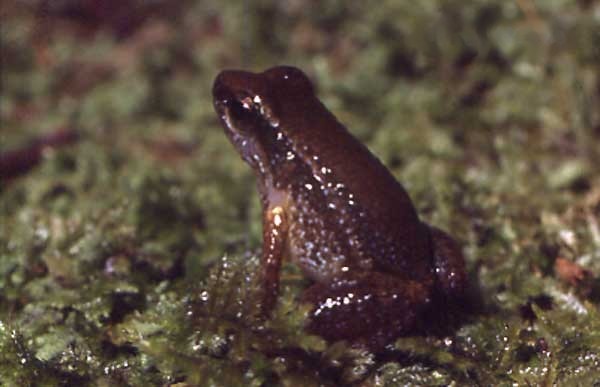
Anomaloglossus stepheni, also known as Stephen's rocket frog, is a small terrestrial frog native to French Guiana, Suriname, and Brazil. Distinctive for its brown coloration with dark side stripes and bluish-white speckling, it exhibits unique parental care where males guard eggs laid in curled fallen leaves, with tadpoles developing entirely on land.
Key Facts
- ›Found in French Guiana, Suriname, and Brazil.
- ›Males are 14–17 MM and females are 16–18 MM in snout-to-vent length.
- ›Brown coloration with dark lateral stripes and bluish-white speckles.
- ›Diurnal and terrestrial, living in forest litter.
- ›Males guard eggs laid in curled leaves and protect developing tadpoles on land.
- ›Listed as 'Least Concern' by the IUCN.
Stephen's Rocket Frog
Forest Litter, Rainforest
French Guiana, Suriname, Brazil
Small Size, Brown Coloration With Dark Lateral Stripes, Bluish-White Speckling On Underside and Toes, Sexual Dimorphism In Vocal Sac Color
About Anomaloglossus stepheni
Anomaloglossus stepheni: Stephen's Rocket Frog
Anomaloglossus stepheni, commonly known as Stephen's rocket frog, is a small species of frog belonging to the family Aromobatidae. This terrestrial amphibian is found in the rainforests of French Guiana, Suriname, and Brazil, particularly in areas like the Adolfo Ducke Forest Reserve. Its relatively small size, with males typically measuring 14–17 mm and females 16–18 mm in snout-to-vent length, coupled with its distinctive brown coloration and dark lateral stripes, helps in its identification.
Description and Habitat
The frog's general appearance is brown, marked by a dark stripe running down each side of its body for about half its length. Bluish-white speckles adorn its underside and toes. Anomaloglossus stepheni is a diurnal species, spending its life within the forest litter where it actively forages for invertebrates. Its habitat is the forest floor of its native South American range.
Biology and Reproduction
Stephen's rocket frog has a fascinating reproductive cycle that takes place during the rainy season. Males are territorial and use calls to attract females. They create sheltered nests within curled fallen leaves, often with another leaf acting as a roof. The female lays a small clutch of three to six eggs, which are encased in gelatinous capsules. Unusually for related species, the tadpoles develop entirely on land within these leaf nests, completing metamorphosis after approximately 31 days without being transported to water. The male frog exhibits significant parental care, guarding the eggs and remaining close to the developing tadpoles, even allowing other females to lay eggs in the same nest, leading to clutches of varying ages.
Conservation Status
Anomaloglossus stepheni is currently listed as 'Least Concern' by the IUCN Red List of Threatened Species. This status reflects its assumed large population size, extensive geographic range, and a seemingly stable population trend, indicating no immediate widespread threats to the species.
Source: Wikipedia ↗
Frequently Asked Questions
What is Stephen's rocket frog?
Stephen's rocket frog, scientifically known as Anomaloglossus stepheni, is a species of frog found in French Guiana, Suriname, and Brazil. It is a small, terrestrial frog characterized by its brown coloring and unique breeding behaviors.
What does Anomaloglossus stepheni look like?
This frog is typically brown with a dark stripe running down each side of its body, extending about halfway. It has bluish-white specks on its underside and toes. Males have a white or grey vocal sac, while females have a pale throat.
Where is Anomaloglossus stepheni found?
Anomaloglossus stepheni is distributed across French Guiana, adjacent areas of Suriname, and the Amazon rainforest in Brazil, particularly in the Adolfo Ducke Forest Reserve.
What does Stephen's rocket frog eat?
As a terrestrial species living in forest litter, Anomaloglossus stepheni forages on invertebrates. Its diet includes insects such as termites, beetles, and flies.
How does Anomaloglossus stepheni reproduce?
Breeding occurs during the rainy season. Males attract females with calls and create nests in curled fallen leaves, where females lay 3-6 eggs. The male then guards the eggs and tadpoles, which develop entirely on land.
What is the conservation status of Anomaloglossus stepheni?
Anomaloglossus stepheni is classified as 'Least Concern' by the IUCN Red List of Threatened Species. This is due to its assumed large population, wide range, and stable population trend.
Related Frogs
Anomaloglossus baeobatrachus
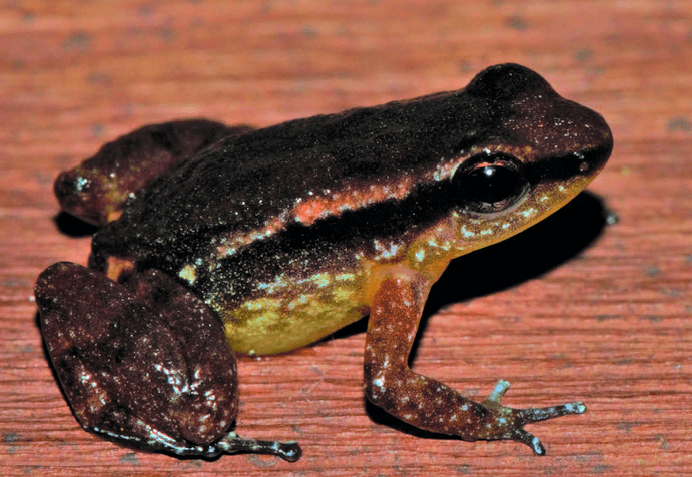
Anomaloglossus baeobatrachus is a frog species native to the rainforests of northern Brazil, French Guiana, Suriname, and Guyana. This diurnal species is distinguished by its habitat on forest leaf litter and its unique breeding behavior where males call from elevated perches.
Anomaloglossus beebei
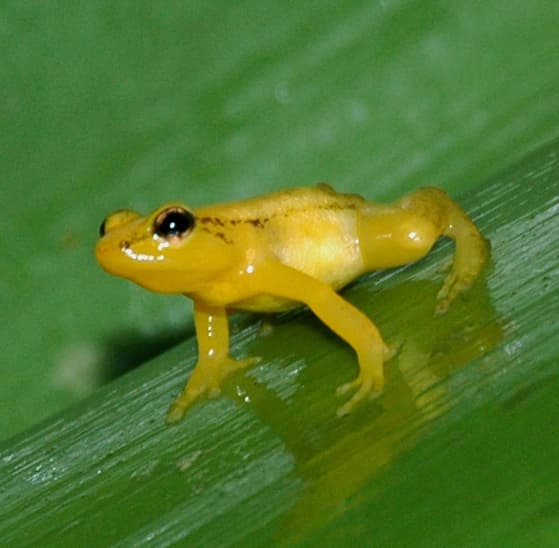
Anomaloglossus beebei, also known as the golden rocket frog, is a small frog species endemic to Guyana's Kaieteur National Park. It is uniquely adapted to living within the phytotelmata, the water-filled leaf axils of the giant bromeliad *Brocchinia micrantha*. This species exhibits reverse sexual dichromatism, with females being more brightly colored than males, and males play a significant role in parental care, defending territories and transporting tadpoles.
Anaxyrus quercicus
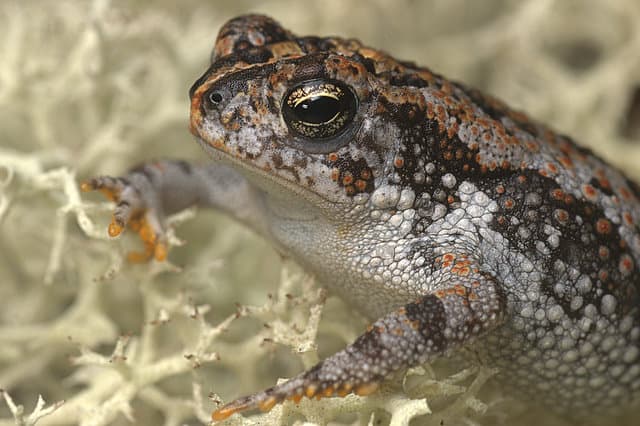
The oak toad (Anaxyrus quercicus) is the smallest toad species in North America, endemic to the coastal regions of the southeastern United States. It is distinguished by its light mid-dorsal stripe, variable spots, and large parotoid glands, and it primarily inhabits sandy pine flatwoods and oak scrub. This species is mostly diurnal and known for its burrowing behavior and a distinctive chirping call produced by males during the breeding season.