
Black striped frog
Sylvirana·Not Threatened
The black-striped frog (Sylvirana nigrovittata) is a species of frog native to a wide range across Southeast Asia and parts of the Indian subcontinent. It is commonly found in gentle forest streams and is distinguished by its presence in evergreen forests and its tadpoles' development in quiet stream sections. While generally common, it faces threats from habitat loss due to deforestation.
Key Facts
- ›Native to northeastern India, Bangladesh, Nepal, southern China, Myanmar, Thailand, Cambodia, Laos, and Vietnam.
- ›Inhabits gentle streams within evergreen forests, including those in deciduous forest areas.
- ›Tadpoles develop in quiet sections of streams.
- ›Can be found at elevations up to 800 meters above sea level.
- ›Threatened by the loss of forest canopy over its stream habitats and by hydrological changes.
- ›Currently not considered threatened by the IUCN.
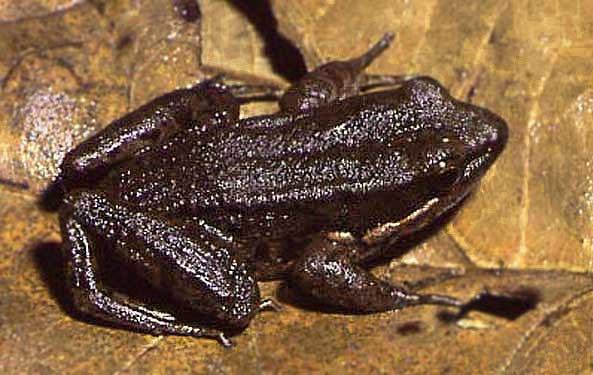
Black-Striped Frog, Black-Spotted Stream Frog, Sapgreen Stream Frog
Evergreen Forest, Deciduous Forest, Streams, Wetlands
India, Bangladesh, Nepal, China, Myanmar, Thailand, Cambodia, Laos, Vietnam
Found In Gentle Forest Streams, Tadpoles Develop In Quiet Stream Sections
About Black striped frog
Black-striped Frog (Sylvirana nigrovittata)
The black-striped frog, scientifically classified as Sylvirana nigrovittata, is a species of frog found across a broad geographical range encompassing northeastern India, Bangladesh, Nepal, southern China, Myanmar, Thailand, Cambodia, Laos, and Vietnam. This species is an inhabitant of gentle streams, typically located within evergreen forests. It can also be found in evergreen patches within deciduous forest environments. Its tadpoles have a specific requirement for quiet stream sections for their development.
Habitat and Distribution
Sylvirana nigrovittata has been observed at elevations up to 800 meters above sea level, indicating its presence in both lowland and montane forest stream ecosystems. The species is considered common within its distribution. However, it faces significant threats primarily from habitat degradation. The loss of forest canopy that covers the streams it relies upon, as well as alterations to the hydrological conditions of these water bodies, are key concerns for its long-term survival.
Conservation Status
Despite the environmental pressures it faces, the black-striped frog is not currently listed as threatened by the International Union for Conservation of Nature (IUCN). Identifications of this species from certain regions, particularly India and Bangladesh, remain uncertain, and earlier literature may refer to different species due to taxonomic redelimitation in 2018. While common, continued monitoring of its habitat is important to ensure its populations remain stable.
Source: Wikipedia ↗
Frequently Asked Questions
Where is the black-striped frog found?
The black-striped frog is found in northeastern India, Bangladesh, Nepal, southern China, Myanmar, Thailand, Cambodia, Laos, and Vietnam. It inhabits areas with gentle streams in evergreen forests.
What kind of habitat does the black-striped frog prefer?
This species prefers gentle streams located within evergreen forests. It can also be found in evergreen galleries within deciduous forest areas, and its tadpoles develop in quiet sections of these streams.
What are the main threats to the black-striped frog?
The primary threats to the black-striped frog include the loss of forest canopy over the streams it inhabits. Hydrological changes in its environment also pose a risk to its survival.
Is the black-striped frog endangered?
No, the black-striped frog is not considered threatened by the IUCN. However, it is impacted by habitat loss and changes to its aquatic environment.
At what altitudes can the black-striped frog be found?
The black-striped frog has been observed at elevations as high as 800 meters above sea level, indicating its ability to thrive in montane forest stream environments.
Related Frogs
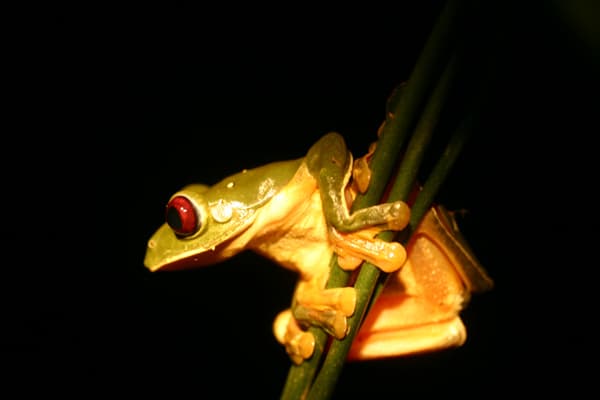
Agalychnis saltator
Agalychnis saltator, also known as the parachuting red-eyed leaf frog or misfit leaf frog, is a species of frog found in the humid and wet forests of Central America, from Honduras to Costa Rica. This arboreal and nocturnal species is distinctive for its bright red eyes with vertical pupils and its ability to 'parachute' by spreading webbing between its limbs and toes to glide between trees.
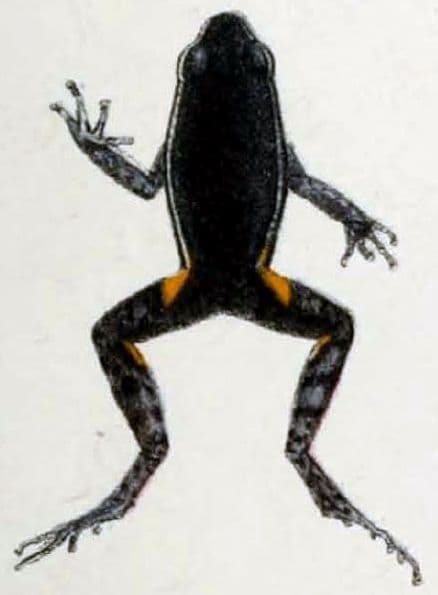
Ameerega hahneli
Ameerega hahneli is a diurnal frog species found in the Amazonian lowlands of South America. Its distinctive appearance includes a brown back and limbs often marked with black spots, a black flank bordered by a white dorsolateral line, and a blue venter with black reticulations. This species is named after Paul Hahnel, who collected the initial specimens.

Amietia angolensis
Amietia angolensis, also known as the Angola river frog or common river frog, is a widespread frog species found across southern and eastern Africa. It inhabits a diverse range of environments, from forests and savannas to grasslands and various freshwater bodies. This species is not considered threatened by the IUCN.