
Nevado del Ruiz
Nevado del Ruiz is a stratovolcano in Colombia that is the highest point in both the Caldas and Tolima departments. It is part of the Andes mountain range and is known for its glaciers and its history of devastating lahars, particularly the 1985 eruption that destroyed the town of Armero and caused an estimated 25,000 deaths, making it the deadliest lahar in recorded history.
Key Facts
- ›Nevado del Ruiz is a stratovolcano located in the Andes mountain range of Colombia.
- ›Volcanic activity began approximately two million years ago, with the current cone forming around 150,000 years ago.
- ›The summit is covered by glaciers, which have significantly retreated since the Last Glacial Maximum.
- ›The 1985 eruption produced lahars that buried the town of Armero, resulting in an estimated 25,000 fatalities.
- ›It is part of Los Nevados National Natural Park and is continuously monitored by the Colombian Geological Survey.
- ›Up to 500,000 people are estimated to be at risk from future lahars.

Known For
- The catastrophic 1985 lahar that destroyed Armero
- Its glaciers and summit snowcap
- Its volcanic activity and potential for lahars
Arenas Crater, Nereides Glacier
Los Nevados National Natural Park
About Nevado del Ruiz
Nevado del Ruiz is a stratovolcano situated in the Andes mountain range of Colombia, marking the highest point in both the Caldas and Tolima departments. Its name, "Nevado del Ruiz," translates to "Snow-covered of Ruiz," reflecting the glaciers that crown its summit. The volcano's geological history is extensive, with volcanic activity beginning approximately two million years ago. The current volcanic cone formed during the present eruptive period, which commenced about 150,000 years ago.
Geography and Geology
The volcano is a stratovolcano, composed of numerous layers of lava alternating with hardened volcanic ash and pyroclastic rocks. Its lavas are andesitic–dacitic in composition. Nevado del Ruiz is part of the Ruiz–Tolima volcanic massif, a group of five ice-capped volcanoes. The massif is located at the intersection of four active faults and lies within the Pacific Ring of Fire. The modern volcanic cone includes five lava domes constructed within the caldera of an ancestral Ruiz volcano. The volcano's summit features the Arenas crater, a large, deep depression.
Glaciers and Hydrology
The summit of Nevado del Ruiz is covered by glaciers that have generally retreated since the Last Glacial Maximum. From a peak coverage of about 1,500 km2 during the period of 28,000 to 21,000 years ago, the glaciated area has dramatically decreased. By 1959, it had reduced to 34 km2, and after the 1985 eruption, it further halved to approximately 10 km2 by 2003. The ice cap can reach depths of up to 190 meters in some areas. The meltwater from these glaciers is a crucial source of fresh water for forty surrounding towns, draining primarily into the Cauca and Magdalena Rivers.
Eruptive History and Hazards
Nevado del Ruiz typically generates Vulcanian to Plinian eruptions, which can produce swift pyroclastic flows. A significant hazard arises when these eruptions melt the mountain's snowcap, leading to massive lahars (mud and debris flows). The most devastating event occurred on November 13, 1985, when a small eruption triggered an enormous lahar that buried and destroyed the town of Armero, causing an estimated 25,000 deaths. This event, known as the Armero tragedy, is the deadliest lahar in recorded history and Colombia's worst natural disaster. Similar, though less deadly, lahars occurred in 1595 and 1845.
Current Status and Monitoring
Nevado del Ruiz continues to pose a threat to nearby communities, with estimates suggesting up to 500,000 people could be at risk from future lahars. Even small eruptions can destabilize the remaining glaciers and trigger mudflows. The volcano is constantly monitored by the Colombian Geological Survey through the Volcanic and Seismic Observatory of Manizales to provide early warnings and preparedness measures. The volcano is part of Los Nevados National Natural Park, a popular tourist destination, but its potential for destructive eruptions remains a serious concern.
Source: Wikipedia ↗
Frequently Asked Questions
What is Nevado del Ruiz known for?
Nevado del Ruiz is most infamous for the catastrophic lahar it generated on November 13, 1985. This mudflow, triggered by a volcanic eruption melting its snowcap, buried the town of Armero and killed an estimated 25,000 people, making it the deadliest lahar in recorded history and Colombia's worst natural disaster.
Where is Nevado del Ruiz located?
Nevado del Ruiz is located in Colombia, on the border of the Caldas and Tolima departments. It is situated in the Andes mountain range, approximately 130 km west of the capital city, Bogotá.
What type of volcano is Nevado del Ruiz?
Nevado del Ruiz is a stratovolcano, characterized by its steep, conical shape built up from alternating layers of lava, hardened ash, and pyroclastic rocks. It is part of the Ruiz–Tolima volcanic massif.
What is the current state of the glaciers on Nevado del Ruiz?
The summit of Nevado del Ruiz is covered by glaciers, which have been in significant retreat since the Last Glacial Maximum due to atmospheric warming. The 1985 eruption destroyed about 10% of the summit ice, and since then, the glaciated area has halved.
What are the main hazards associated with Nevado del Ruiz?
The primary hazard associated with Nevado del Ruiz is the potential for lahars, which are mud and debris flows triggered by volcanic eruptions melting the summit's snowcap and glaciers. These flows can move rapidly down river valleys and pose a significant threat to nearby towns and villages.
Is Nevado del Ruiz an active volcano?
Yes, Nevado del Ruiz is an active volcano. Its eruptive history spans millions of years, and it is continuously monitored by the Colombian Geological Survey due to the ongoing threat it poses to surrounding areas, particularly from lahars.
Related Glaciers
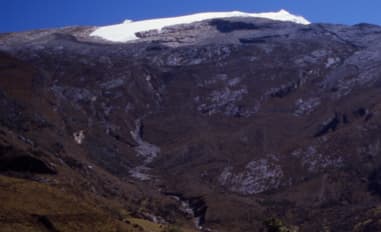
Ritacuba Blanco
Ritacuba Blanco is the highest peak in Colombia's Cordillera Oriental, part of the Andes Mountains. It is significant as the location of a rapidly melting glacier, which serves as a stark indicator of global warming's impact on tropical mountains. The peak is accessible for climbing, though its glacier is a notable feature for those who ascend it.

Sierra Nevada de Santa Marta
The Sierra Nevada de Santa Marta is an isolated mountain range in northern Colombia, distinct from the Andes. It is the highest coastal range in the tropics, with its peaks reaching nearly 5,700 meters and lying just 42 kilometers from the Caribbean coast. This range is a crucial ecological hub, housing diverse ecosystems and serving as the source of 36 rivers that supply water to approximately 1.2 million people.

Antisana
Antisana is a stratovolcano located in the northern Andes of Ecuador, standing as the fourth highest volcano in the country. It is situated approximately 50 kilometers southeast of Quito and presents a formidable challenge for technical climbers.