
Siachen Glacier
Valley Glacier·Administered·Asia·Alpine
The Siachen Glacier is a major glacier in the eastern Karakoram range of the Himalayas, notable for its significant length and strategic importance. It is the longest glacier in the Karakoram and the second longest in the world's non-polar regions, feeding vital river systems like the Indus. The glacier has become a site of prolonged military dispute between India and Pakistan.
Key Facts
- ›It is 76 km (47 MI) long, making it the longest glacier in the Karakoram range.
- ›It is the second-longest glacier in the world's non-polar areas.
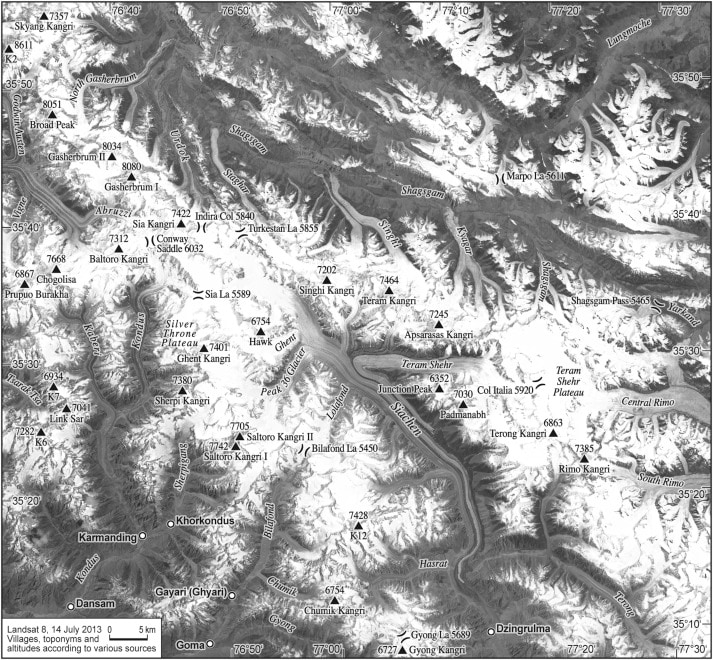
- ›Its head is at Indira Col on the India-China border at an altitude of 5,753 M (18,875 ft).
- ›The glacier's meltwater is the primary source of the Nubra River, a tributary of the Indus River.
- ›The region experiences extreme winter conditions with temperatures dipping to -50 °C (-58 °F) and over 1000 CM (35 ft) of snowfall.
- ›Both India and Pakistan maintain a significant military presence along the glacier and surrounding heights.
Known For
- Its significant length and status as the longest glacier in the Karakoram
- Its strategic importance and status as the world's highest battleground
- The prolonged military dispute between India and Pakistan over its control
Indira Col, Saltoro Ridge, Sia La, Bilafond La, Gyong La
About Siachen Glacier
The Siachen Glacier is a prominent glacier located in the eastern Karakoram range of the Himalayas. It is renowned for being the longest glacier in the Karakoram and the second longest in the world's non-polar regions, stretching 76 kilometers (47 miles) in length. Its headwaters are situated at the Indira Col on the India-China border at an elevation of 5,753 meters (18,875 feet), descending to 3,620 meters (11,875 feet) at its terminus. The glacier's meltwaters are a crucial source for the Nubra River, which eventually feeds into the Indus River, a lifeline for a vast irrigation system.
Strategic Importance and Dispute
Beyond its geological significance, the Siachen Glacier region holds immense strategic importance, making it the world's highest battleground. Since April 1984, India and Pakistan have maintained a significant military presence, engaged in intermittent conflict. India controls the entire Siachen Glacier and most of the dominating heights on the Saltoro Ridge to its west following Operation Meghdoot. Pakistan maintains a territorial claim and controls areas west of the ridge. Despite numerous attempts, efforts to demilitarize the region have been unsuccessful, and the harsh climate has resulted in more casualties than combat.
Environmental Impact and Future
The extensive military occupation has introduced environmental challenges, including pollution from waste dumping and the use of chemicals. Preliminary studies indicate that the glacier is retreating at an alarming rate, with predictions of significant size reduction by 2035. Proposals for a "Peace Park" have been put forth by environmentalists and peace activists to protect the fragile ecosystem and its rare species, such as the snow leopard. Efforts are underway by scientific organizations to develop methods for waste management and to study the glacier's response to climate change.
Source: Wikipedia ↗
Frequently Asked Questions
Where is the Siachen Glacier located?
The Siachen Glacier is situated in the eastern Karakoram range of the Himalayas, northeast of the point where the Line of Control between India and Pakistan concludes. It lies between the Saltoro Ridge to the west and the main Karakoram range to the east.
How long is the Siachen Glacier?
The Siachen Glacier is approximately 76 kilometers (47 miles) long. This length makes it the longest glacier in the entire Karakoram range and the second longest glacier found in the world's non-polar regions.
What is the significance of the Siachen Glacier's meltwater?
The melting waters from the Siachen Glacier are the principal source of the Nubra River, which in turn flows into the Shyok River. Ultimately, these waters feed into the Indus River, supporting one of the world's largest irrigation systems.
What is the climate like at the Siachen Glacier?
The climate in the Siachen Glacier region is extremely harsh and cold. Average winter snowfall exceeds 1000 cm (35 ft), and temperatures can drop as low as -50 °C (-58 °F).
What is the territorial dispute surrounding the Siachen Glacier?
Both India and Pakistan claim sovereignty over the entire Siachen region. India gained control of the glacier and surrounding heights in 1984 through Operation Meghdoot, and both nations maintain a military presence, though attempts at demilitarization have been unsuccessful.
What environmental issues are associated with the Siachen Glacier?
The significant military presence has led to environmental concerns, including pollution from waste dumping and the use of chemicals for melting ice. Research is ongoing to manage and mitigate the impact of waste, with plans for campaigns to airlift garbage and develop methods for waste decomposition.
Related Glaciers

Batura Glacier
Batura Glacier is one of the largest and longest glaciers found outside of the polar regions, stretching 57 km in length. Located in the upper Hunza region of Gilgit-Baltistan, Pakistan, it flows west to east and is notable for its debris-covered lower portions and proximity to the Karakoram Highway, making it a subject of scientific study.

Vanch-Yakh Glacier
The Vanch-Yakh Glacier, also known as the Fedchenko Glacier, is a significant ice formation in the Pamir Mountains of Tajikistan. It holds the distinction of being the longest glacier outside of the Earth's polar regions, making it a crucial feature for understanding glacial dynamics in mid-latitude mountain ranges.

Baltoro Glacier
The Baltoro Glacier is a major glacier located in the Karakoram range of Pakistan-administered Kashmir. It is renowned for being surrounded by some of the world's highest peaks, including K2, and serves as a critical source for the Braldo River, which eventually flows into the Indus. Scientific observations suggest the glacier is not retreating but undergoes surges, making it a dynamic and significant feature of the region.