
Torrecillas Glacier
The Torrecillas Glacier is a significant glacier located in Los Alerces National Park, Chubut Province, Argentina. It descends into the Y-shaped glacial lake, Lake Menéndez, and is notable for its proximity to extensive Alerce forests, which are among the oldest and largest in Argentina.
Key Facts
- ›The Torrecillas Glacier descends to within a few hundred meters of Lake Menéndez's shoreline.
- ›It is part of the Futaleufú River system, which flows into the Pacific Ocean in Chile.
- ›The glacier is situated in Los Alerces National Park, a protected area in Chubut Province.
- ›Flowing into Lake Menéndez are streams originating from snowfields and glaciers along the border with Chile.
- ›The glacier's meltwater contributes to the unique ecosystem surrounding Lake Menéndez, including rare Alerce trees.

Known For
- Proximity to Lake Menéndez and its Alerce forests
- Contribution to the glacial landscape of Los Alerces National Park
Descends Near Lake MenéNdez Shoreline, Part of A Y-Shaped Glacial Lake System
Los Alerces National Park
About Torrecillas Glacier
The Torrecillas Glacier is a notable glacier situated within the stunning natural landscape of Los Alerces National Park in Chubut Province, Argentina. It is a key component of the glacial formations that define the Y-shaped Lake Menéndez, a body of water carved by glacial forces within the Andes. The glacier's descent is characterized by its proximity to the lake's shoreline, reaching within a few hundred meters, and it contributes meltwater to the Futaleufú River system, which ultimately flows into the Pacific Ocean in Chile.
Significance and Surroundings
The area surrounding the Torrecillas Glacier and Lake Menéndez is ecologically significant. The tips of the lake's two arms host some of the most extensive and ancient Alerce (Fitzroya) forests found in Argentina. These remarkable trees, including the largest known Alerce in the country, are a major draw for visitors and underscore the unique biodiversity supported by the glacial melt and the temperate Valdivian rainforest ecosystem. Access to the lake and its glacial features is managed, with travel primarily by boat or on foot, and certain areas are restricted to preserve the environment.
Geological Context
Lake Menéndez itself is a testament to glacial activity, occupying deep troughs formed by converging glacial tongues. The convergence of these glacial forces, including the presence of the Torrecillas Glacier, has shaped the distinctive fjord-like valleys that characterize the lake. Streams originating from the glaciers and snowfields along the nearby border with Chile feed into the lake, further contributing to its formation and the surrounding hydrology. While specific data on the glacier's dimensions like length, area, or thickness are not detailed, its role in the dramatic glacial topography of the region is evident.
Source: Wikipedia ↗
Frequently Asked Questions
Where is the Torrecillas Glacier located?
The Torrecillas Glacier is located in Chubut Province, Argentina, within Los Alerces National Park. It is situated in the Andes mountain range and is a feature of the Lake Menéndez system.
What is notable about the Torrecillas Glacier's surroundings?
The glacier is found near Lake Menéndez, which is renowned for its extensive Alerce (Fitzroya) forests. These forests contain some of the largest and oldest Alerce trees in Argentina, with one specimen being over 2,600 years old.
How does the Torrecillas Glacier interact with Lake Menéndez?
The Torrecillas Glacier descends close to the shoreline of Lake Menéndez, a Y-shaped lake of glacial origin. Streams originating from the glacier and surrounding snowfields flow into the lake.
Is the Torrecillas Glacier easily accessible?
Access to the immediate vicinity of Lake Menéndez is primarily by boat or foot, as there are no roads or developments near the lake. Some shore areas and tributary streams are restricted, indicating that direct access to the glacier itself might be limited or require specific arrangements.
Related Glaciers

Perito Moreno Glacier
The Perito Moreno Glacier is a significant ice formation located in Los Glaciares National Park in Argentina, originating in the Andes mountain range shared with Chile. It is renowned for its dramatic, naturally occurring ruptures where an ice dam forms across Lake Argentino, causing water levels to rise and then break through the ice barrier in a spectacular event. This glacier is a major tourist attraction and a crucial part of the Southern Patagonian Ice Field, which represents the world's third-largest reserve of fresh water.
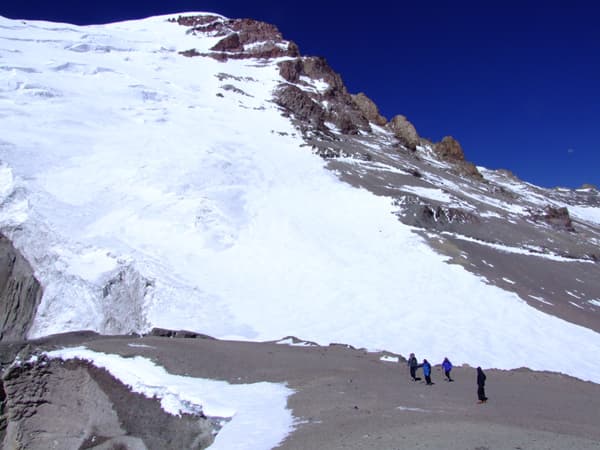
Polish Glacier
The Polish Glacier is a significant glacial feature on Aconcagua, the highest peak in the Andes and the Americas. It was named in honor of the 1934 Polish expedition that established a new route to the summit via this glacier, which subsequently became known as the Polish Route.

Upsala Glacier
The Upsala Glacier is a significant valley glacier situated on the eastern side of the Southern Patagonian Ice Field. Named after Uppsala University, which sponsored early glaciological studies, it is a notable feature of Argentinian Patagonia and a popular day tour destination from El Calafate. The glacier is particularly well-known for its rapid and ongoing retreat, which has been documented since its initial observation in 1810.