
Perito Moreno Glacier
The Perito Moreno Glacier is a significant ice formation located in Los Glaciares National Park in Argentina, originating in the Andes mountain range shared with Chile. It is renowned for its dramatic, naturally occurring ruptures where an ice dam forms across Lake Argentino, causing water levels to rise and then break through the ice barrier in a spectacular event. This glacier is a major tourist attraction and a crucial part of the Southern Patagonian Ice Field, which represents the world's third-largest reserve of fresh water.
Key Facts
- ›It is one of 48 glaciers fed by the Southern Patagonian Ice Field.
- ›The glacier's terminus is 5 km wide and 74 meters above Lake Argentino.
- ›It is named after explorer Francisco Moreno, a pioneer in the region.
- ›The Perito Moreno Glacier is known for its periodic, dramatic ice dam ruptures.
- ›It is a significant tourist attraction in Argentine Patagonia.
- ›The glacier is part of the Southern Patagonian Ice Field, the world's third-largest reserve of fresh water.

Known For
- Dramatic ice dam ruptures
- Being one of the few advancing or stable glaciers in the late 20th/early 21st century
- Its status as a major tourist attraction
Brazo Rico, Canal De Los TéMpanos
Los Glaciares National Park
About Perito Moreno Glacier
The Perito Moreno Glacier, also known by its Spanish name Glaciar Perito Moreno and historically as Francisco Gormaz or Bismarck Glacier, is a monumental ice formation situated within Los Glaciares National Park in southwestern Santa Cruz Province, Argentina. Its origins lie in the Andes mountain range, shared with Chile, and it is also a component of Chile's Bernardo O'Higgins National Park. This glacier is celebrated as one of the most significant tourist attractions in the Argentine Patagonia, drawing visitors from around the globe.
Unique Phenomenon: The Rupture
The Perito Moreno Glacier is perhaps most famous for its periodic and dramatic ice dam ruptures. The glacier's terminus extends across the Brazo Rico arm of Lake Argentino, effectively bisecting the lake and creating a massive ice barrier. The pressure from the impounded water on the Brazo Rico side can rise significantly, leading to the formation of an ice bridge. This bridge eventually breaks through in a spectacular event, releasing a vast outpouring of water into the main body of Lake Argentino and subsequently into the Santa Cruz River. This dam-ice-bridge-rupture cycle is a natural phenomenon that recurs with varying frequency, ranging from once a year to less than once every decade. The exposed shoreline after a rupture provides evidence of the immense water levels achieved.
Glaciological Significance and Status
As an ice formation measuring 250 km² in area and 30 km in length, Perito Moreno is one of 48 glaciers fed by the Southern Patagonian Ice Field. This ice field is a crucial geographical feature, representing the world's third-largest reserve of fresh water. For many years, Perito Moreno was considered unusual among glaciers for maintaining a state of equilibrium, accumulating mass at a rate comparable to its loss. However, since 2020, observations have indicated that the glacier's northern front is retreating, a change that glaciologists suggest may be linked to climate change. The reasons for its prolonged period of stability remain a subject of scientific discussion.
Historical Naming and Exploration
The glacier's history is marked by several names bestowed by explorers. In 1879, British Chilean Navy captain Juan Tomás Rogers was the first non-indigenous person to observe it, naming it "Francisco Gormaz" after the Director of the Hydrographic Office of the Chilean Navy. Later, Rudolph Hauthal, part of the Argentine Boundary Commission, named it "Bismarck" in honor of the Prussian Chancellor. The name "Perito Moreno" was finally assigned in 1899 by Lieutenant Iglesias of the Argentine Hydrographic Institute, in homage to Francisco Moreno, an explorer and pioneer who significantly contributed to the study and defense of Argentinian interests in the region during the 19th century.
Tourism and Accessibility
Due to its impressive size and relative accessibility, the Perito Moreno Glacier is a premier tourist destination. The Los Glaciares National Park features a well-developed visitor center with a walking circuit offering panoramic views of the glacier's southern flank and eastern edge. Boat tours on Lake Argentino provide another perspective, allowing visitors to approach the glacier's northern flank. For the more adventurous, ice trekking tours, known as "mini-trekking" and "big ice," have become increasingly popular, offering an up-close experience on the glacier's surface, often with the provision of crampons by tour operators. The city of El Calafate serves as the primary base for tourism, boasting an international airport and numerous tour companies facilitating daily excursions.
Source: Wikipedia ↗
Frequently Asked Questions
What is the Perito Moreno Glacier?
The Perito Moreno Glacier is a large glacier located in Los Glaciares National Park in Argentina. It is famous for its impressive size and the phenomenon of periodic ice dam ruptures across Lake Argentino.
Where is the Perito Moreno Glacier located?
The glacier is situated in southwestern Santa Cruz Province, Argentina, within Los Glaciares National Park. Its origins are in the Andes mountain range shared with Chile, and it is also part of Chile's Bernardo O'Higgins National Park.
Why is the Perito Moreno Glacier famous?
It is most famous for its periodic ruptures, where the glacier advances to dam the Brazo Rico arm of Lake Argentino, causing water levels to rise dramatically before the ice barrier breaks. This natural spectacle is a major draw for tourists.
What is the size of the Perito Moreno Glacier?
The ice formation covers an area of 250 km², is 30 km in length, and has a total ice depth of 170 meters. Its terminus is 5 km wide and 74 meters above the surface of Lake Argentino.
Is the Perito Moreno Glacier stable?
For a long period in the late 20th and early 21st centuries, the glacier maintained a state of equilibrium, accumulating mass at a rate similar to its loss. However, since 2020, its northern front has been observed to be retreating, possibly due to climate change.
What is the rupture phenomenon at Perito Moreno?
The rupture is a natural event where the glacier's ice dam blocks the Brazo Rico arm of Lake Argentino. The accumulated water pressure eventually breaks through the ice, creating a powerful discharge into the main lake. This cycle can occur from annually to less than once every decade.
How accessible is Perito Moreno for tourists?
Perito Moreno is one of the most important tourist attractions in Argentine Patagonia. A visitor center and walking circuit offer views of its southern flank and east-facing edge, and boat tours on Lake Argentino are also available. Ice trekking tours are also popular.
Related Glaciers

Upsala Glacier
The Upsala Glacier is a significant valley glacier situated on the eastern side of the Southern Patagonian Ice Field. Named after Uppsala University, which sponsored early glaciological studies, it is a notable feature of Argentinian Patagonia and a popular day tour destination from El Calafate. The glacier is particularly well-known for its rapid and ongoing retreat, which has been documented since its initial observation in 1810.
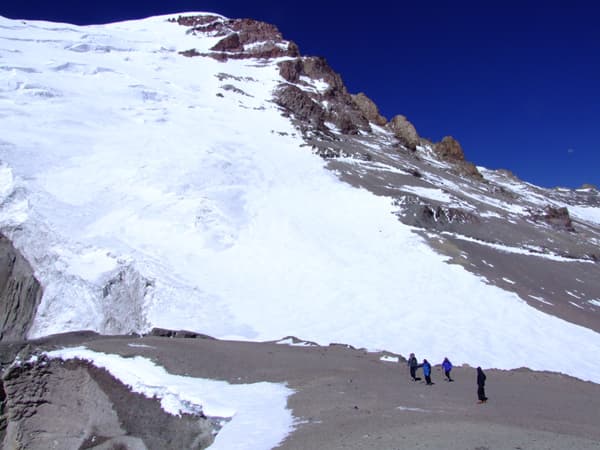
Polish Glacier
The Polish Glacier is a significant glacial feature on Aconcagua, the highest peak in the Andes and the Americas. It was named in honor of the 1934 Polish expedition that established a new route to the summit via this glacier, which subsequently became known as the Polish Route.

Torrecillas Glacier
The Torrecillas Glacier is a significant glacier located in Los Alerces National Park, Chubut Province, Argentina. It descends into the Y-shaped glacial lake, Lake Menéndez, and is notable for its proximity to extensive Alerce forests, which are among the oldest and largest in Argentina.