
Viedma Glacier
Valley Glacier·Argentina/Chile·South America·Alpine
Viedma Glacier is a substantial valley glacier situated within the Southern Patagonian Ice Field in South America. It is notable for its moraine-rich terminus that flows into Lake Viedma, a primary source of the lake's water. The glacier is located in a disputed border region between Chile and Argentina, with parts within both Los Glaciares National Park and Bernardo O'Higgins National Park.
Key Facts
- ›Part of the Southern Patagonian Ice Field, one of its 48 outlet glaciers larger than 20 sq km.
- ›Its terminus is approximately 2 kilometers wide where it enters Lake Viedma.
- ›Features dark, debris-filled moraines entwined within its ice mass.
- ›Exhibits large, canyon-sized crevasses along its sides due to differential ice flow.
- ›Located in a region claimed by both Chile and Argentina, within national parks of both countries.

Known For
- Its moraine-rich terminus flowing into Lake Viedma
- Being a significant outlet glacier of the Southern Patagonian Ice Field
Moraines, Crevasses, Calving Ice
Los Glaciares National Park, Bernardo O'Higgins National Park, World Heritage Site
About Viedma Glacier
Viedma Glacier is a significant valley glacier that forms a part of the vast Southern Patagonian Ice Field. Situated at the southern extremity of mainland South America, this glacier is renowned for its terminus, which is rich in moraine material and actively flows into the western reaches of Lake Viedma. The melting ice from Viedma Glacier is a primary contributor to the lake's water volume.
Geographically, Viedma Glacier resides in a region with an undefined border between Chile and Argentina. Argentinian law places it within Los Glaciares National Park, an area recognized as a World Heritage Site since 1981. Concurrently, Chilean law encompasses a portion of the glacier within Bernardo O'Higgins National Park. The Southern Patagonian Ice Field itself is an immense expanse of ice covering 13,000 square kilometers, with Viedma Glacier being one of its 48 outlet glaciers that each possess an ice field area exceeding 20 square kilometers.
Glacier Terminus and Features
The glacier's terminus presents a striking spectacle, measuring approximately 2 kilometers in width at the point where it meets Lake Viedma. Here, substantial ice chunks break off and drift into the lake, eventually melting. The ice mass of Viedma Glacier is visibly marked by dark, parallel lines, which are the debris-laden moraines that have become integrated into the developing glacial ice. Perpendicular to these moraines, along the glacier's sides, are pronounced crevasses. These large, canyon-like cracks are a result of the differential movement between the ice adjacent to the valley walls, which moves more slowly due to friction, and the faster-flowing ice at the glacier's center. Calving of ice is also a notable phenomenon observed on the southwestern side of the terminus, which ends in a distinct cliff.
Source: Wikipedia ↗
Frequently Asked Questions
Where is Viedma Glacier located?
Viedma Glacier is located at the southern end of mainland South America, as part of the Southern Patagonian Ice Field. It lies in a border region between Chile and Argentina, within Los Glaciares National Park (Argentina) and Bernardo O'Higgins National Park (Chile).
What is the significance of Viedma Glacier's terminus?
The terminus of Viedma Glacier is about 2 kilometers wide and flows into the western end of Lake Viedma. It is characterized by a moraine-rich cliff from which ice chunks calve and float into the lake.
What are the dark lines seen on Viedma Glacier?
The dark parallel lines visible within the white ice of Viedma Glacier are debris-filled moraines. These are formed from soil and rock that collect along the sides and front of the glacier as it moves.
What causes the large cracks on the sides of Viedma Glacier?
The large, canyon-sized crevasses seen along the sides of Viedma Glacier are formed by the stress between the slower-moving ice along the valley walls (due to friction) and the faster-moving ice in the glacier's center.
Related Glaciers

Bernardo Glacier
Bernardo Glacier is a significant glacier situated within Bernardo O'Higgins National Park in Chile. It is one of the largest glaciers in the Southern Patagonian Ice Field and flows westward into Bernardo Fjord, making it a notable feature of the region's glacial landscape.
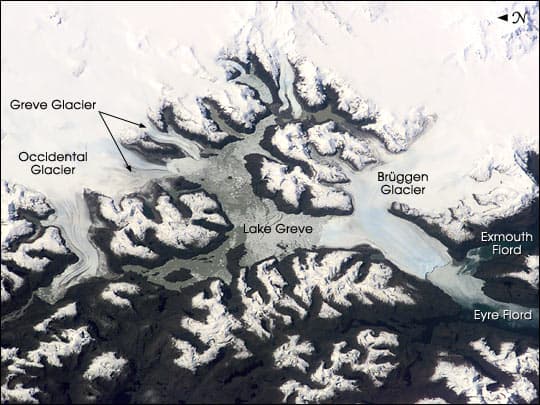
Brüggen Glacier
Brüggen Glacier, also known as Pío XI Glacier, is the largest western outflow from the Southern Patagonian Ice Field in southern Chile. It holds the distinction of being the longest glacier in the Southern Hemisphere outside of Antarctica, with a length of approximately 66 km. Notably, unlike many glaciers globally, Brüggen Glacier experienced significant advancement between 1945 and 1976, surging several kilometers and altering the local fjord landscape.
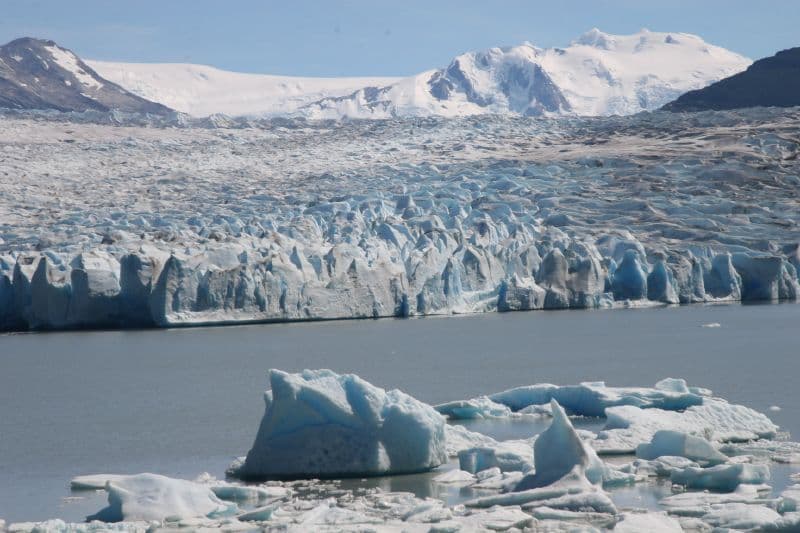
Grey Glacier
Grey Glacier is a significant glacier located in the Southern Patagonian Ice Field, west of the Cordillera del Paine. It flows southward into the lake of the same name, a process that can result in large icebergs calving off its front. The glacier is a notable feature within the Torres del Paine National Park, offering dramatic views for visitors.