
Ames
The Ames crater is a significant buried meteorite impact structure located in Major County, Oklahoma. Discovered in 1991, its geological importance is amplified by the substantial oil and gas reserves found within it, making it one of the largest of several impact craters associated with oil production in the United States.
Key Facts
- ›The Ames crater is 10 miles (16 km) in diameter.
- ›Its age is estimated to be 470 ± 30 million years, dating to the Ordovician period.
- ›The crater is buried under approximately 9,000 feet (2,700 m) of sediment and is not visible on the surface.
- ›It was discovered in 1991 by Rex Olson through seismic data analysis.
- ›Drilling within the crater revealed significant oil and gas deposits, leading to prolific production.
- ›Ames is one of the largest of six oil-producing astroblemes in the United States.

Decorah Crater, Slate Islands Crater, Rock Elm Crater
About Ames
Ames Crater
Ames crater is a significant buried meteorite impact structure, also known as an astrobleme, located in Major County, Oklahoma, United States. The structure is situated near the center of the town of Ames, Oklahoma, and lies approximately 30 miles (48 km) southwest of Enid. Its substantial geological and economic importance stems from its discovery in 1991 and the subsequent finding of large oil and gas reserves within its boundaries.
Crater Description and Discovery
The Ames crater measures 10 miles (16 km) in diameter and is estimated to be 470 ± 30 million years old, dating back to the Ordovician period. At the time of impact, the region was covered by a shallow sea. The impact event created immense pressure, causing a slight recoil of the meteorite and an uplifted center. Over eons, sediment layers were deposited, and geological movements tilted the formation, ultimately burying the crater deep beneath the surface. It remained undiscovered until 1991 when Rex Olson, an exploration manager for Continental Resources, identified an anomaly resembling a hoof print in seismic data.
Economic Significance
The crater is concealed under approximately 9,000 feet (2,700 m) of sediment, making it invisible from the surface. Prior to its discovery, many geologists doubted that impact craters could harbor significant petroleum deposits. However, Continental Resources drilled deep into the structure, striking oil at a depth of 10,000 feet (3,000 m). The impact penetrated the Arbuckle Dolomite, fracturing the rock and making vast quantities of oil and gas accessible. Since its discovery, at least 60 wells have been drilled in the Ames Crater area. As of 2007, it was reported to have produced over 17.4 million barrels of oil and 79.5 billion cubic feet of natural gas, establishing it as one of the largest among six producing astroblemes in the United States.
Source: Wikipedia ↗
Frequently Asked Questions
Where is the Ames crater located?
The Ames crater is situated in Major County, Oklahoma, United States. The town of Ames, Oklahoma, is located near the center of the structure, which lies approximately 30 miles (48 km) southwest of Enid, Oklahoma.
How large is the Ames crater?
The Ames crater has an estimated diameter of 10 miles (16 kilometers).
When was the Ames crater discovered?
The Ames crater was discovered in 1991. Its presence was identified through the analysis of seismic test data by Rex Olson, who noticed a pattern resembling a hoof print.
Why is the Ames crater significant?
The Ames crater is significant due to its substantial oil and gas production. It is one of the largest of six meteorite craters in the United States that are associated with oil-producing formations.
Is the Ames crater visible on the surface?
No, the Ames crater is not visible on the surface. It is buried under approximately 9,000 feet (2,700 meters) of sediment, making its discovery reliant on subsurface geological data.
What is the estimated age of the Ames crater?
The age of the Ames crater is estimated to be 470 ± 30 million years, placing it within the Ordovician geological period.
Related Impact Craters

Glover Bluff
Glover Bluff is a partially exposed impact crater located in Wisconsin, United States, with an estimated diameter of 8 kilometers. Despite significant erosion, shatter cones are associated with the structure, indicating its impact origin. It remains an understudied impact site, with its exact age unconstrained beyond being at least as young as the Ordovician period.
Slate Islands
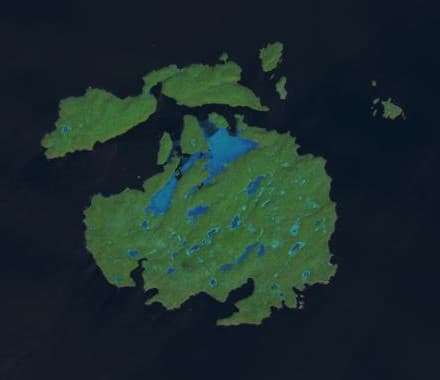
The Slate Islands are an archipelago in Lake Superior, Ontario, Canada, formed by a large meteorite impact. The impact created a crater estimated to be 32 km wide, with the remaining islands interpreted as a central uplift. Established as a provincial park in 1985, the islands are notable for their unique geology, including shatter cones, and for hosting Ontario's largest herd of boreal woodland caribou.

Lawn Hill
The Lawn Hill crater is an eroded impact structure located in northwestern Queensland, Australia. Its existence was confirmed in 1987 with the discovery of shatter cones and shocked quartz, revealing an 18 km diameter ring of dolomite hills that marks the remnant of the original crater.