
Slate Islands
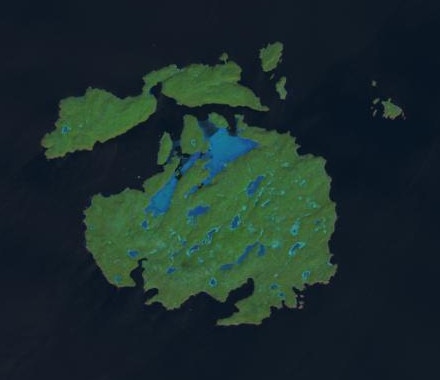
The Slate Islands are an archipelago in Lake Superior, Ontario, Canada, formed by a large meteorite impact. The impact created a crater estimated to be 32 km wide, with the remaining islands interpreted as a central uplift. Established as a provincial park in 1985, the islands are notable for their unique geology, including shatter cones, and for hosting Ontario's largest herd of boreal woodland caribou.
Key Facts
- ›The Slate Islands are the remnants of a meteorite impact crater approximately 32 km in diameter.
- ›The impact event is estimated to have occurred around 450 million years ago, during the Ordovician period.
- ›The islands are composed of ancient metamorphosed volcanic rocks, sedimentary rocks, and younger volcanic pipes (diatremes).
- ›Notable geological features include large shatter cones, which are formed by the shockwaves of meteorite impacts.
- ›The archipelago is home to Ontario's largest herd of boreal woodland caribou, a population studied extensively for its unique island biogeography.
- ›The Slate Islands were designated as a natural environment provincial park in 1985.
Decorah Crater, Ames Crater, Rock Elm Crater
About Slate Islands
The Slate Islands Impact Crater
The Slate Islands, located in Lake Superior, Ontario, Canada, are the remnants of a significant meteorite impact that occurred approximately 450 million years ago. This ancient impact event created a large crater, estimated to have been around 32 kilometers (20 miles) in diameter. Over vast stretches of geological time, erosion has reshaped the landscape, leaving the current archipelago interpreted as a central uplift of the original impact structure.
Geological Significance
The geology of the Slate Islands is a testament to their violent origin. The islands are composed of ancient metamorphosed volcanic rocks, some predating 2.7 billion years, as well as sedimentary rocks from the Rove and Gunflint formations, approximately 1.85-2.10 billion years old. Younger diatremes, volcanic pipes formed by gaseous explosions, also punctuate the landscape. Most notably, the islands are home to exceptional examples of shatter cones, rare geological features formed by the immense shockwaves generated by meteorite impacts. One shatter cone found here measures an impressive 9 meters (30 feet), making it one of the largest known specimens globally. Allogenic breccia, a type of rock formed from fragmented material ejected during an impact, is also present.
The Slate Islands impact may be part of a larger event, potentially occurring around the same time as other Middle Ordovician impacts in North America, such as those that formed the Decorah, Ames, and Rock Elm craters.
Provincial Park and Biodiversity
In recognition of its unique natural and geological heritage, the Slate Islands were established as a Natural Environment Provincial Park in 1985. The park's remoteness, enforced by Lake Superior's waters, contributes to its distinct ecological characteristics. The islands are particularly renowned for supporting Ontario's largest herd of boreal woodland caribou, which migrated to the islands via ice bridge most recently in 1907. The caribou population has been a subject of extensive study, providing insights into island biogeography and the dynamics of isolated ecosystems. The surrounding waters are protected from commercial fishing to preserve native lake trout stocks, serving as a source for brood stock used in restoration efforts.
Source: Wikipedia ↗
Frequently Asked Questions
What is the origin of the Slate Islands?
The Slate Islands are the result of a significant meteorite impact. This impact created a large crater, and the islands themselves are interpreted as a central uplift that remains after erosion.
How old is the Slate Islands impact crater?
The age of the impact event is estimated to be around 450 million years old, placing it in the Ordovician geological period. Some sources suggest an age range of 800-500 million years.
What geological features are found at the Slate Islands?
The islands exhibit evidence of meteorite impact, including shatter cones, which are distinctive conical rock formations created by shockwaves. Allogenic breccia is also present on the islands.
What is the significance of the Slate Islands' caribou population?
The Slate Islands host Ontario's largest herd of boreal woodland caribou. This population is a classic example of island biogeography, with unique species absences and high population densities observed over time.
When were the Slate Islands protected as a park?
The Slate Islands were established as a natural environment provincial park in 1985. This designation aims to protect the area's biodiversity and natural and cultural landscapes.
Related Impact Craters

Gosses Bluff
Gosses Bluff is the eroded remnant of a significant impact crater located in Australia's southern Northern Territory. Estimated to have formed around 142.5 million years ago from an asteroid or comet impact, its original 22 km diameter rim is now gone, leaving a 5 km wide central uplift structure. Known as Tnorala to the Western Arrernte people, it holds deep cultural and spiritual significance.
Goyder
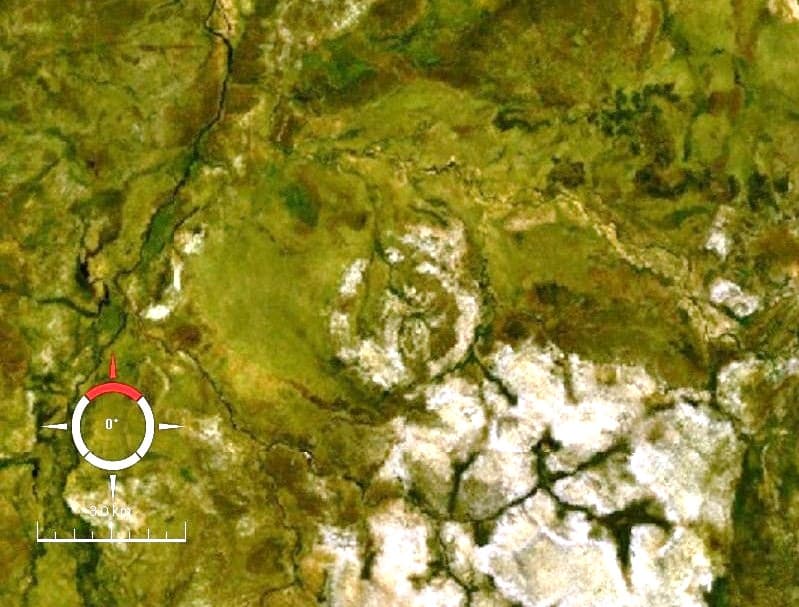
The Goyder impact structure is the eroded remnant of an ancient impact crater located in Arnhem Land, Northern Territory, Australia. It is characterized by a 3 km diameter ring of fractured sandstone, interpreted as a central uplift, with an estimated original crater rim diameter of 9-12 km. Evidence such as shatter cones and shocked quartz confirms its impact origin.

Lawn Hill
The Lawn Hill crater is an eroded impact structure located in northwestern Queensland, Australia. Its existence was confirmed in 1987 with the discovery of shatter cones and shocked quartz, revealing an 18 km diameter ring of dolomite hills that marks the remnant of the original crater.