
Glover Bluff
Glover Bluff is a partially exposed impact crater located in Wisconsin, United States, with an estimated diameter of 8 kilometers. Despite significant erosion, shatter cones are associated with the structure, indicating its impact origin. It remains an understudied impact site, with its exact age unconstrained beyond being at least as young as the Ordovician period.
Key Facts
- ›Located in Wisconsin, United States.
- ›Estimated diameter of 8 kilometers (5.0 miles).
- ›Partially exposed but significantly eroded.
- ›Shatter cones are associated with the impact structure.
- ›Target rocks are Cambrian and Ordovician sandstone and dolomite.
- ›Age is unconstrained but at least as young as the Ordovician period.

Shatter Cones
About Glover Bluff
The Glover Bluff crater is an impact structure located in Wisconsin, United States. It possesses an estimated diameter of approximately 8 kilometers (5.0 miles) and is characterized by its partially exposed yet significantly eroded state. Despite the erosion, the presence of shatter cones, geological formations indicative of extreme shock pressures, strongly associates it with an impact event.
Geological Context and Age
The impact occurred in sedimentary rocks, specifically sandstone and dolomite, dating back to the Cambrian and Ordovician periods. This geological context establishes that the impact event must have taken place at least as recently as the Ordovician period, though its precise age remains unconstrained by current data. The crater is also noted for its proximity to a prominent west-trending positive magnetic anomaly and a Bouguer gravity anomaly.
Research Status
Glover Bluff is recognized as an understudied impact crater, representing one of the least investigated impact structures globally. This lack of extensive study means that many aspects of its formation and history are yet to be fully understood.
Source: Wikipedia ↗
Frequently Asked Questions
Where is the Glover Bluff crater located?
The Glover Bluff crater is situated in Wisconsin, United States. It is an impact structure found within this region.
What is the size of the Glover Bluff crater?
The estimated diameter of the Glover Bluff crater is approximately 8 kilometers (5.0 miles). It is considered a moderately sized impact structure.
Is the Glover Bluff crater well-preserved?
No, the Glover Bluff crater is only partially exposed and has undergone significant erosion. This has impacted its visibility and study.
What geological evidence points to Glover Bluff being an impact crater?
Shatter cones, which are distinctive conical rock formations produced by shock waves from an impact, are associated with the Glover Bluff structure. The target rocks are also sedimentary layers typical of impact sites.
When did the impact event that formed Glover Bluff occur?
The precise age of the Glover Bluff impact is not well-constrained. However, given that the impacted rocks are of Cambrian and Ordovician age, the impact must have occurred at least as recently as the Ordovician period.
Is Glover Bluff a well-studied impact crater?
No, Glover Bluff is considered one of the least studied impact structures. It is noted for being an understudied crater.
Related Impact Craters

Ames
The Ames crater is a significant buried meteorite impact structure located in Major County, Oklahoma. Discovered in 1991, its geological importance is amplified by the substantial oil and gas reserves found within it, making it one of the largest of several impact craters associated with oil production in the United States.
Slate Islands
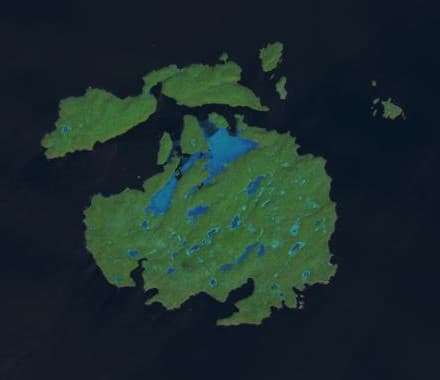
The Slate Islands are an archipelago in Lake Superior, Ontario, Canada, formed by a large meteorite impact. The impact created a crater estimated to be 32 km wide, with the remaining islands interpreted as a central uplift. Established as a provincial park in 1985, the islands are notable for their unique geology, including shatter cones, and for hosting Ontario's largest herd of boreal woodland caribou.

Lawn Hill
The Lawn Hill crater is an eroded impact structure located in northwestern Queensland, Australia. Its existence was confirmed in 1987 with the discovery of shatter cones and shocked quartz, revealing an 18 km diameter ring of dolomite hills that marks the remnant of the original crater.