
Lawn Hill
The Lawn Hill crater is an eroded impact structure located in northwestern Queensland, Australia. Its existence was confirmed in 1987 with the discovery of shatter cones and shocked quartz, revealing an 18 km diameter ring of dolomite hills that marks the remnant of the original crater.
Key Facts
- ›Diameter: Approximately 18 km, with suggestions of an original diameter closer to 20 km.
- ›Age: Estimated to be from the Ordovician period, around 472 million years ago.
- ›Discovery: Confirmed as an impact structure in 1987.
- ›Location: Situated 220 km north-north-west of Mount Isa, Queensland, Australia.
- ›Morphology: Characterized by an 18 km diameter ring of dolomite hills, indicating an eroded impact structure.
- ›Evidence: Shatter cones and shocked quartz found at the center confirm its impact origin.

Shatter Cones, Shocked Quartz
About Lawn Hill
Lawn Hill Impact Structure
The Lawn Hill structure is an ancient impact crater located in northwestern Queensland, Australia. While significant erosion has altered its original form, it is recognized as an Ordovician impact event that occurred approximately 472 million years ago. The site is marked by a prominent ring of dolomite hills, spanning about 18 kilometers in diameter, which represents the remnant of the former impact structure.
Discovery and Confirmation
For a period, the origin of the circular feature at Lawn Hill was uncertain. However, the scientific identification of shatter cones and shocked quartz within uplifted rocks at the crater's center in 1987 provided definitive evidence of an impact event. These geological markers are characteristic indicators of high-energy meteorite impacts.
Geological Context and Age
The precise age of the Lawn Hill impact has been a subject of study. While the surrounding limestones are of Middle Cambrian age (around 510 million years old), initial debates considered whether these were deposited before or after the impact. More recent research, including 40Ar-39Ar dating of impact-related melt particles, has established the impact's age as Ordovician, approximately 472 million years ago. The structure's survival is attributed to being buried by sedimentation in the active Georgina Basin shortly after the impact.
Description
The visible manifestation of the Lawn Hill impact is an 18 km diameter ring of dolomite hills. It is believed that the original crater may have been slightly larger, potentially around 20 km in diameter, before erosion reshaped the landscape. The presence of shatter cones and shocked quartz are key indicators of the immense forces involved in the impact event.
Source: Wikipedia ↗
Frequently Asked Questions
Where is the Lawn Hill crater located?
The Lawn Hill crater is situated in northwestern Queensland, Australia, approximately 220 kilometers north-north-west of Mount Isa.
How large is the Lawn Hill crater?
The currently visible structure is marked by an 18 km diameter ring of dolomite hills. It has been suggested that the original crater may have been slightly larger, around 20 km in diameter.
When did the impact event that formed Lawn Hill occur?
Based on radiometric dating of impact-related melt particles, the impact event is now thought to have occurred during the Ordovician period, approximately 472 million years ago.
What evidence confirms Lawn Hill is an impact crater?
The origin of the circular feature was confirmed with the discovery of shatter cones and shocked quartz found in uplifted rocks at the center of the structure in 1987.
Why is the Lawn Hill crater so well-preserved?
The excellent preservation of the structure is attributed to its burial by post-impact sedimentation. The Georgina Basin was an active depocenter at the time of the impact.
Related Impact Craters
Slate Islands
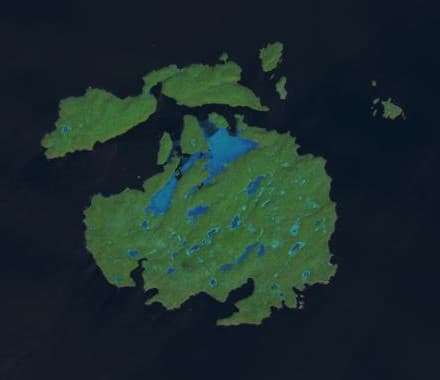
The Slate Islands are an archipelago in Lake Superior, Ontario, Canada, formed by a large meteorite impact. The impact created a crater estimated to be 32 km wide, with the remaining islands interpreted as a central uplift. Established as a provincial park in 1985, the islands are notable for their unique geology, including shatter cones, and for hosting Ontario's largest herd of boreal woodland caribou.
Glikson
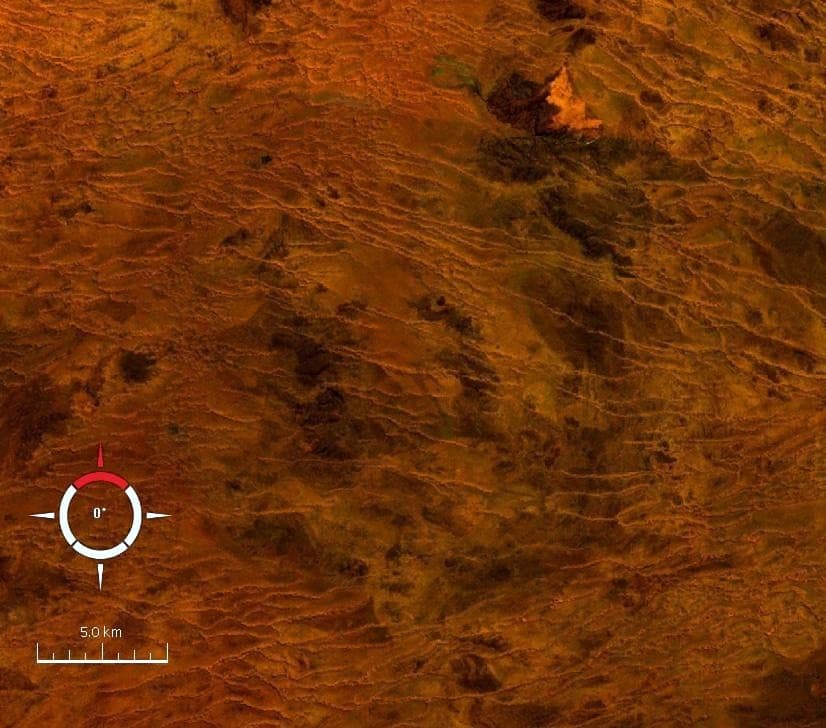
The Glikson crater is an eroded impact structure located in the Little Sandy Desert of central Western Australia. It is characterized by a prominent 14 km diameter ring-shaped aeromagnetic anomaly, with evidence of deformation extending to 19 km, suggesting this as the original crater diameter. The confirmation of shatter cones and microscopic shock effects provides reliable evidence for its impact origin.

Yarrabubba
The Yarrabubba impact structure is the remnants of a significant impact event located in Western Australia. With an estimated age of 2.229 billion years, it was once considered the oldest known impact structure on Earth with a confident age, though subsequent discoveries have challenged this title. Despite its eroded state, evidence like shocked quartz and geophysical data point to its formation by a substantial bolide.