
Bosumtwi
Ghana·Pleistocene·asteroid
Lake Bosomtwe is Ghana's only natural lake, situated within an ancient impact crater approximately 10.5 kilometers in diameter. The crater, estimated to be 1.07 million years old, is a sacred site for the Ashanti people and a popular recreational area, though its geological features are partially obscured by erosion and dense rainforest.
Key Facts
- ›The impact crater has a diameter of 10.5 kilometers.
- ›The estimated age of the crater is 1.07 million years.
- ›The crater is located within the Pleistocene geological period.
- ›The impactor is believed to be an asteroid from the middle main-belt.
- ›Shock features are overgrown or covered by the lake, making study difficult.
- ›Tektites from the impact are found in Ivory Coast.

Shocked Materials, Tektites
About Bosumtwi
Bosumtwi Impact Crater
The Bosumtwi impact structure is the geological scar left by a celestial body's collision with Earth, located in Ghana. It is notable for hosting Lake Bosomtwe, the only natural lake in the country. The crater itself measures approximately 10.5 kilometers in diameter and is estimated to be 1.07 million years old, dating back to the Pleistocene epoch.
Geological Features and Study
The crater's depth is around 380 meters, with lake sediments adding an additional 370 meters. Despite its geological significance, studying Bosumtwi has presented challenges due to its location within a dense rainforest and the effects of erosion. Many surface shock features, such as shatter cones, are either overgrown or submerged beneath the lake. However, scientific investigation has been advanced through drilling into the central uplift beneath the lake floor, yielding abundant shocked materials. Evidence of the impact's reach extends beyond Ghana, with tektites found in Ivory Coast and microtektites discovered in deep-sea sediments off the African coast.
Origin and Climate History
Research suggests the impactor was an asteroid originating from the middle main-belt, likely entering at a high inclination. Before the impact, the area was a lush rainforest. Following the collision, the crater filled with water, forming Lake Bosomtwe. Paleoclimate records indicate that the lake level has fluctuated significantly over time, influenced by periods of heavy rainfall that caused overflow and periods of low water levels that allowed the rainforest to encroach upon the basin.
Cultural and Recreational Significance
Culturally, Bosumtwi is revered as a sacred lake by the Ashanti people, believed to be a place where the souls of the dead bid farewell to the goddess Asase Ya. This traditional belief influences practices, such as fishing only from wooden planks. The area surrounding the lake is a popular recreational spot, with approximately 30 villages nearby and a combined population of about 70,000. Abono is particularly noted as a favored settlement for tourists.
Source: Wikipedia ↗
Frequently Asked Questions
Where is the Bosumtwi impact crater located?
The Bosumtwi impact crater is located in Ghana, approximately 30 km south-east of Kumasi, the capital of Ashanti. The crater contains the only natural lake in Ghana, Lake Bosomtwe.
How old is the Bosumtwi impact crater?
The Bosumtwi impact crater is estimated to be 1.07 million years old. This age places the impact event within the Pleistocene geological period.
What is the size of the Bosumtwi impact crater?
The Bosumtwi impact crater is approximately 10.5 kilometers (6.5 miles) in diameter. The lake within the crater is slightly smaller, measuring about 8 km across.
What is the significance of the Bosumtwi impact crater?
The Bosumtwi impact crater is significant as it hosts Ghana's only natural lake and is considered a sacred site by the Ashanti people. It also provides valuable scientific data on impact events, with shocked materials found beneath the lake floor and tektites discovered in neighboring regions.
What type of celestial body caused the Bosumtwi impact?
Studies suggest that the impactor was likely an asteroid originating from the middle main-belt. This conclusion is based on statistical analyses of orbital simulations of the impact event.
What challenges exist in studying the Bosumtwi impact crater?
The Bosumtwi impact crater is situated in a dense rainforest, and erosion has partly obscured its features. Shock features like shatter cones are often overgrown by vegetation or covered by the lake, making direct study difficult.
Related Impact Craters
Amguid
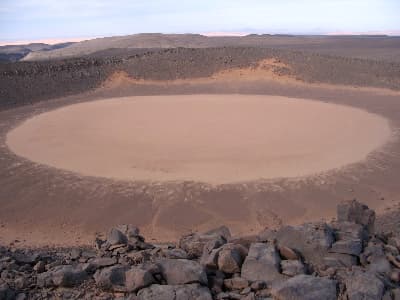
Amguid is a well-preserved impact crater situated in the Central Sahara of Algeria. Its relatively young age, estimated to be less than 100,000 years, and its pristine condition due to the arid desert environment make it a significant site for studying impact events. The crater's morphology and geological features, including shatter cones and breccia, provide insights into the low-velocity impact event.
Kalkkop
Kalkkop is a confirmed impact crater located in the Eastern Cape Province of South Africa, approximately 50 kilometers southeast of Aberdeen. The impact event occurred about 250,000 years ago, leaving a significant crater that has since been filled with a deep limestone deposit.

Meteor/Barringer
Meteor Crater, also known as Barringer Crater, is one of the best-preserved meteorite impact craters on Earth, located in northern Arizona. Excavated approximately 50,000 years ago by a nickel-iron meteorite, its well-preserved state is attributed to its relatively young age and the arid climate. The crater has been a site of significant scientific investigation and remains privately owned by the Barringer family.