
Chicxulub
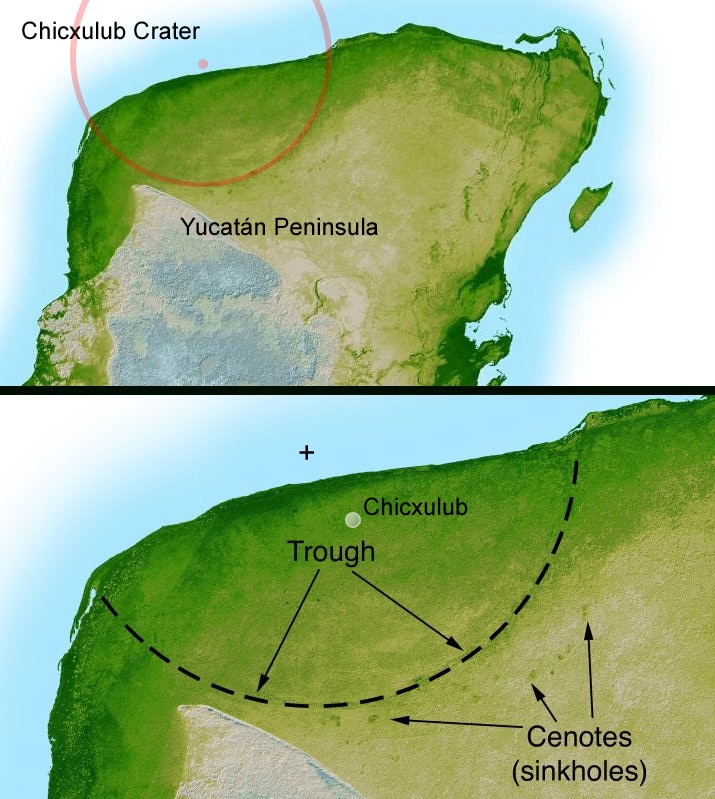
The Chicxulub crater, located beneath the Yucatán Peninsula in Mexico, is a massive impact structure formed approximately 66 million years ago by an asteroid impact. This event is widely recognized as the primary cause of the Cretaceous–Paleogene extinction event, which led to the demise of 75% of Earth's plant and animal species, including the non-avian dinosaurs.
Key Facts
- ›Formed approximately 66 million years ago.
- ›Caused by an asteroid approximately 10 kilometers in diameter.
- ›Estimated diameter of 200 kilometers.
- ›Buried about 1 kilometer beneath younger sedimentary rocks.
- ›Discovery attributed to geophysicists Antonio Camargo and Glen Penfield in the late 1970s.
- ›Its impact is strongly linked to the Cretaceous–Paleogene extinction event.
Shocked Quartz, Tektites
About Chicxulub
Chicxulub Crater
The Chicxulub crater is a significant impact structure located beneath the Yucatán Peninsula in Mexico. It was formed approximately 66 million years ago by the impact of an asteroid estimated to be about 10 kilometers in diameter. This catastrophic event is widely accepted as the primary trigger for the Cretaceous–Paleogene (K–Pg) extinction event, a mass extinction that eradicated 75% of Earth's plant and animal species, including all non-avian dinosaurs.
Discovery and Confirmation
Geophysicists Antonio Camargo and Glen Penfield first identified anomalies suggesting a large geological feature during petroleum exploration in the Yucatán Peninsula in the late 1970s. Although Penfield initially struggled to find conclusive evidence, a collaboration with Alan R. Hildebrand in 1990 led to the examination of samples that strongly indicated an impact origin. Key evidence supporting this conclusion includes the presence of shocked quartz, a distinct gravity anomaly, and tektites found in surrounding areas. The crater is named after the nearby onshore community of Chicxulub Pueblo.
Impact Specifics and Effects
The impact occurred on a marine carbonate platform, with water depths varying significantly across the impact site. The asteroid's impact released an immense amount of energy, generating winds exceeding 1,000 kilometers per hour and causing megatsunamis over 100 meters tall. The event ejected an estimated 25 trillion metric tons of material into the atmosphere, leading to global wildfires, a prolonged period of darkness caused by dust and soot, and a drastic global temperature drop. The vaporization of sulfur-rich gypsum from the impact site contributed to the formation of sulfates in the atmosphere, exacerbating climate change and acid rain. While the immediate effects were devastating, the impact also created a subsurface hydrothermal system that may have aided in the recovery of life.
Geological Significance and Morphology
The Chicxulub crater is one of the largest impact structures on Earth, with an estimated diameter of 200 kilometers, though more recent evidence suggests it could be up to 300 kilometers wide. It is characterized by a concentric multi-ring structure, including an outer ring of normal faults, a main crater rim, and an inner peak ring. The crater is buried under about 1 kilometer of younger sedimentary rocks. Its intact peak ring is accessible for scientific research, making it invaluable for understanding impact processes. The crater's formation also created the Yucatán sedimentary basin, which has historically influenced human settlement in the region by creating conditions favorable for human habitation where surface water is scarce.
Source: Wikipedia ↗
Frequently Asked Questions
When was the Chicxulub crater formed?
The Chicxulub crater was formed slightly over 66 million years ago. This precise dating is supported by multiple lines of evidence, including argon–argon dating of tektites and bentonite horizons.
What caused the Chicxulub impact?
The impact was caused by an asteroid approximately 10 kilometers in diameter. This celestial body struck Earth with immense force, releasing energy estimated to be in the range of 1023 to 1025 joules.
What is the significance of the Chicxulub crater?
The Chicxulub crater is significant because its formation coincides with the Cretaceous–Paleogene extinction event. The devastation and climate disruption resulting from the impact are widely accepted as the primary cause of this mass extinction, which wiped out 75% of Earth's species, including non-avian dinosaurs.
How was the Chicxulub crater discovered?
The crater was discovered by geophysicists Antonio Camargo and Glen Penfield in the late 1970s while they were searching for petroleum in the Yucatán Peninsula. Initial geophysical data revealed anomalies, and later research, particularly in 1990 with Alan R. Hildebrand, provided evidence of its impact origin.
What is the size of the Chicxulub crater?
The Chicxulub crater is estimated to be 200 kilometers in diameter. It is largely buried beneath younger sedimentary rocks, with a depth of about 1 kilometer. More recent evidence suggests the crater might be even larger, up to 300 km wide.
What kind of rocks were present at the impact site?
At the time of impact, the site was a marine carbonate platform. The seafloor rocks consisted predominantly of carbonate rock, including dolomite and limestone, along with evaporites such as anhydrite. These were underlain by igneous crystalline basement composed of granite.
What were the immediate effects of the Chicxulub impact?
The impact generated winds exceeding 1,000 kilometers per hour and spawned megatsunamis over 100 meters tall. A vast cloud of hot dust, ash, and steam was ejected into the atmosphere, igniting wildfires globally and leading to a period of darkness and cooling due to blocked sunlight.
Related Impact Craters
Boltysh
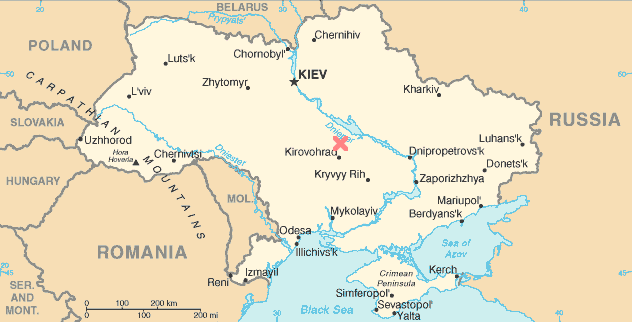
The Boltysh crater, also known as Bovtyshka, is a significant buried impact structure in Ukraine's Kirovohrad Oblast. With a diameter of 24 kilometers and an age of approximately 65.39 million years, it is notably close in age to the Chicxulub crater. While not believed to have caused major global environmental effects like Chicxulub, its discovery and dating have contributed to understanding impact events around the Cretaceous-Paleogene boundary.

Nördlinger Ries
The Nördlinger Ries is a significant impact crater located in Bavaria and Baden-Württemberg, Germany, formed approximately 14.8 million years ago. Its discovery confirmed meteorite impact as its origin, evidenced by the presence of coesite and suevite, and it served as a training ground for Apollo astronauts due to its resemblance to lunar craters.
Haughton
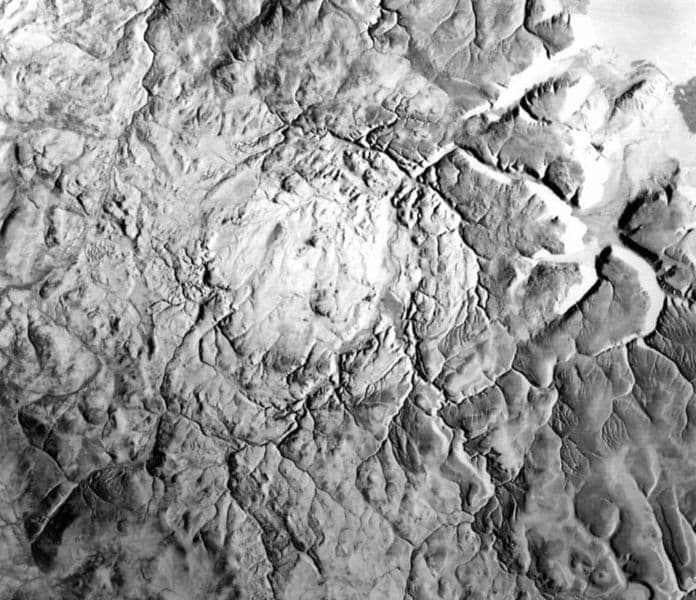
The Haughton impact crater, located on Devon Island in far Northern Canada, is a significant geological site due to its well-preserved features resulting from its high-latitude, cold environment. Formed approximately 31-32 million years ago, it serves as a valuable terrestrial analogue for Martian impact craters, prompting extensive research by space exploration organizations.