
Nördlinger Ries
The Nördlinger Ries is a significant impact crater located in Bavaria and Baden-Württemberg, Germany, formed approximately 14.8 million years ago. Its discovery confirmed meteorite impact as its origin, evidenced by the presence of coesite and suevite, and it served as a training ground for Apollo astronauts due to its resemblance to lunar craters.
Key Facts
- ›Formed 14.808 ± 0.038 million years ago in the Miocene.
- ›Original crater rim estimated at 24 km in diameter.
- ›Confirmed as a meteorite impact crater in 1960 by Eugene Shoemaker and Edward C. T. Chao.
- ›Contains millions of tiny diamonds formed from the impact's graphite deposit.
- ›Used for training Apollo astronauts for lunar impact structure investigation.
- ›Is a rampart crater, a type rarely found on Earth and more common on Mars.

Steinheim Crater
Coesite, Suevite, Moldavite, Diaplectic Glasses
About Nördlinger Ries
The Nördlinger Ries is a prominent impact crater and large circular depression located in western Bavaria and eastern Baden-Württemberg, Germany. Formed approximately 14.8 million years ago during the Miocene epoch, this geological feature is a testament to a powerful extraterrestrial impact event.
Formation and Discovery
The Nördlinger Ries was created by the impact of an asteroid, estimated to be about 1.5 km in diameter, traveling at a velocity of 20 km/s. The original crater rim had an estimated diameter of 24 km. Initially, its origin was debated, with theories suggesting volcanic, glacial, or tectonic causes. However, in 1960, Eugene Shoemaker and Edward C. T. Chao presented conclusive evidence that the depression was a meteorite impact crater. This was supported by the discovery of coesite, a mineral that forms under the extreme pressures of impact events, found in suevite from the Otting quarry. The suevite itself, a material formed from shocked Mesozoic sediments, is also a key indicator of the impact.
Unique Characteristics and Significance
The Nördlinger Ries is notable for being a rampart crater, a type of impact structure rarely found on Earth and more commonly observed on Mars, characterized by fluidized ejecta flows. The impact event released an immense amount of energy, estimated to be equivalent to 40 million Hiroshima bombs. The impact also created millions of tiny diamonds from a local graphite deposit, which are found in the stone buildings of Nördlingen. This crater is considered the source of moldavite tektites, which were ejected up to 450 km away.
Geological and Historical Context
After the impact, the crater filled with water, forming a large lake that eventually silted up. The present-day basin was exposed by erosion during the Ice Ages. The Nördlinger Ries is one of the best-studied impact craters on Earth and has played a crucial role in understanding impact processes. Its resemblance to lunar craters made it an ideal training ground for Apollo astronauts, including those from the Apollo 14 and 17 missions, who prepared here to study lunar impact structures. The area also holds historical significance, with the Ofnet Caves on its edge yielding Mesolithic human skulls, and the site being the location of the Battle of the Ries in 841 AD.
Source: Wikipedia ↗
Frequently Asked Questions
What is the Nördlinger Ries?
The Nördlinger Ries is a large circular depression in western Bavaria and eastern Baden-Württemberg, Germany, recognized as a meteorite impact crater. It was formed approximately 14.8 million years ago.
How was the Nördlinger Ries formed?
The depression was formed by the impact of an asteroid approximately 1.5 km in diameter traveling at 20 km/s. The impact generated immense shock pressures and temperatures, vaporizing rock and creating the crater.
What evidence confirms the Nördlinger Ries is an impact crater?
Key evidence includes the presence of coesite, a mineral formed under high-pressure shock conditions, found in suevite from the Otting quarry. The church in Nördlingen is also built from local suevite, which is a product of shocked Mesozoic sediments.
What is unique about the Nördlinger Ries crater's morphology?
The Nördlinger Ries is described as a rampart crater, a structural type that is almost exclusively found on Mars. Rampart craters are characterized by fluidized ejecta flows, resembling a mudflow after impact.
What is the significance of the Nördlinger Ries for space exploration?
The Nördlinger Ries is an easily accessible and large impact crater that serves as a convenient analog for lunar craters. Because of this, it was used as a location to train Apollo astronauts to investigate lunar impact structures.
Are there any other impact craters near the Nördlinger Ries?
Yes, the much smaller Steinheim crater is located about 42 km west-southwest of the Nördlinger Ries. While it was once thought to have formed simultaneously, studies suggest the Steinheim crater is younger than the Nördlinger Ries.
What are moldavites and what is their connection to the Nördlinger Ries?
Moldavites are tektites, which are solidified melt droplets ejected from an impact event. The Ries impact event is believed to be the source of moldavite tektites found in southern Bohemia and Moravia, ejected up to 450 km from the crater.
What is the geological age and period of the Nördlinger Ries impact?
The impact occurred 14.808 ± 0.038 million years ago, placing it in the Miocene epoch. The Miocene is part of the Neogene Period, which falls within the Cenozoic Era.
Related Impact Craters
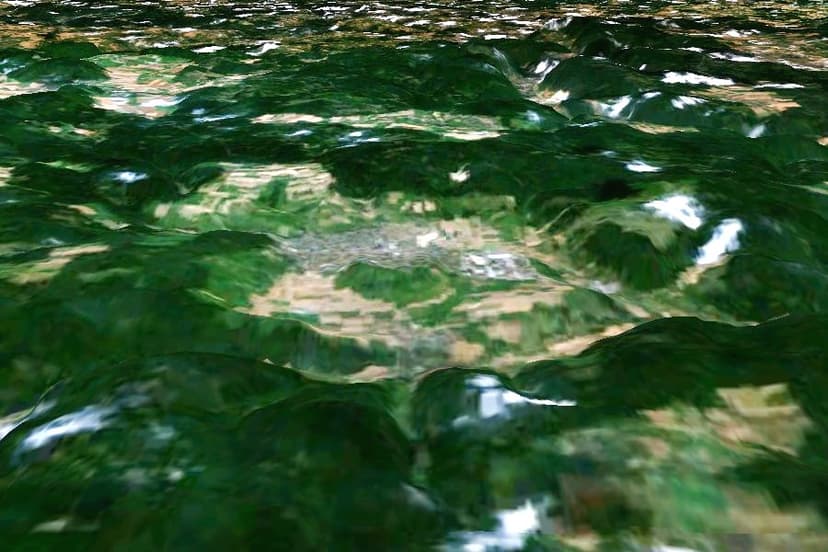
Steinheim
The Steinheim crater, located in Baden-Württemberg, Germany, is a significant impact structure with a diameter of 3.8 km. Estimated to be around 14.3 million years old, it is situated near the larger Nördlinger Ries crater, with recent studies suggesting a potential age difference between the two.
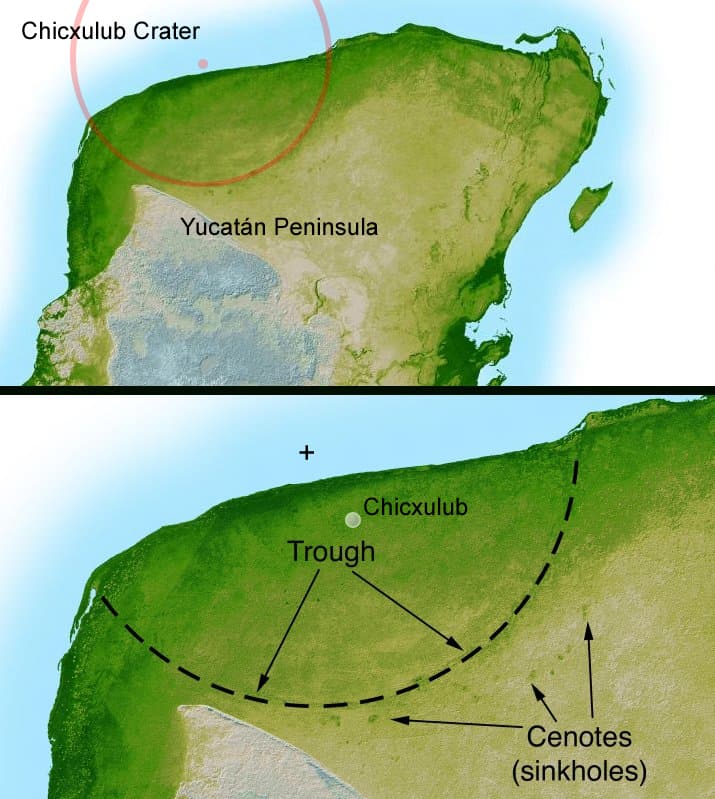
Chicxulub
The Chicxulub crater, located beneath the Yucatán Peninsula in Mexico, is a massive impact structure formed approximately 66 million years ago by an asteroid impact. This event is widely recognized as the primary cause of the Cretaceous–Paleogene extinction event, which led to the demise of 75% of Earth's plant and animal species, including the non-avian dinosaurs.
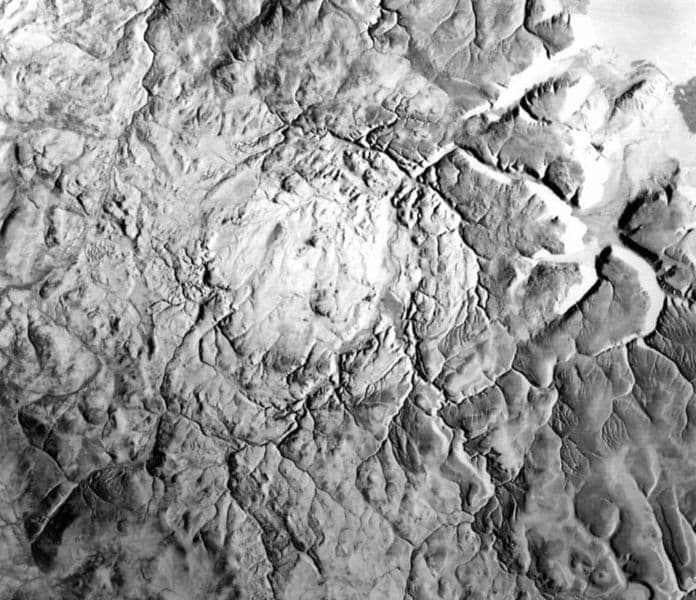
Haughton
The Haughton impact crater, located on Devon Island in far Northern Canada, is a significant geological site due to its well-preserved features resulting from its high-latitude, cold environment. Formed approximately 31-32 million years ago, it serves as a valuable terrestrial analogue for Martian impact craters, prompting extensive research by space exploration organizations.