
Decorah
The Decorah crater, located near Decorah, Iowa, is a potential impact structure estimated to be 5.6 km in diameter. It is believed to have formed approximately 470 million years ago during the Middle Ordovician period when a meteor around 200 meters wide struck the Earth, pushing down the underlying bedrock. Despite its significant size, no surface evidence of the impact remains due to burial by the Winneshiek Shale.
Key Facts
- ›Estimated diameter of 5.6 km (3.5 miles).
- ›Formed approximately 470 million years ago during the Middle Ordovician period.
- ›Caused by a meteor estimated to be 200 meters (660 ft) wide.
- ›The crater is covered by the Winneshiek Shale, obscuring any surface evidence.
- ›The impact pushed down underlying bedrock by several hundred feet.
- ›May be part of a larger Middle Ordovician meteor event.

Rock Elm Crater, Slate Islands Crater, Ames Crater
About Decorah
Decorah Crater
The Decorah crater, also known as the Decorah impact structure, is a potential impact site located on the eastern edge of Decorah, Iowa, in the United States. This geological feature is theorized to have been formed by the impact of a meteor approximately 200 meters (660 ft) in width. The event is estimated to have occurred during the Middle Ordovician Period, roughly 470 million years ago.
Description and Significance
This impact structure is estimated to have a diameter of about 5.6 kilometers (3.5 miles). Significantly, the crater is entirely covered by the Winneshiek Shale, a geological formation that lies more than 50 feet below the current riverbed of the Upper Iowa River. Consequently, there is no visible evidence of the impact on the Earth's surface today. The force of the impact, estimated to be equivalent to 1,000 megatons of TNT, was substantial enough to depress the underlying Ordovician and Cambrian bedrock by several hundred feet, though it is not believed to have penetrated the Earth's mantle.
The Decorah impact may be one of several meteoric events that occurred around the same time, approximately 469 million years ago. This period is theorized to have experienced a cluster of impacts, including three other confirmed craters: the Rock Elm crater in Wisconsin, the Slate Islands crater in Lake Superior, and the Ames crater in Oklahoma. The sediments within the Decorah crater, specifically the Middle Ordovician Winneshiek Lagerstätte, have yielded a diverse array of unusual fossil fauna. Among these discoveries is Pentecopterus decorahensis, a newly identified species of eurypterid (sea scorpion) that was the largest known predator of its time, measuring nearly six feet in length. The species name was directly derived from the name of the nearby city, Decorah.
Source: Wikipedia ↗
Frequently Asked Questions
Where is the Decorah crater located?
The Decorah crater is located on the east side of the city of Decorah in Iowa, United States. It is situated in an area covered by the Winneshiek Shale.
How large is the Decorah crater?
The Decorah crater is estimated to be 5.6 kilometers (3.5 miles) in diameter. The meteor that caused the impact was approximately 200 meters (660 ft) wide.
When did the Decorah impact event occur?
The impact event that formed the Decorah crater is thought to have occurred during the Middle Ordovician Period, approximately 470 million years ago.
Is there any visible evidence of the Decorah crater on the surface?
No, there is no surface evidence of the Decorah crater. It is covered by the Winneshiek Shale, which lies more than 50 feet below the bottom of the Upper Iowa River.
What geological effects did the Decorah impact have?
The impact event, equivalent to 1,000 megatons of TNT, pushed down the underlying Ordovician and Cambrian bedrock several hundred feet. It did not appear to penetrate the Earth's mantle.
Is the Decorah crater related to other impact events?
The Decorah crater may be one of several Middle Ordovician meteors that impacted around the same time, approximately 469 million years ago. This proposed Ordovician meteor event includes other confirmed craters like Rock Elm, Slate Islands, and Ames.
Related Impact Craters

Ouarkziz
Ouarkziz Crater is an impact structure located in northwestern Algeria, near the Moroccan border. This 3.5-kilometer diameter crater was formed by a meteor impact less than 70 million years ago, during the late Cretaceous Period. Despite significant erosion, its circular shape is still discernible, highlighting older sedimentary rock layers.

Rock Elm
The Rock Elm Disturbance is an impact crater located in Pierce County, Wisconsin, United States. The crater, approximately 6 km in diameter, is notable for its association with the discovery of reidite, a rare high-pressure mineral formed under intense impact conditions. Its age is estimated to be between 455 and 430 million years old, placing it in the Middle Ordovician Period.
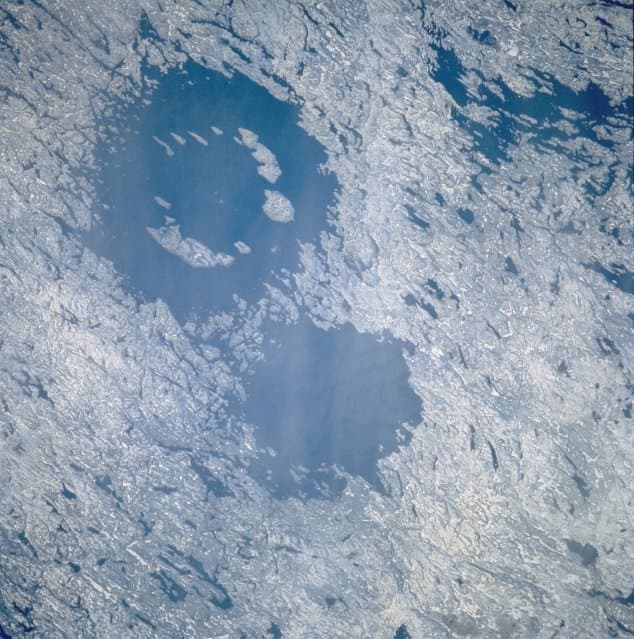
Clearwater East
Clearwater East is one of two impact craters, forming the Clearwater Lakes in Quebec, Canada. This complex crater, with a diameter of 26 km, is estimated to be around 460-470 million years old, dating back to the Middle Ordovician period. Its central peak is submerged beneath lake water and sediments, but its presence has been confirmed through geological surveys and core drilling.