
Glikson
Australia·Paleozoic·Eroded remnant
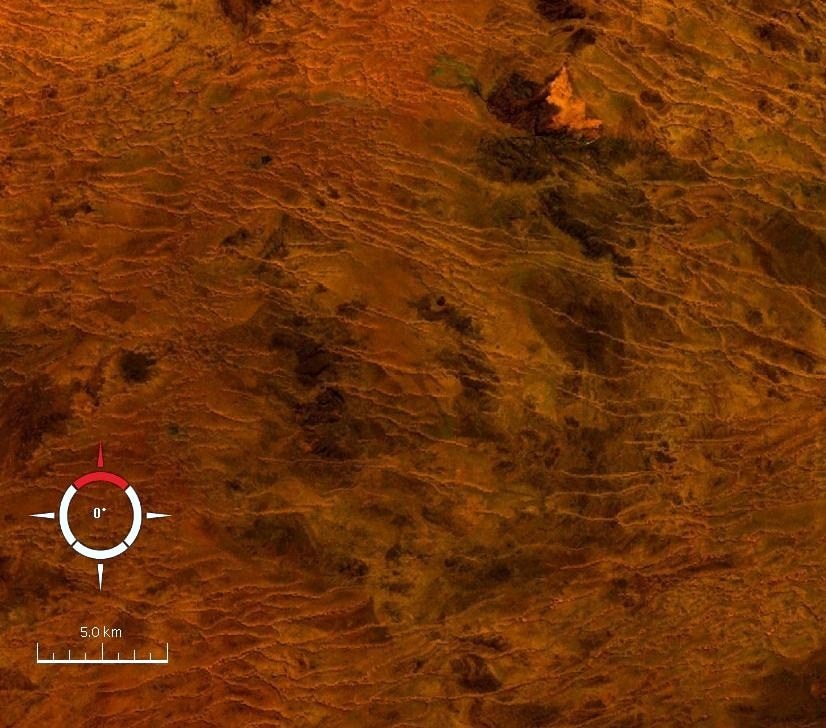
The Glikson crater is an eroded impact structure located in the Little Sandy Desert of central Western Australia. It is characterized by a prominent 14 km diameter ring-shaped aeromagnetic anomaly, with evidence of deformation extending to 19 km, suggesting this as the original crater diameter. The confirmation of shatter cones and microscopic shock effects provides reliable evidence for its impact origin.
Key Facts
- ›Located in the Little Sandy Desert of central Western Australia.
- ›Features a 14 km diameter ring-shaped aeromagnetic anomaly.
- ›Deformation consistent with impact origin extends to 19 km, estimated original diameter.
- ›Confirmed as an impact structure by shatter cones and microscopic shock effects.
- ›Likely of Paleozoic age, younger than nearby dolerite dated at 508 ± 5 Ma (Middle Cambrian).
Shatter Cones
About Glikson
Glikson Crater
The Glikson crater is an impact structure, also known as an astrobleme, representing the eroded remnant of a crater. It is situated in the Little Sandy Desert region of central Western Australia.
Discovery and Confirmation
A possible impact structure was first reported in 1997. The site was named in honor of Australian geologist A. Y. Glikson, with attention drawn by a prominent 14 km diameter ring-shaped aeromagnetic anomaly. Subsequent discoveries of shatter cones and microscopic shock effects have provided reliable evidence confirming its origin as an impact event.
Geological Characteristics
The area within the crater's ring contains sparse outcrops of uplifted and deformed Neoproterozoic sandstone, though much of it is covered by sand dunes. Deformation consistent with an impact origin extends to a diameter of 19 km, which is considered the most accurate estimate for the original size of the crater. The ring-shaped aeromagnetic anomaly is thought to have been caused by the disruption of a horizontal layer of magnetic igneous rock, a sill, by the impact. Nearby dolerite outcrops have been dated to 508 ± 5 Ma (Middle Cambrian). If this dolerite is the same rock responsible for the aeromagnetic anomaly, the impact event itself must be younger, likely of Paleozoic age.
Source: Wikipedia ↗
Frequently Asked Questions
Where is the Glikson crater located?
The Glikson crater is situated in the Little Sandy Desert of central Western Australia. It is an eroded remnant of an impact crater.
What evidence confirms Glikson as an impact structure?
Reliable evidence for an impact origin includes the recent discovery of shatter cones and microscopic shock effects within the structure. A prominent ring-shaped aeromagnetic anomaly also suggests an impact event.
What is the estimated size of the Glikson crater?
The deformation of the sandstone consistent with an impact origin extends out to a diameter of 19 km, which is considered the best estimate for the original diameter of the crater. A prominent aeromagnetic anomaly within the site has a diameter of 14 km.
How old is the Glikson crater?
The impact event is likely of Paleozoic age. This is inferred because nearby dolerite outcrops, potentially related to the aeromagnetic anomaly, have been dated to 508 ± 5 Ma, placing them in the Middle Cambrian period.
Related Impact Craters

Lawn Hill
The Lawn Hill crater is an eroded impact structure located in northwestern Queensland, Australia. Its existence was confirmed in 1987 with the discovery of shatter cones and shocked quartz, revealing an 18 km diameter ring of dolomite hills that marks the remnant of the original crater.

Yarrabubba
The Yarrabubba impact structure is the remnants of a significant impact event located in Western Australia. With an estimated age of 2.229 billion years, it was once considered the oldest known impact structure on Earth with a confident age, though subsequent discoveries have challenged this title. Despite its eroded state, evidence like shocked quartz and geophysical data point to its formation by a substantial bolide.

Santa Fe
The Santa Fe impact structure is a deeply eroded remnant of a crater formed by a bolide impact in the Sangre de Cristo Mountains of New Mexico. Discovered in 2005 due to the presence of shatter cones, it is estimated to be between 1.4 and 1.6 billion years old, with an original diameter of 6 to 13 kilometers.