
Yarrabubba
Australia·Rhyacian·Paleoproterozoic·eroded remnant
The Yarrabubba impact structure is the remnants of a significant impact event located in Western Australia. With an estimated age of 2.229 billion years, it was once considered the oldest known impact structure on Earth with a confident age, though subsequent discoveries have challenged this title. Despite its eroded state, evidence like shocked quartz and geophysical data point to its formation by a substantial bolide.
Key Facts
- ›Estimated age of 2.229 ± 0.005 billion years.
- ›Located in the Yilgarn craton, Western Australia.
- ›Original crater diameter estimated between 30 to 70 km.
- ›Evidence includes shocked quartz and shatter cones.
- ›Dating based on uranium-lead analysis of zircon and monazite crystals.
- ›Was once considered the oldest confirmed impact structure on Earth.

Miralga Impact Structure
Shocked Quartz, Zircon, Monazite
About Yarrabubba
Yarrabubba Impact Structure
The Yarrabubba impact structure represents the eroded remnants of a colossal impact event that occurred in what is now Western Australia. Situated in the northern Yilgarn craton, this site holds significant scientific interest due to its extreme age.
Age and Significance
With an age of 2.229 ± 0.005 billion years, Yarrabubba was, for a time, recognized as the oldest known impact structure on Earth with a reliably determined age. This age places the impact event in the early Rhyacian period, a time near the end of the Huronian glaciation. The dating was achieved through sophisticated uranium-lead analysis of ancient zircon and monazite crystals found at the site.
Description and Evidence
The original rim of the Yarrabubba crater has been entirely eroded, making it difficult to discern on modern aerial or satellite imagery. The impact's presence is primarily inferred from geological evidence. This includes the discovery of shocked quartz and shatter cones within outcrops of granite believed to be near the crater's center. Geophysical data further supports the existence and extent of the impact structure. While the precise diameter of the initial crater remains uncertain, estimates range from 30 to 70 kilometers (19 to 43 miles). Computer simulations suggest that an impactor approximately 7 kilometers in diameter striking a 2-kilometer-thick ice sheet overlying the granite bedrock could produce a crater of compatible dimensions.
Ongoing Research and Debate
The status of Yarrabubba as the oldest impact structure has been subject to scientific discussion. While its 2.229 billion-year age is well-established, subsequent research has introduced complexities. Some studies have proposed later impact timings, and the discovery and dating of other impact structures, such as the Miralga impact structure also in Western Australia, have led to re-evaluations. These developments mean that while Yarrabubba remains an exceptionally old and important impact site, its claim to being the absolute oldest is now part of an evolving scientific understanding.
Source: Wikipedia ↗
Frequently Asked Questions
What is the Yarrabubba impact structure?
The Yarrabubba impact structure is the eroded remains of a crater formed by a celestial body impacting Earth. It is situated in the northern Yilgarn craton of Western Australia.
How old is the Yarrabubba impact structure?
The impact has been dated to 2.229 ± 0.005 billion years ago. This age places the event in the early Rhyacian period, near the end of the Huronian glaciation.
What is the size of the Yarrabubba crater?
The precise diameter of the original crater is uncertain due to erosion. However, estimates suggest it ranged from 30 to 70 kilometers (19 to 43 miles) across.
What evidence exists for the Yarrabubba impact?
Evidence includes the presence of shocked quartz and shatter cones found in granite outcrops near the presumed center of the crater. Geophysical data also supports its existence.
Has the age of the Yarrabubba impact structure been definitively established?
While initially dated to 2.229 billion years, making it the oldest known, subsequent studies have challenged this. Some research suggests later impact times, and other structures in Western Australia have been dated older, leading to ongoing debate about its status as the oldest.
Related Impact Craters

Vredefort
The Vredefort impact structure in South Africa is one of Earth's largest and oldest known impact craters. Although the original crater has been eroded away, the remaining deformed bedrock forms the Vredefort Dome, a significant geological feature. Its immense size and age make it crucial for understanding early Earth history and impact events.
Glikson
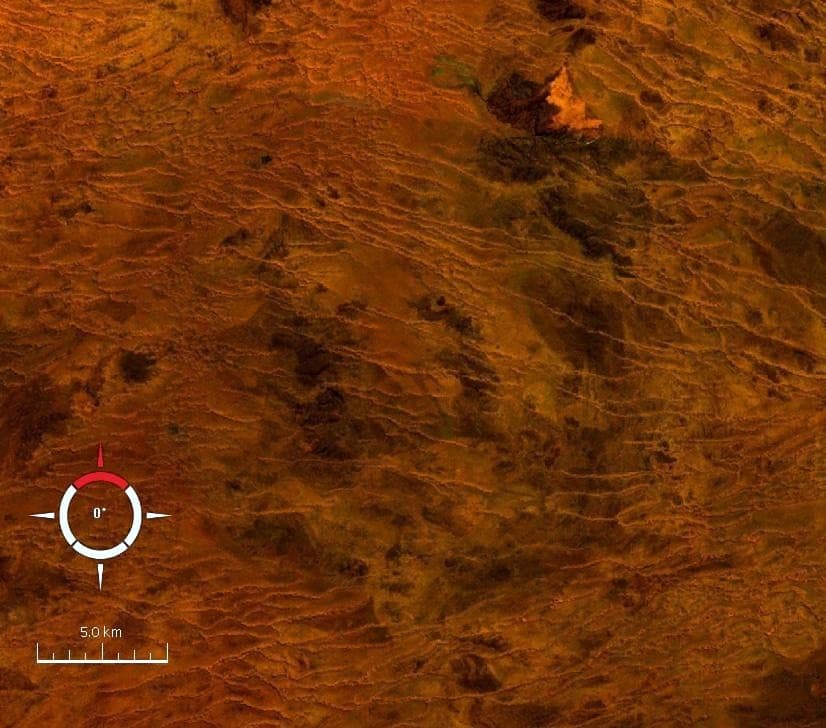
The Glikson crater is an eroded impact structure located in the Little Sandy Desert of central Western Australia. It is characterized by a prominent 14 km diameter ring-shaped aeromagnetic anomaly, with evidence of deformation extending to 19 km, suggesting this as the original crater diameter. The confirmation of shatter cones and microscopic shock effects provides reliable evidence for its impact origin.

Lawn Hill
The Lawn Hill crater is an eroded impact structure located in northwestern Queensland, Australia. Its existence was confirmed in 1987 with the discovery of shatter cones and shocked quartz, revealing an 18 km diameter ring of dolomite hills that marks the remnant of the original crater.