
Gosses Bluff
Australia·Cretaceous·Mesozoic·asteroid or comet
Gosses Bluff is the eroded remnant of a significant impact crater located in Australia's southern Northern Territory. Estimated to have formed around 142.5 million years ago from an asteroid or comet impact, its original 22 km diameter rim is now gone, leaving a 5 km wide central uplift structure. Known as Tnorala to the Western Arrernte people, it holds deep cultural and spiritual significance.
Key Facts
- ›The estimated original crater rim diameter was 22 km.
- ›The impact event occurred approximately 142.5 ± 0.8 million years ago.
- ›The current exposed feature is about 5 km in diameter and interpreted as the central uplift.
- ›Shatter cones provide strong evidence for its impact origin.
- ›It is known as Tnorala to the Western Arrernte Aboriginal people.
- ›The site is now part of the Tnorala Conservation Reserve.

Shatter Cones
About Gosses Bluff
Gosses Bluff, also known as Tnorala to the Western Arrernte people, is recognized as the eroded remnant of a significant impact crater in Australia's southern Northern Territory. Situated approximately 175 km west of Alice Springs, this geological feature holds both scientific and profound cultural importance.
Formation and Geology
The impact event that created Gosses Bluff is estimated to have occurred around 142.5 ± 0.8 million years ago, during the earliest Cretaceous period, very close to the boundary with the Jurassic. The celestial body responsible is believed to have been an asteroid or a comet. While the original crater rim, with an estimated diameter of 22 km, has been eroded away over millions of years, the currently exposed structure is a 5-kilometer-diameter, 180-meter-high feature. This prominent landform is interpreted by geologists as the eroded central uplift of the original impact structure. The presence of abundant shatter cones at the site provides strong evidence supporting its classification as an impact crater, a theory first proposed in the 1960s.
Cultural Significance
For the Aboriginal people of the Western Arrernte language group, Gosses Bluff is known as Tnorala and is considered a sacred site. A traditional story recounts its origin in the Dreamtime, where a celestial woman's baby, placed in a basket (turna, also known as a coolamon), fell from the sky while the women danced. The baby's impact with the Earth is said to have pushed up the rocks, forming the circular mountain range. The baby's parents, the evening and morning stars, are believed to still search for their child. The turna itself is said to be visible in the sky as the constellation Corona Australis.
Modern Context
Gosses Bluff is now located within the Tnorala Conservation Reserve, ensuring its protection. The site has also attracted scientific interest beyond its impact origin, having been a target for petroleum exploration in the past, with two abandoned exploration wells situated near its center. The fictional impact crater in the novel and series The Lost Flowers of Alice Hart was inspired by Gosses Bluff.
Source: Wikipedia ↗
Frequently Asked Questions
What is Gosses Bluff and where is it located?
Gosses Bluff is believed to be the eroded remnant of an impact crater. It is situated in the southern Northern Territory of Australia, approximately 175 km west of Alice Springs and 212 km north-east of Uluru.
How old is Gosses Bluff and what formed it?
The impact that formed Gosses Bluff is estimated to have occurred around 142.5 ± 0.8 million years ago, during the earliest Cretaceous period, near the Jurassic–Cretaceous boundary. It is thought to have been caused by the impact of an asteroid or comet.
What is the current visible structure of Gosses Bluff?
While the original crater rim is eroded away, the currently exposed feature is a 5-kilometer-diameter, 180-meter-high structure. This is interpreted as the eroded relic of the crater's central uplift.
What evidence supports Gosses Bluff being an impact crater?
The strongest evidence for Gosses Bluff being an impact structure comes from the abundance of shatter cones found at the site. The impact origin was first proposed in the 1960s.
Does Gosses Bluff have any cultural significance?
Yes, Gosses Bluff is known as Tnorala to the Aboriginal people of the Western Arrernte language group and is considered a sacred place. A traditional story attributes its formation to a celestial baby falling to Earth.
Has there been any human activity related to Gosses Bluff?
In the past, Gosses Bluff has been a target for petroleum exploration, and two abandoned exploration wells are located near its center. It is now protected within the Tnorala Conservation Reserve.
Related Impact Craters
Goyder
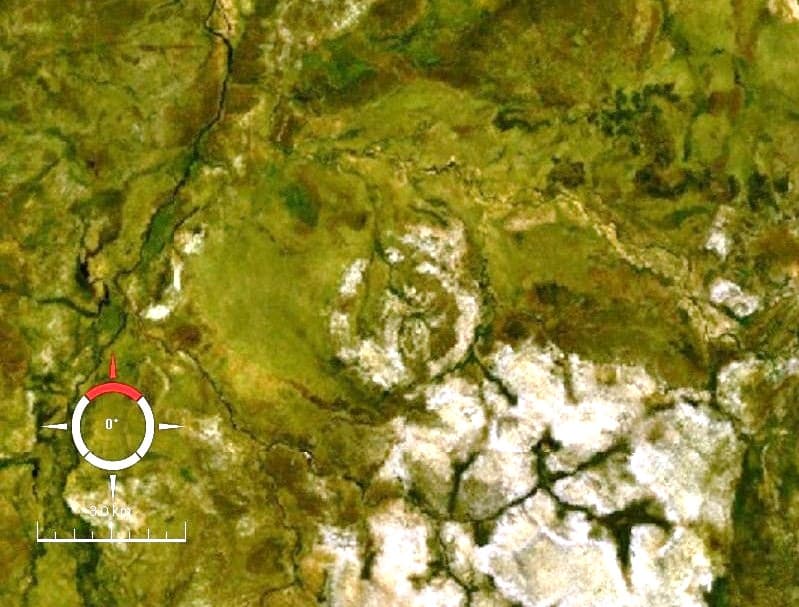
The Goyder impact structure is the eroded remnant of an ancient impact crater located in Arnhem Land, Northern Territory, Australia. It is characterized by a 3 km diameter ring of fractured sandstone, interpreted as a central uplift, with an estimated original crater rim diameter of 9-12 km. Evidence such as shatter cones and shocked quartz confirms its impact origin.
Slate Islands
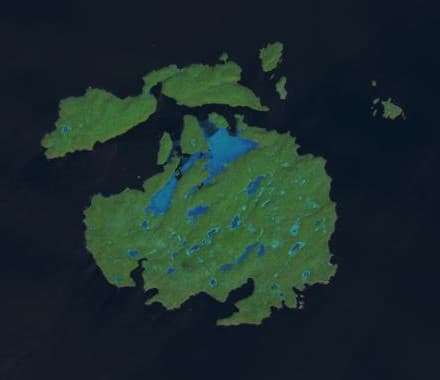
The Slate Islands are an archipelago in Lake Superior, Ontario, Canada, formed by a large meteorite impact. The impact created a crater estimated to be 32 km wide, with the remaining islands interpreted as a central uplift. Established as a provincial park in 1985, the islands are notable for their unique geology, including shatter cones, and for hosting Ontario's largest herd of boreal woodland caribou.
Manson
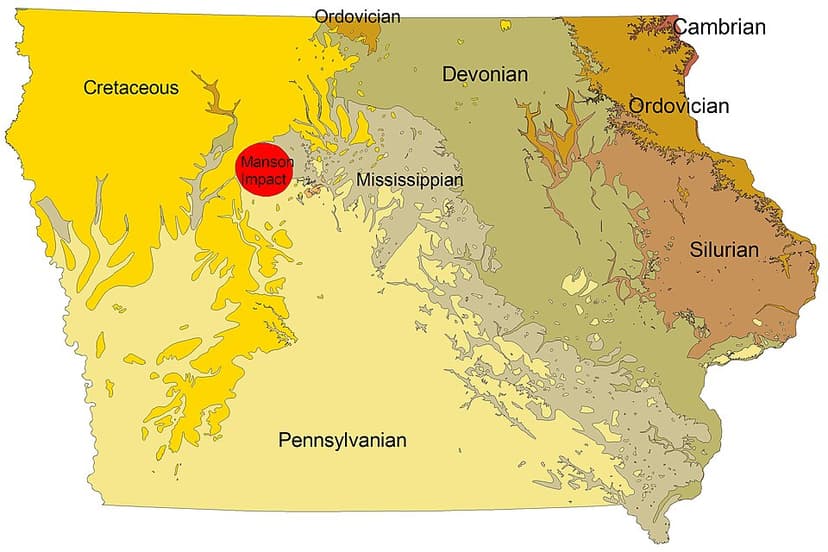
The Manson impact structure is a large, buried impact crater in Iowa, formed approximately 74 million years ago by an asteroid or comet. Despite its significant size and historical consideration for a role in the dinosaur extinction, its surface evidence is obscured by glacial till, making it a hidden geological feature.