
Holleford
The Holleford Crater is a buried impact structure located near Holleford, Ontario, Canada. It was discovered in the 1950s through aerial photograph analysis and subsequent geophysical studies confirmed it as a meteorite impact crater, despite not being exposed on the surface. The crater is estimated to be 550 million years old and is a significant site for geological research.
Key Facts
- ›Diameter is 2.35 kilometers (1.5 miles).
- ›Age is estimated to be 550 ± 100 million years.
- ›Located near Holleford, South Frontenac, Ontario, Canada.
- ›Discovered in the 1950s via aerial photograph analysis.
- ›Not exposed at the surface, but a surface depression exists.
- ›Confirmed as an impact crater through magnetic, seismic, gravity, and drilling studies.

About Holleford
Holleford Crater
The Holleford Crater is a significant, though buried, impact structure located near the community of Holleford in South Frontenac, Ontario, Canada. Its existence was first revealed in the 1950s through detailed analysis of aerial photographs, an effort spearheaded by Carlyle S. Beals of the Dominion Observatory in Ottawa. Subsequent comprehensive geophysical investigations by the Geological Survey of Canada, including magnetic, seismic, and gravity studies, alongside a diamond drilling program, provided conclusive evidence that the depression was the result of an ancient meteorite impact.
Estimated to be 550 ± 100 million years old, the Holleford Crater dates back to the Ediacaran or Cambrian periods. The impact event occurred when a meteorite, approximately 100 meters in diameter, struck the Earth at a high velocity of around 55,000 kilometers per hour. While a surface depression is observable, the crater itself is not exposed, lying beneath the current ground level within the Precambrian bedrock. The site is located on land historically associated with the Babcook Family Homestead Farm near Hartington, Ontario, and has been a frequent destination for geology students from Queen's University since the 1960s. An official commemorative plaque was erected in the 1970s, and Queen's University's Miller Hall Museum of Geology features a display dedicated to the crater.
Source: Wikipedia ↗
Frequently Asked Questions
Where is the Holleford Crater located?
The Holleford Crater is situated near the community of Holleford, within South Frontenac, Ontario, Canada. It is located on properties that were part of the Babcook Family Homestead Farm near Hartington, Ontario.
How large is the Holleford Crater?
The Holleford Crater has an estimated diameter of 2.35 kilometers, which is approximately 1.5 miles across. The meteorite that created it was estimated to be around 100 meters in diameter.
How old is the Holleford Crater?
The age of the Holleford Crater is estimated to be 550 million years old, with a margin of error of 100 million years. This places the impact event within the Ediacaran or Cambrian periods.
Is the Holleford Crater visible on the surface?
No, the Holleford Crater is not exposed at the surface. While there is a surface depression indicating its presence, the crater itself is buried within the Precambrian bedrock.
When and how was the Holleford Crater discovered?
The Holleford Crater was discovered in the 1950s. Its presence was first identified during an analysis of aerial photographs, conducted under the direction of Carlyle S. Beals of the Dominion Observatory in Ottawa.
What studies confirmed Holleford as an impact crater?
In the late 1950s, the Geological Survey of Canada conducted several geophysical studies, including magnetic observations, seismic studies, and gravity studies. A diamond drilling program also took place, with all studies yielding data consistent with a meteorite impact.
Related Impact Craters
Slate Islands
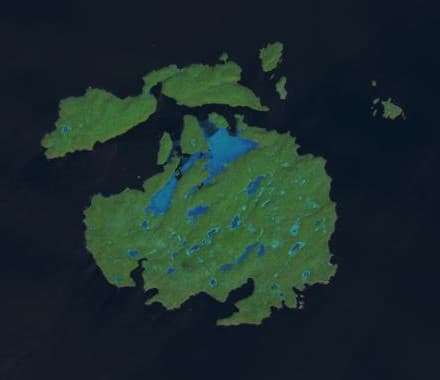
The Slate Islands are an archipelago in Lake Superior, Ontario, Canada, formed by a large meteorite impact. The impact created a crater estimated to be 32 km wide, with the remaining islands interpreted as a central uplift. Established as a provincial park in 1985, the islands are notable for their unique geology, including shatter cones, and for hosting Ontario's largest herd of boreal woodland caribou.
Haughton
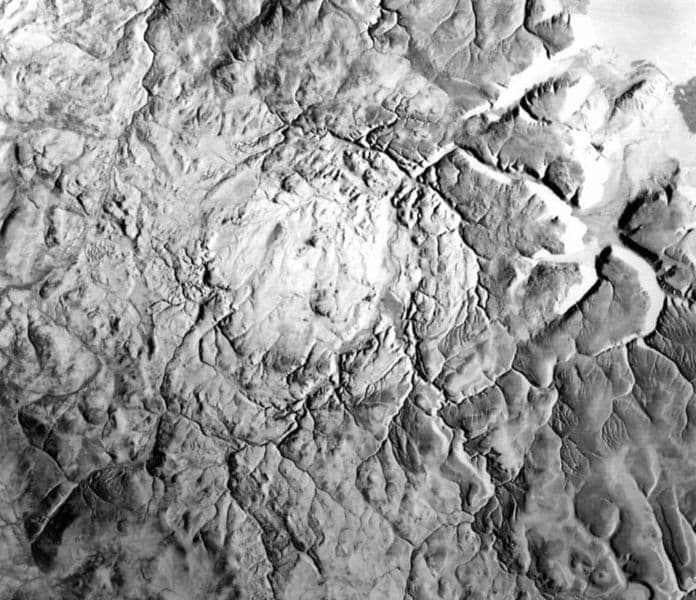
The Haughton impact crater, located on Devon Island in far Northern Canada, is a significant geological site due to its well-preserved features resulting from its high-latitude, cold environment. Formed approximately 31-32 million years ago, it serves as a valuable terrestrial analogue for Martian impact craters, prompting extensive research by space exploration organizations.

Carswell
Carswell is a large impact structure located in northern Saskatchewan, Canada, with a diameter of approximately 39 kilometers. Estimated to be 115 million years old, it formed during the Lower Cretaceous period and is significantly exposed at the surface, making it a valuable site for geological study. The structure features a complex central peak with distinctive geological evidence of a high-energy impact event.