
La Moinerie
Canada·Silurian or Devonian·Lake-filled crater
La Moinerie is an 8 km wide impact crater located in Quebec, Canada, now filled with water to form Lac La Moinerie. Estimated to be 400 million years old, the crater's original features have been significantly eroded by glaciers.
Key Facts
- ›Diameter: 8 km
- ›Age: Approximately 400 million years old
- ›Location: Quebec, Canada
- ›Geological Period: Silurian or Devonian
- ›Morphology: Water-filled lake (Lac La Moinerie)
- ›Condition: Significantly eroded by glaciers

About La Moinerie
La Moinerie Impact Crater
La Moinerie is an impact crater located in the Canadian province of Quebec. This geological feature measures approximately 8 kilometers in diameter and is estimated to have formed around 400 million years ago, during the Silurian or Devonian periods. The impact event created a significant depression that is now filled with water, forming the lake known as Lac La Moinerie.
Geological Features and History
The crater is exposed on the surface and is a prominent feature within the Rivière-Koksoak area of the Kativik territory. However, the passage of glaciers over millions of years has substantially eroded many of La Moinerie's original physical characteristics. Much of the central uplift, a common feature in impact craters of this size, has been worn away by glacial activity, altering its pristine morphology.
Research and Recognition
While specific details regarding its initial scientific discovery are not widely documented, the structure has been recognized as a probable impact site. Research, such as that presented in the Geological Society of America in 1978, has investigated the Lac La Moinerie crater as a potential impact structure in New Quebec. Its presence and altered state offer insights into the long-term geological processes affecting impact sites on Earth.
Source: Wikipedia ↗
Frequently Asked Questions
Where is the La Moinerie impact crater located?
La Moinerie is situated in the Kativik territory of Quebec, Canada, within Rivière-Koksoak. It is now largely occupied by the body of water known as Lac La Moinerie.
How old is the La Moinerie impact crater?
The age of the La Moinerie impact crater is estimated to be around 400 million years old, placing it within the Silurian or Devonian geological periods.
What is the size of the La Moinerie impact crater?
The impact crater, La Moinerie, measures approximately 8 kilometers in diameter. It is currently visible on the surface as a lake.
Has the La Moinerie crater been affected by erosion?
Yes, glaciers have significantly eroded many of the original physical features of the La Moinerie crater. This erosion has obscured much of the central uplift structure.
Related Impact Craters
Charlevoix
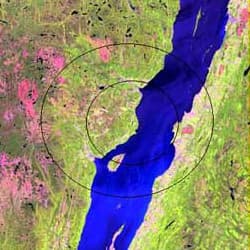
The Charlevoix impact structure is a large, eroded meteorite impact site located in the Charlevoix region of Quebec, Canada. Estimated to have been 54 kilometers in diameter, its age is approximately 450 million years, making it a significant geological feature with a central uplift interpreted as a result of elastic rebound. The structure is classified as a multi-ringed basin, and its relatively smooth terrain has facilitated human settlement, with most of the region's population residing within its boundaries.
Clearwater East
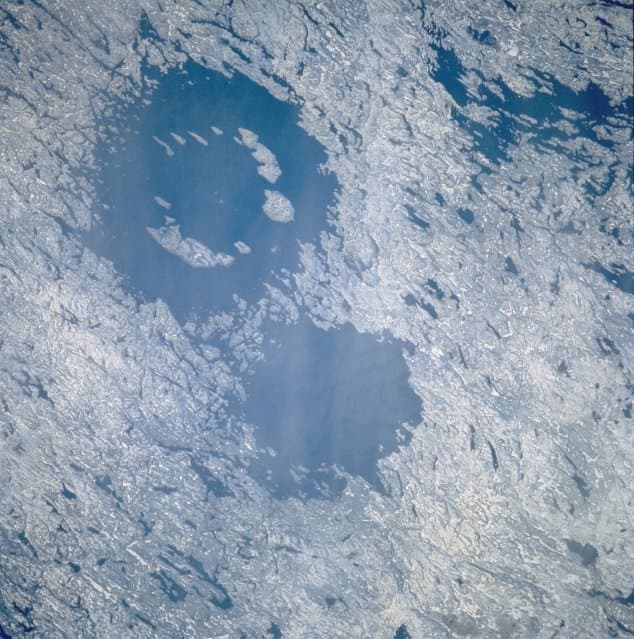
Clearwater East is one of two impact craters, forming the Clearwater Lakes in Quebec, Canada. This complex crater, with a diameter of 26 km, is estimated to be around 460-470 million years old, dating back to the Middle Ordovician period. Its central peak is submerged beneath lake water and sediments, but its presence has been confirmed through geological surveys and core drilling.
Slate Islands
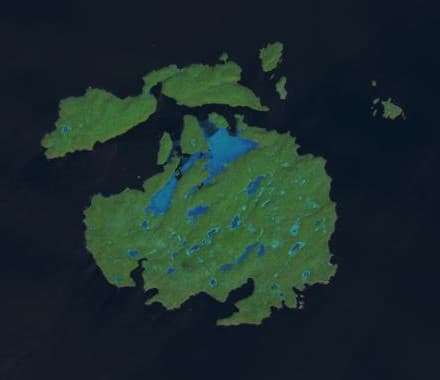
The Slate Islands are an archipelago in Lake Superior, Ontario, Canada, formed by a large meteorite impact. The impact created a crater estimated to be 32 km wide, with the remaining islands interpreted as a central uplift. Established as a provincial park in 1985, the islands are notable for their unique geology, including shatter cones, and for hosting Ontario's largest herd of boreal woodland caribou.