
Middlesboro
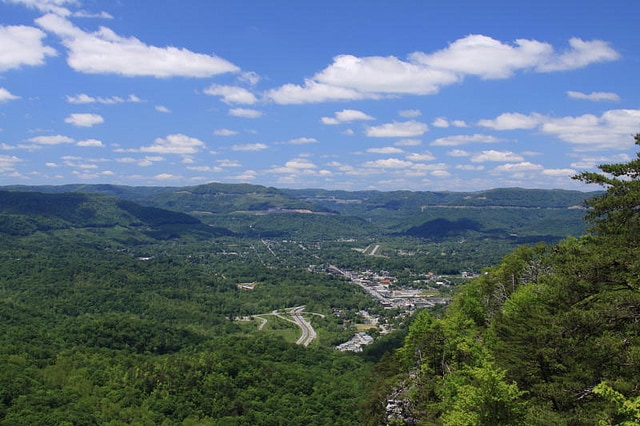
The Middlesboro crater, also known as an astrobleme, is a meteorite impact structure located in Kentucky, United States, with the city of Middlesboro built within its bounds. Its estimated age is less than 300 million years, and it is notable for being the only known location where coal is mined inside an impact crater.
Key Facts
- ›The Middlesboro crater is approximately 3 miles (about 5 km) in diameter.
- ›Its age is estimated to be less than 300 million years, dating back to the Permian period.
- ›The impactor is estimated to have been about 100 meters in diameter.
- ›It was identified as an impact basin in 1962 by K. J. Englund and J. B. Roen.
- ›Shatter cones and shocked quartz, indicators of impact events, have been found at the site.
- ›Middlesboro is the only place globally where coal is mined within an impact crater.
Shatter Cones, Shocked Quartz
About Middlesboro
Middlesboro Crater
The Middlesboro crater, also referred to as an astrobleme, is a significant meteorite impact structure located in Kentucky, United States. The modern city of Middlesboro is largely situated within the bounds of this ancient impact site. The crater's diameter is approximately 3 miles (about 5 km), and its formation is estimated to have occurred less than 300 million years ago, during the Permian geological period.
History and Discovery
Situated within the Appalachian Mountains, the Middlesboro crater plays a role in the geological landscape that facilitated westward expansion, forming part of the critical passage known as the Cumberland Gap. The town of Middlesboro itself was established in 1886 with the intention of exploiting local iron and coal deposits. Unbeknownst to its founder, Alexander A. Arthur, the town's location was due to an extraterrestrial event. The impact origin of the crater was definitively identified in 1962 by K. J. Englund and J. B. Roen of the U. S. Geological Survey. Further evidence, such as shatter cones, a distinct geological formation created only by impact events, and shocked quartz, was discovered by Robert Dietz in 1966, solidifying its status as an impact structure.
Geological Significance
The Middlesboro crater is notable for several geological reasons. It is recognized as one of the key geological features contributing to the formation of the Cumberland Gap. The presence of abundant shatter cones and shocked quartz provides clear evidence of the high-energy impact event. Uniquely, Middlesboro holds the distinction of being the only known location in the world where coal mining operations are conducted inside an impact crater. This necessitates the use of specialized mining techniques due to the complex geological strata resulting from the impact.
Modern Recognition and Tourism
In recognition of its scientific and geological importance, the Middlesboro crater site was designated a Distinguished Geologic Site by the Kentucky Society of Professional Geologists in September 2003. While coal mining remains a primary economic activity, local efforts are underway to promote the crater as a tourist destination. The construction of the Cumberland Gap Tunnel has also improved accessibility for visitors to the region and the nearby Cumberland Gap National Historical Park, potentially increasing interest in the unique geological heritage of the Middlesboro crater.
Source: Wikipedia ↗
Frequently Asked Questions
Where is the Middlesboro crater located?
The Middlesboro crater is located in Kentucky, United States, within the Appalachian Mountains. The city of Middlesboro is situated in the center of the crater.
How large is the Middlesboro crater?
The crater has an estimated diameter of approximately 3 miles, which is about 5 kilometers across. The impactor itself is thought to have been around 100 meters in diameter.
When did the impact event that formed the Middlesboro crater occur?
The age of the Middlesboro crater is estimated to be less than 300 million years old. This places the impact event within the Permian geological period.
Who discovered the Middlesboro crater?
The impact basin was identified in 1962 by K. J. Englund and J. B. Roen of the U. S. Geological Survey. Robert Dietz further contributed to its identification in 1966 by discovering shatter cones.
What is significant about the Middlesboro crater's geology?
The Middlesboro crater is geologically significant because shatter cones, a rock formation exclusive to impact events, are found abundantly there. It is also the only known location worldwide where coal is mined within an impact crater, requiring specialized mining techniques.
What geological formations are associated with the Middlesboro crater?
The Middlesboro crater is part of a series of geological features that include the Yellow Creek valley, a natural gap in the Cumberland Mountain ridge, and an eroded gap in Pine Mountain. These collectively form the Cumberland Gap, a historically important westward passage.
Related Impact Craters
Decaturville
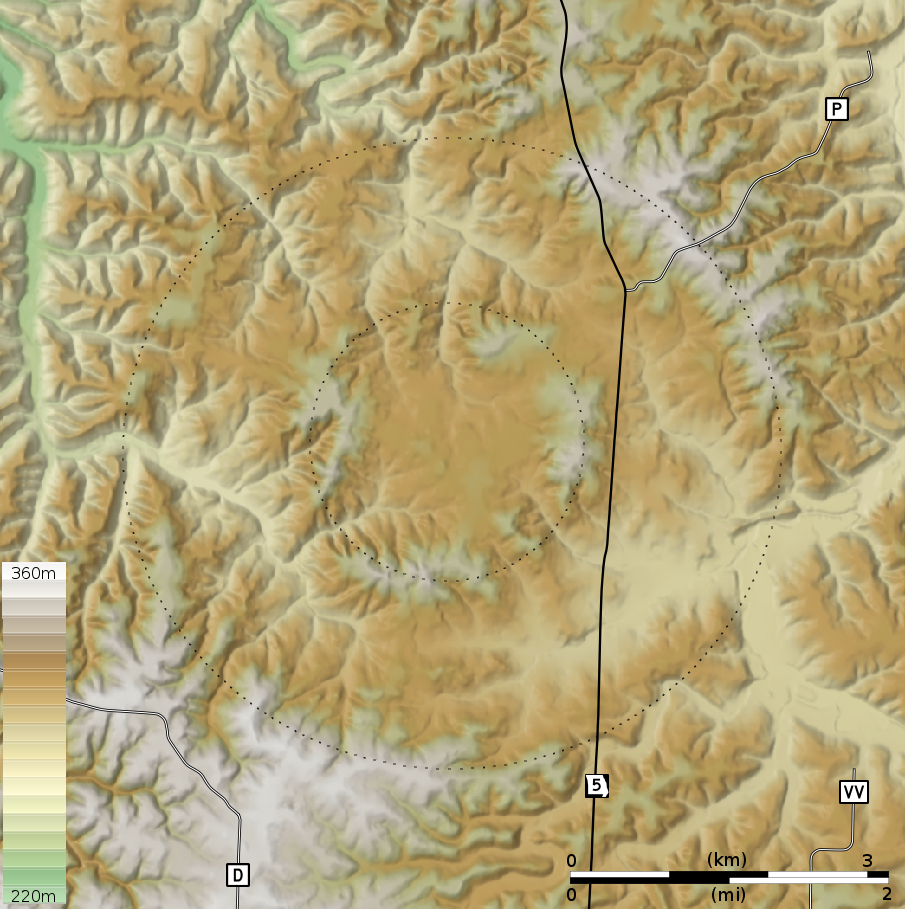
The Decaturville crater, also known as the Decaturville Dome, is an impact structure located near Decaturville, Missouri. It is part of a series of geophysical features hypothesized to be remnants of an ancient serial impact event. The crater is notable for its size and its exposure at the surface, allowing for geological study of the impact's effects.
Upheaval Dome
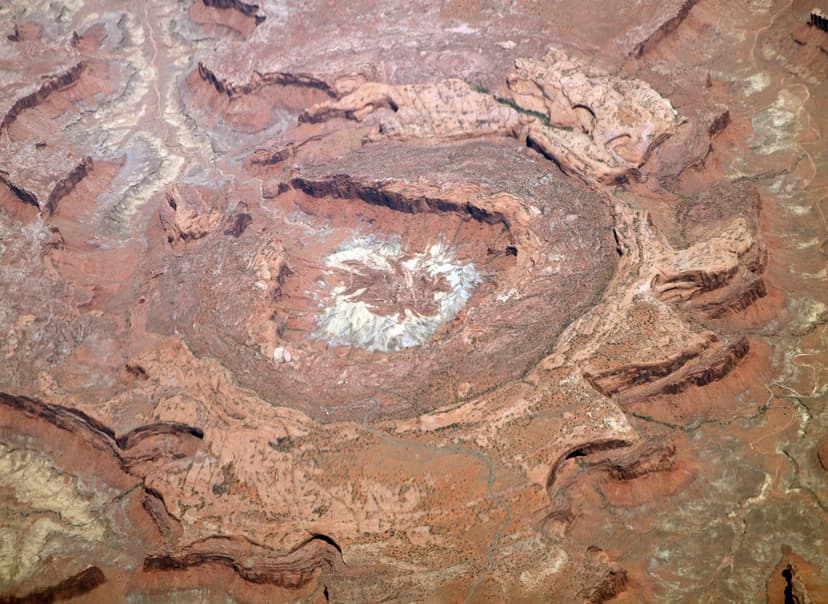
Upheaval Dome is a geological structure in Utah, USA, approximately 10 km in diameter, whose origin has been debated between being a salt dome or a meteorite impact structure. Current scientific consensus favors the impact crater interpretation, supported by evidence such as shocked quartz and concentric geological rings, indicating an event less than 170 million years old.

Ames
The Ames crater is a significant buried meteorite impact structure located in Major County, Oklahoma. Discovered in 1991, its geological importance is amplified by the substantial oil and gas reserves found within it, making it one of the largest of several impact craters associated with oil production in the United States.