
Morokweng
South Africa·Tithonian·Mesozoic·L chondrite asteroid
The Morokweng impact structure is a massive, buried crater located in South Africa's North West province. Estimated to be around 146 million years old, it was formed by the impact of an L chondrite asteroid. Significantly, fragments of the original asteroid have been recovered from the site, a rare occurrence for large impact structures.
Key Facts
- ›Estimated diameter ranges from 75 km to over 240 km, with recent estimates around 190 km.
- ›Age is approximately 146.06 ± 0.16 million years, dating to the Tithonian stage of the Late Jurassic.
- ›Discovered in 1994 through magnetic and gravimetric surveys.
- ›Formed by an L chondrite asteroid estimated to be 5 to 10 km in diameter.
- ›Fragments of the original asteroid were found buried deep below the surface.
- ›An iridium layer in Brazil's Araripe basin may be linked to this impact event.

About Morokweng
Morokweng Impact Structure
The Morokweng impact structure is a vast, buried geological feature located in South Africa's North West province, near the town of Morokweng and close to the border with Botswana. Its immense size and the rare discovery of asteroid fragments make it a significant site for scientific study.
Description and Discovery
First identified in 1994, the Morokweng structure was detected through magnetic and gravimetric surveys, as it is not exposed at the surface but lies buried beneath the Kalahari Desert. Estimates of its diameter vary, with some studies suggesting figures ranging from 75 to over 240 kilometers. More recent analyses, combining borehole petrographic data with national gravity and airborne magnetic field imagery, point to a likely diameter of approximately 190 kilometers. The impact event is dated to 146.06 ± 0.16 million years ago, placing it firmly within the Tithonian stage of the Late Jurassic period, just before the transition to the Cretaceous.
The Impacting Asteroid and Its Remains
Core samples indicate that the impact was caused by an L chondrite asteroid, estimated to have been between 5 and 10 kilometers in diameter. A remarkable discovery occurred in May 2006 when a group of scientists drilling into the site unearthed a 25-centimeter-diameter fragment of the original asteroid at a depth of 770 meters. The presence of such substantial fragments was unexpected, as it was generally assumed that asteroids of this size would be almost entirely vaporized upon impact. The composition of these fragments is also notable, containing iron-rich silicates and sulfides but lacking metallic iron. Some of these recovered asteroid pieces are now on display at the Science Museum in London and the "Museo del cielo e della Terra" in Italy.
Geological Significance
Further research, including a 2007 paper, has utilized microgravity, aeromagnetic, satellite, and borehole data to suggest that the Morokweng structure may extend up to 240 kilometers in diameter and exhibit a complex, multi-ringed morphology. The potential significance of this impact extends beyond South Africa, as an iridium layer found in the Tithonian strata of the Araripe basin in northeastern Brazil has been tentatively linked to this event, suggesting a possible role in the extinction events of that era.
Source: Wikipedia ↗
Frequently Asked Questions
Where is the Morokweng impact structure located?
The Morokweng impact structure is buried beneath the Kalahari Desert in South Africa's North West province. It is situated near the town of Morokweng and close to the border with Botswana.
How old is the Morokweng impact structure?
The impact structure is estimated to be 146.06 ± 0.16 million years old. This age places the impact event within the Tithonian stage of the Late Jurassic epoch.
What caused the Morokweng impact?
The Morokweng impact was caused by an L chondrite asteroid. This asteroid is estimated to have been between 5 and 10 kilometers in diameter.
Has any part of the asteroid been found at Morokweng?
Yes, a significant discovery was made in 2006 when scientists found a 25-centimeter-diameter fragment of the original asteroid buried 770 meters below the surface. Much smaller fragments were also found at other depths.
Is the Morokweng impact structure visible on the surface?
No, the Morokweng impact structure is not exposed at the surface. It lies buried beneath the Kalahari Desert and has been mapped using geophysical surveys.
What is the estimated size of the Morokweng impact structure?
Estimates for the diameter of the structure vary. Some studies suggest sizes between 75–80 km, while others propose over 240 km. More recent analyses integrating borehole data and geophysical surveys indicate a likely size of around 190 km.
Related Impact Craters
Kalkkop
Kalkkop is a confirmed impact crater located in the Eastern Cape Province of South Africa, approximately 50 kilometers southeast of Aberdeen. The impact event occurred about 250,000 years ago, leaving a significant crater that has since been filled with a deep limestone deposit.

Vredefort
The Vredefort impact structure in South Africa is one of Earth's largest and oldest known impact craters. Although the original crater has been eroded away, the remaining deformed bedrock forms the Vredefort Dome, a significant geological feature. Its immense size and age make it crucial for understanding early Earth history and impact events.
S2 spherule bed
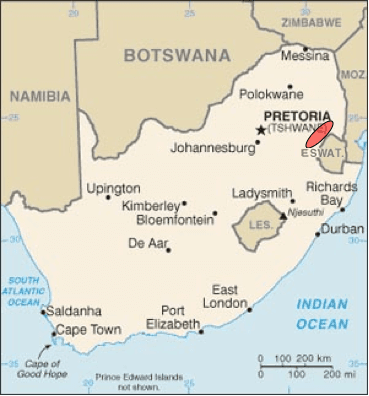
The S2 spherule bed is one of at least 8 layers containing spherules found within the Barberton Greenstone Belt, dating back approximately 3.26 billion years. These spherules are evidence of ancient impact events, with the S2 event being one of the most powerful, potentially causing global catastrophes like megatsunamis and prolonged darkness. The Barberton Greenstone Belt itself is a significant geological formation, preserving some of the oldest rocks and traces of life on Earth.