
S2 spherule bed
South Africa·Mesoarchaean·Archaean·asteroid
The S2 spherule bed is one of at least 8 layers containing spherules found within the Barberton Greenstone Belt, dating back approximately 3.26 billion years. These spherules are evidence of ancient impact events, with the S2 event being one of the most powerful, potentially causing global catastrophes like megatsunamis and prolonged darkness. The Barberton Greenstone Belt itself is a significant geological formation, preserving some of the oldest rocks and traces of life on Earth.
Key Facts
- ›Part of the Barberton Greenstone Belt in South Africa.
- ›Dates to approximately 3.26 billion years ago.
- ›Represents a significant impact event, evidenced by spherule layers.
- ›The impactor is estimated to have been 20-50 kilometers in diameter.
- ›The resulting crater is estimated to have been 400-1,000 kilometers in diameter.
- ›Associated with global catastrophic events such as megatsunamis.
Vredefort Impact Structure, Chicxulub Impactor
Spherules
About S2 spherule bed
The S2 spherule bed is a geological marker within the Barberton Greenstone Belt of South Africa, providing evidence of a colossal impact event that occurred approximately 3.26 billion years ago. This event is one of at least eight significant impacts recorded in the belt, each leaving behind layers of spherules—tiny spheres formed from the condensed vaporized material ejected during the impact. The S2 impact is particularly notable for its immense scale, with the impacting body estimated to have been between 20 and 50 kilometers in diameter, potentially creating a crater ranging from 400 to 1,000 kilometers across.
Impact and its Consequences
The S2 impact event is believed to have been one of the most powerful in Earth's history. Its consequences were likely catastrophic on a global scale. The impact would have triggered extremely violent earthquakes worldwide, generated megatsunamis thousands of meters high, and caused widespread boiling of the ocean's surface, leading to tens of meters of global ocean evaporation. Furthermore, the massive ejection of debris into the atmosphere would have plunged the Earth into darkness for years to decades, drastically altering the climate and potentially impacting nascent life forms.
Geological Context
The Barberton Greenstone Belt, where the S2 spherule bed is found, is a geologically significant region. It preserves some of the oldest exposed rocks on Earth, dating back over 3.6 billion years, and contains some of the earliest traces of life. The belt is composed of a sequence of mafic to ultramafic lavas and metasedimentary rocks, along with intrusive granitoid rocks. The presence of multiple spherule layers, including S1 through S8, indicates a period of intense bombardment during the early Archaean eon, making this region invaluable for understanding both planetary impact processes and the early evolution of Earth.
Source: Wikipedia ↗
Frequently Asked Questions
What is the S2 spherule bed?
The S2 spherule bed is a geological layer within the Barberton Greenstone Belt that contains spherules, which are tiny spheres formed from condensed vapor created by an impact event. It is one of at least eight such layers identified in the region.
How old is the S2 impact event?
The S2 impact event is dated to approximately 3.26 billion years ago. This makes it one of the oldest recorded impact events on Earth.
What was the scale of the S2 impact event?
The S2 impact was one of the most powerful recorded, with the impactor estimated to be 20-50 kilometers in diameter and the resulting crater potentially spanning 400-1,000 kilometers. It likely caused global catastrophes, including extreme earthquakes, megatsunamis, and prolonged darkness.
Where is the S2 spherule bed located?
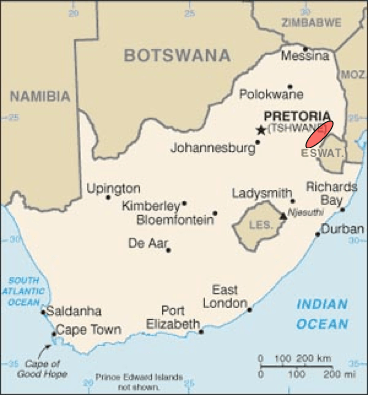
The S2 spherule bed is found within the Barberton Greenstone Belt, located on the eastern edge of the Kaapvaal craton in South Africa.
What is the significance of the Barberton Greenstone Belt in relation to the S2 spherule bed?
The Barberton Greenstone Belt preserves some of the oldest rocks on Earth and contains multiple layers of spherules from ancient impact events, including the S2 event. This makes it a crucial site for studying early Earth history and the effects of large impacts.
Related Impact Craters

Vredefort
The Vredefort impact structure in South Africa is one of Earth's largest and oldest known impact craters. Although the original crater has been eroded away, the remaining deformed bedrock forms the Vredefort Dome, a significant geological feature. Its immense size and age make it crucial for understanding early Earth history and impact events.
Kalkkop
Kalkkop is a confirmed impact crater located in the Eastern Cape Province of South Africa, approximately 50 kilometers southeast of Aberdeen. The impact event occurred about 250,000 years ago, leaving a significant crater that has since been filled with a deep limestone deposit.

Morokweng
The Morokweng impact structure is a massive, buried crater located in South Africa's North West province. Estimated to be around 146 million years old, it was formed by the impact of an L chondrite asteroid. Significantly, fragments of the original asteroid have been recovered from the site, a rare occurrence for large impact structures.