
Rochechouart
The Rochechouart impact structure in France is a significant site for understanding asteroid impacts, despite its original crater being largely eroded away. Its recognition was crucial in debunking theories of cryptovolcanism and confirming impacts as a geological process. The structure is notable for preserving a complete sequence of impactite lithologies and shock metamorphic features.
Key Facts
- ›Located on the western margin of the French Massif Central, near Limoges.
- ›The impact origin was first recognized in 1969 and definitively confirmed in the MID-1970s.
- ›The initial impact crater's morphology is lost due to erosion, but estimates place its original diameter between 40 ± 10 km.
- ›The impact occurred approximately 203-207 million years ago, during the Rhaetian stage of the Late Triassic.
- ›The impactor is inferred to have been an asteroid, likely a type of achondrite.
- ›A National Natural Reserve was established in 2008 to protect representative geological features of the structure.
Manicouagan Impact Structure, Saint Martin Crater, Obolon' Crater, Red Wing Crater
Impactites, Breccias, Suevite
About Rochechouart
Rochechouart Impact Structure
The Rochechouart impact structure, located in France on the western margin of the French Massif Central near Limoges, represents a significant site for understanding the geological processes of asteroid impacts. While erosion has largely obscured its original surface features, the site preserves crucial evidence of the impact event, including highly deformed bedrock and fragments of the crater floor. The structure's recognition was a pivotal moment in geology, helping to confirm impacts as a valid geological process and move away from theories of cryptovolcanism.
History and Confirmation
The presence of unusual rock types in the Rochechouart area was noted as early as the 19th century, but their origin was debated for decades. The impact origin was first recognized by F. Kraut in 1969 and definitively confirmed in the mid-1970s by P. Lambert. This confirmation was particularly significant as it was based on the detection of projectile contamination, specifically elevated nickel content, in the absence of a clear crater morphology or meteorite debris. This evidence was instrumental in countering skepticism and the prevailing cryptovolcanism hypothesis.
Age and Impact Event
The precise age of the Rochechouart impact has been a subject of ongoing research, with estimates spanning a wide range. However, recent determinations since 2010 converge on an age between 203 and 207 million years ago, placing the event during the Rhaetian stage, shortly before the Triassic-Jurassic boundary. The celestial body responsible for the impact is believed to have been an asteroid, likely a specific type of achondrite, rather than a comet.
Geological Setting and Characteristics
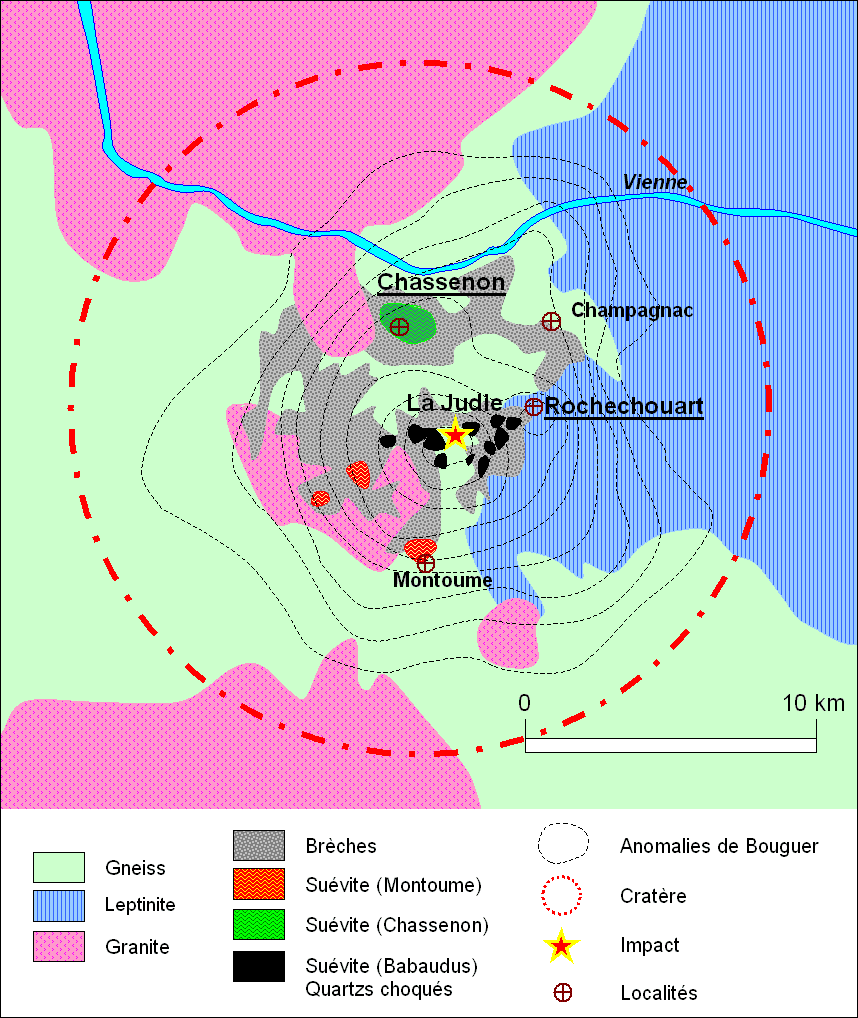
The impact occurred on crystalline rocks, primarily gneisses and granites, which were part of an ancient, eroded mountain range. The Rochechouart structure exhibits a central zone of breccias and impact melt rocks, surrounded by an annular zone with breccia dikes and fractured bedrock. Despite significant erosion, the site offers an exceptionally complete sequence of impactites and shock metamorphic features, including shatter cones and various melt-rich and melt-poor impactites. The fine-grained impact materials deposited last are particularly well-preserved near Chassenon.
Size and Morphology
While an official database lists a diameter of 23 km, this figure is considered to represent the area of reported deformation rather than the original crater size. Geologists now estimate that the initial impact crater was much larger, likely in the range of 40 ± 10 km. The absence of a central uplift, coupled with evidence of its collapse, suggests a complex crater morphology, characteristic of larger impact events.
Significance and Research
Rochechouart is considered to provide uniquely direct access for investigating fundamental questions about impact cratering as both a geological and a potential biological process. Its well-preserved sequence allows for the study of crater fill mechanics, satellite effects like tsunamis and pyroclastic explosions, and the phenomenon of rock "fluidization." The structure also offers insights into impact-induced hydrothermal systems and the potential for emergent life in impact craters. Despite its scientific potential, Rochechouart was historically under-investigated, a situation that is rapidly changing with the establishment of research centers and ongoing drilling programs to explore the crater's history.
Source: Wikipedia ↗
Frequently Asked Questions
Where is the Rochechouart impact structure located?
The Rochechouart impact structure is situated in France, on the western margin of the French Massif Central, near the city of Limoges. It spans the administrative boundary between the Charente and Haute-Vienne departments.
When did the impact event that created the Rochechouart structure occur?
The age of the Rochechouart impact is estimated to be between 203 and 207 million years ago. This places the event during the Rhaetian geological stage, near the Triassic-Jurassic boundary.
What is the estimated size of the Rochechouart impact crater?
While the original surface morphology of the crater is gone due to erosion, current estimates suggest the initial crater was significantly larger than previously thought, falling in the range of 40 ± 10 kilometers in diameter.
What type of celestial body caused the Rochechouart impact?
Evidence, particularly the prominent siderophile contamination, suggests that the impactor was an asteroid. While early debates considered iron meteorites or chondrites, more recent studies point towards a special type of achondrite.
Why is the Rochechouart impact structure significant?
Rochechouart is significant because its confirmation as an impact structure helped to definitively end the debate surrounding cryptovolcanism and solidify impact cratering as a recognized geological process. It also offers exceptional access for studying crater fill mechanics and the geological effects of large impacts.
Has the Rochechouart impact structure been officially recognized?
Yes, the French State officially acknowledged the heritage value of the Rochechouart impact structure in 2008 by creating the "Réserve Naturelle Nationale de l’astroblème de Rochechouart-Chassenon".
Related Impact Craters

Dellen
The Dellen lake system in Hälsingland, Sweden, is a prominent example of an impact crater. Formed approximately 89 million years ago during the Late Cretaceous period, the crater's impact created the unique geological formation known as Dellenite, which is now the provincial rock. The lake system itself is a popular destination for fly-fishermen, particularly for its brown trout population.
Lappajärvi
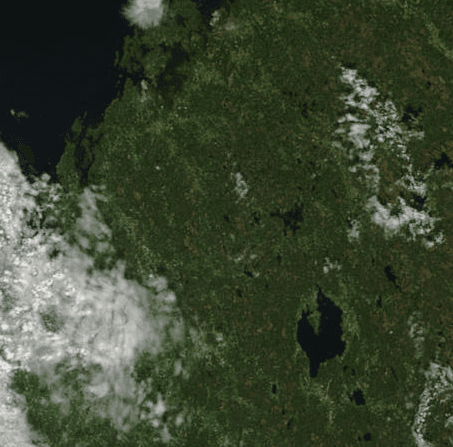
The Lappajärvi impact structure is a large, partly eroded meteorite crater in Finland, now occupied by a lake of the same name. It is one of the largest and youngest impact craters in Finland and is significant for scientific research, including projections for future landscapes. The area has also been recognized with a UNESCO Global Geopark application.

Manicouagan
Manicouagan Reservoir, located in Quebec, Canada, is a prominent annular lake formed by an ancient meteorite impact. This impact structure, once a large crater, is now largely submerged beneath the reservoir and is famously known as the "eye of Quebec" due to its distinctive appearance from space.