
Tabun-Khara-Obo
Mongolia·Middle Jurassic to Early Cretaceous·simple
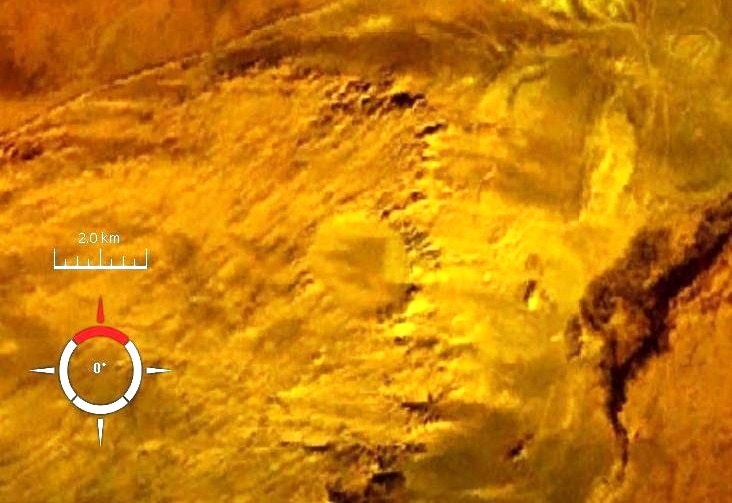
Tabun-Khara-Obo is a confirmed impact crater located in the Dornogovi Aimag province of southeastern Mongolia. This exposed crater is 1.3 km in diameter and has an estimated age of 150 ± 20 million years, dating back to the Middle Jurassic to Early Cretaceous periods. Its identification as a probable impact site occurred in the 1960s, with confirmation later established through drilling studies.
Key Facts
- ›Diameter: 1.3 km (0.81 MI)
- ›Age: 150 ± 20 million years (Middle Jurassic to Early Cretaceous)
- ›Location: Dornogovi Aimag, southeastern Mongolia
- ›First identified as probable impact site: 1960s
- ›Confirmation: Drilling in 2008 revealed impact features
- ›Morphology: Exposed crater with rim rising 20-30 meters above bottom
About Tabun-Khara-Obo
Tabun-Khara-Obo Impact Crater
Tabun-Khara-Obo is a confirmed impact crater situated in the Dornogovi Aimag province of southeastern Mongolia. This geological feature is exposed at the surface and measures 1.3 kilometers (0.81 miles) in diameter. The crater's rim stands 20 to 30 meters above its bottom, which is now covered by a significant layer of lake deposits, indicating it once held a lake.
Age and Discovery
The estimated age of the Tabun-Khara-Obo impact crater is 150 ± 20 million years, placing its formation within the Middle Jurassic to Early Cretaceous geological periods. Its potential as an impact site was first identified in the 1960s. Scientific confirmation of its impact origin was achieved through drilling conducted in 2008, which uncovered rock features characteristic of high-speed impact events, such as those caused by meteorites.
Source: Wikipedia ↗
Frequently Asked Questions
Where is the Tabun-Khara-Obo impact crater located?
The Tabun-Khara-Obo impact crater is situated in the Dornogovi Aimag province in the southeastern part of Mongolia.
How large is the Tabun-Khara-Obo crater?
The crater has a diameter of 1.3 kilometers (0.81 miles). Its rim rises approximately 20 to 30 meters above the crater floor, which is covered by up to 171 meters of lake deposits.
When did the impact event that formed Tabun-Khara-Obo occur?
The estimated age of the Tabun-Khara-Obo impact crater is 150 ± 20 million years. This places the event within the Middle Jurassic to Early Cretaceous geological periods.
How was the Tabun-Khara-Obo crater confirmed as an impact structure?
The site was first recognized as a probable impact crater in the 1960s. Definitive confirmation came decades later, particularly through drilling in 2008 which revealed rock features consistent with high-speed impacts.
Is the Tabun-Khara-Obo crater visible on the surface?
Yes, the Tabun-Khara-Obo crater is exposed at the surface. Its rim is a visible feature, though the crater floor is covered by a substantial layer of ancient lake deposits.
Related Impact Craters

Dalgaranga
The Dalgaranga crater is a small, exceptionally well-preserved impact structure located in Western Australia. Discovered in 1921, it is unique as the only known impact crater formed by a mesosiderite meteorite, with fragments of the stony-iron projectile found at the site. Its small size and pristine condition suggest a relatively young age.
Amguid
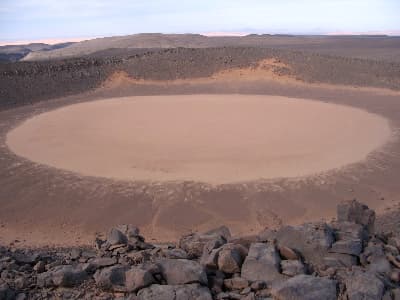
Amguid is a well-preserved impact crater situated in the Central Sahara of Algeria. Its relatively young age, estimated to be less than 100,000 years, and its pristine condition due to the arid desert environment make it a significant site for studying impact events. The crater's morphology and geological features, including shatter cones and breccia, provide insights into the low-velocity impact event.

Wolfe Creek
Wolfe Creek Crater, also known as Kandimalal by the local Djaru people, is a remarkably well-preserved meteorite impact crater located in Western Australia. Its pristine condition makes it a significant geological site, comparable to the Barringer Crater in Arizona, and it holds deep cultural importance for Indigenous Australians.