
Mosor rock lizard
The Mosor rock lizard (Dinarolacerta mosorensis) is a flattened lizard characterized by a long head and slender tail, typically reaching about 7 cm in snout-to-vent length. Its dorsal surface is brown, greyish-brown, or olive-brown with dark mottling, while its underparts are unspotted and yellow or orange in adults. This species inhabits high-rainfall limestone outcrops and karst regions above the treeline in southern Croatia, Bosnia and Herzegovina, and Montenegro.
Key Facts
- ›The Mosor rock lizard has a flattened body with a long head and slender tail.
- ›Adults measure approximately 7 cm in snout-to-vent length, with a tail about twice that length.
- ›Its dorsal coloration is brown to olive-brown, often with darker mottling, and its underparts are typically yellow or orange.
- ›The species is found in high-rainfall areas, typically on limestone outcrops and karst regions above the treeline.
- ›Females lay a single clutch of about four eggs annually.
- ›Its conservation status is assessed as 'vulnerable' due to habitat decline.

Mosor Rock Lizard
Croatia, Bosnia and Herzegovina, Montenegro
Limestone Outcrops, Karst Regions, Juniper-Clad Slopes, Open Woodland, Areas Near Springs
- Flattened Lizard With A Long Head and Slender Tail.
- Snout-To-Vent Length of About 7 cm .
- Tail Is Approximately Twice the Length of the Snout-To-Vent Length.
- Dorsal Surface Is Somewhat Glossy, Brown, Greyish-Brown, Or Olive-Brown With Darker Mottling and Speckling.
- Flanks Are Usually Darker In Colour, With Spotting Sometimes Restricted To the Mid-Dorsal Area.
- Underparts Are Unspotted and Usually Yellow Or Orange In Adults, But Can Be White Or Grey.
- Juveniles Have Pale Bellies and Sometimes Bluish Tails.
- Found In High Rainfall Areas.
- Inhabits Altitudes Between 450 and 1,900 Metres.
- Females Lay A Single Clutch of Eggs Once A Year.
- Eggs Are Retained Within the Female For About Five Weeks After Mating.
- Eggs Hatch About Two and A Half Weeks After Being Laid.
Logging
About Mosor rock lizard
The Mosor Rock Lizard
The Mosor rock lizard, scientifically known as Dinarolacerta mosorensis, is a species of lizard belonging to the Lacertidae family. This reptile is recognized for its flattened body, characterized by a long head and a slender tail which is roughly twice the length of its body. Adults typically measure around 7 centimeters in snout-to-vent length. Its dorsal coloration varies from brown to olive-brown, often adorned with darker mottling and speckling, while its underparts are generally unspotted and present as yellow or orange in mature individuals.
Habitat and Distribution
This lizard species is primarily found in the high-rainfall regions of southern Croatia, Bosnia and Herzegovina, and Montenegro. Its preferred habitat consists of limestone outcrops and karst landscapes situated above the treeline, though it also inhabits juniper-clad slopes, open woodlands, and areas surrounding springs. The Mosor rock lizard is typically found at elevations ranging from 450 to 1,900 meters.
Reproduction and Conservation
Female Mosor rock lizards lay a single clutch of approximately four eggs per year. These eggs are retained within the female for about five weeks post-mating and hatch approximately two and a half weeks later. Juveniles are quite small upon hatching, measuring less than 3 centimeters. The Mosor rock lizard faces threats, notably from logging which contributes to the decline of its habitat. Consequently, its total area of occupancy is less than 2,000 square kilometers, and it is generally uncommon within its range. The International Union for Conservation of Nature (IUCN) has assessed its conservation status as 'vulnerable'.
Source: Wikipedia ↗
Frequently Asked Questions
What is the scientific name of the Mosor rock lizard?
The scientific name of the Mosor rock lizard is Dinarolacerta mosorensis. This binomial name is used to classify it within the scientific community.
Where is the Mosor rock lizard found?
The Mosor rock lizard is naturally found in southern Croatia, Bosnia and Herzegovina, and Montenegro. Its presence in Albania is possible but requires further confirmation.
What does the Mosor rock lizard look like?
It is a flattened lizard with a long head and a slender tail. Its back is typically brown, greyish-brown, or olive-brown with dark speckles, and its belly is usually yellow or orange in adults.
What is the typical habitat of the Mosor rock lizard?
The Mosor rock lizard prefers high-rainfall areas, specifically limestone outcrops or karst regions situated above the treeline. It can also be found on juniper-clad slopes, in open woodlands, and near springs.
How does the Mosor rock lizard reproduce?
Females of the Mosor rock lizard lay a single clutch of approximately four eggs once a year. The eggs are incubated internally for about five weeks before hatching two and a half weeks later.
What is the conservation status of the Mosor rock lizard?
The International Union for Conservation of Nature (IUCN) has assessed the Mosor rock lizard's conservation status as 'vulnerable'. This is due to its limited area of occupancy and declining habitat.
Related Lizards
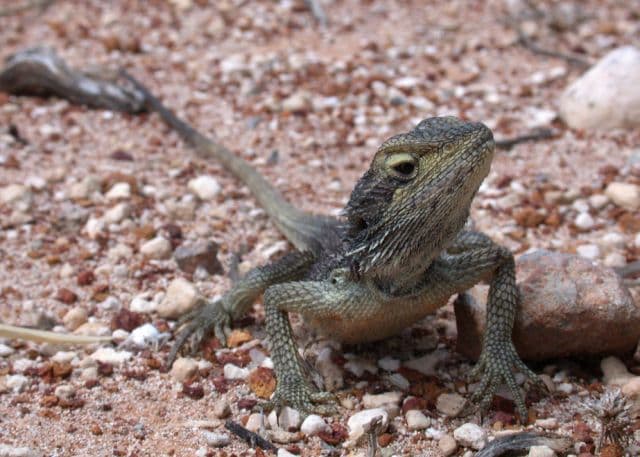
Abrolhos bearded dragon
The Abrolhos bearded dragon (Pogona minor minima) is a small agamid lizard endemic to the islands of the Houtman Abrolhos archipelago off the coast of Western Australia. It is characterized by its smaller size compared to related bearded dragons and inhabits sandy or limestone outcrop environments.

Furcifer nicosiai
Furcifer nicosiai is a large chameleon species endemic to western Madagascar, specifically found within the Tsingy de Bemaraha National Park. Distinguished by its high parietal crest and lack of snout appendages, it shares similarities with Furcifer verrucosus but can be identified by its smaller size and different color patterns. It is currently classified as an endangered species due to habitat loss and degradation.

European green lizard
The European green lizard is a large lizard found across European mid-latitudes, ranging from Slovenia to the Black Sea coasts. It is typically observed basking on rocks or lawns and seeking shelter in bushes. Males are characterized by a larger head and uniform green coloration with small spots, while females are more slender and often display light bands bordered by black spots.