
Anatolian worm lizard
The Anatolian worm lizard, also scientifically known as Blanus strauchi, is a species of amphisbaenian native to Southeast Europe and the Middle East. It is characterized by its burrowing lifestyle and is found in shrubland habitats. The species is oviparous, meaning it reproduces by laying eggs.
Key Facts
- ›Native to Southeast Europe and the Middle East.
- ›Found in shrubland habitats.
- ›Reproduces by laying eggs (oviparous).
- ›Named in honor of herpetologist Alexander Strauch.
- ›Two recognized subspecies exist.
- ›Can be found at altitudes up to 1,400 meters.

Turkish Worm Lizard
Greece, Iraq, Syria, Turkey
- Amphisbaenian Species, Characterized By A Serpentine Body and Reduced Or Absent Limbs.
- Burrowing Lifestyle Is Implied By Its Classification As A Worm Lizard and Habitat Preference.
About Anatolian worm lizard
The Anatolian worm lizard, scientifically designated as Blanus strauchi, is a species belonging to the amphisbaenian suborder within the family Blanidae. This reptile is indigenous to the regions of Southeast Europe and the Middle East, with specific documented occurrences in Greece, Iraq, Syria, and Turkey.
Habitat and Distribution
This species thrives in shrubland environments, demonstrating adaptability to diverse terrains within its geographic range. Its habitat extends from sea level up to an altitude of 1,400 meters (approximately 4,600 feet). The Anatolian worm lizard is recognized for its burrowing nature, a characteristic common to amphisbaenians.
Taxonomy and Subspecies
The species Blanus strauchi was named in honor of the Russian herpetologist Alexander Strauch. There are two recognized subspecies of B. strauchi: the nominotypical subspecies, Blanus strauchi strauchi, and Blanus strauchi bedriagae. The scientific naming reflects historical classifications and taxonomic revisions.
Reproduction
In terms of reproduction, the Anatolian worm lizard is oviparous. This means that the species reproduces by laying eggs, a method shared by many reptiles. Further details regarding its reproductive cycle, such as clutch size or incubation periods, are not extensively documented in the available information.
Source: Wikipedia ↗
Frequently Asked Questions
What is the scientific name for the Anatolian worm lizard?
The scientific name for the Anatolian worm lizard is Blanus strauchi. It belongs to the family Blanidae.
Where is the Anatolian worm lizard found geographically?
The Anatolian worm lizard is geographically distributed across Southeast Europe and the Middle East. Specifically, it has been recorded in Greece, Iraq, Syria, and Turkey.
What type of habitat does the Anatolian worm lizard prefer?
The preferred natural habitat for Blanus strauchi is shrubland. They can be found in these environments at altitudes ranging from sea level up to 1,400 meters (4,600 ft).
How does the Anatolian worm lizard reproduce?
The Anatolian worm lizard is oviparous, which means it reproduces by laying eggs. This is a common reproductive strategy among many reptile species.
Are there different subspecies of the Anatolian worm lizard?
Yes, there are two recognized subspecies of Blanus strauchi. These include the nominotypical subspecies, Blanus strauchi strauchi, and Blanus strauchi bedriagae.
Related Lizards

Cryptoblepharus carnabyi
The inland snake-eyed skink (Cryptoblepharus australis) is a small, swift lizard characterized by fused eyelids and a dorsally depressed body with long, splayed limbs for excellent vertical and horizontal movement. It inhabits arid inland Australia, preferring semi-arid zones, woodlands, shrublands, grasslands, and spinifex environments, and is often found on vertical surfaces like rocks, trees, and buildings. Its diet primarily consists of insects.
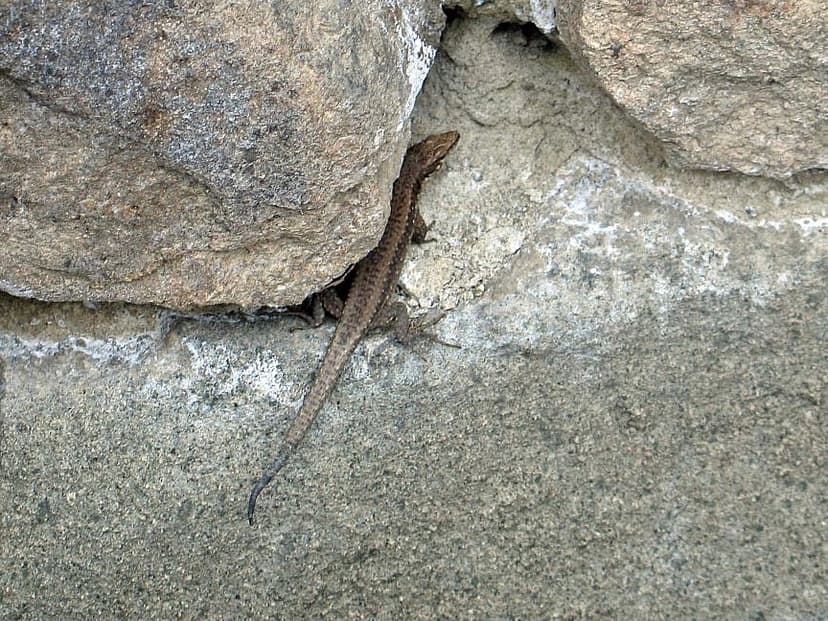
Anatolian rock lizard
The Anatolian rock lizard, scientifically known as Anatololacerta anatolica, is a common lizard species found in western Anatolia and adjacent Greek islands. This lizard inhabits temperate forests and rocky environments, characterized by its flattened body and variable markings, often featuring pale spots on a dark olive-brown base.

Anolis carolinensis carolinensis
The Anolis carolinensis, commonly known as the green anole or Carolina anole, is a small to medium-sized lizard native to the southeastern United States. It is distinguished by its ability to change color from shades of brown to green, a trait that leads to its common nickname 'American chameleon,' though it is not a true chameleon. These arboreal lizards inhabit forests, grasslands, and can even adapt to urban environments with sufficient vegetation and insect prey.