
Chamaeleo zeylanicus
The Indian chameleon (Chamaeleo zeylanicus) is a slow-moving, arboreal lizard native to South Asia, including India, Sri Lanka, and Pakistan. It is distinguished by its unique prehensile tail, independent eye movement, and the remarkable ability to change skin color, primarily for communication and thermoregulation, rather than camouflage. This species possesses a long, sticky tongue to capture prey from a distance.
Key Facts
- ›Native to India, Sri Lanka, and Pakistan.
- ›Moves slowly with a bobbing or swaying motion.
- ›Features a long, sticky tongue for catching insects.
- ›Possesses independent eye movement and a prehensile tail.
- ›Changes skin color for communication and temperature control, not camouflage.
- ›Males have a tarsal process or spur.

Indian Chameleon
India, Sri Lanka, Pakistan, South Asia
- Head Has A Bony Casque, Ornamented With Crests Or Tubercles.
- Interorbital Septum Present.
- Dentition Is Acrodont; Teeth Are Compressed, Triangular, and More Or Less Distinctly Tricuspid.
- Palate Is Toothless.
- Eyes Are Large, Covered By Thick, Granular Lids With A Small Central Opening For the Pupil.
- No Tympanum Or External Ear.
- Body Is Compressed, Neck Is Very Short.
- Vertebrae Are Procoelian; Abdominal Ribs Are Present.
- Limbs Are Long, Raising the Body.
- Digits Are Arranged In Bundles of Two and Three; In the Hand, the Inner Bundle Is Formed of Three, the Outer of Two Digits; It Is the Reverse In the Foot.
- Tail Is Prehensile.
- Head and Body Are Covered With Granules Or Tubercles.
- Casque Is Much Elevated Posteriorly, With A Strong Curved Parietal Crest.
- Strong Lateral Crest Present.
- Indication of A Dermal Occipital Lobe On Each Side.
- No Enlarged Tubercles On the Body.
- Feebly Serrated Dorsal Crest Present.
- Series of Conical Tubercles Form A Distinct Crest Along the Throat and Belly.
- Males Have A Tarsal Process Or Spur.
- Tail Is Longer Than Head and Body In Males.
- Gular-Ventral Crest and the Commissure of the Mouth Are White.
- Snout To Vent Length Up To 7 Inches.
- Prehensile Tail Up To 8 Inches Long.
Insects
- Moves Slowly With A Bobbing Or Swaying Movement.
- Primarily Arboreal.
- Uses A Long, Sticky Tongue To Catch Insects.
- Changes Skin Color For Communication and Thermoregulation .
- Independent Eye Movement.
About Chamaeleo zeylanicus
The Indian Chameleon (Chamaeleo zeylanicus)
The Indian chameleon, scientifically known as Chamaeleo zeylanicus, is a distinctive reptile native to South Asia, with populations found across India, Sri Lanka, and parts of Pakistan. This species is characterized by its slow, deliberate movements, often accompanied by a bobbing or swaying motion that mimics the movement of branches, a common trait among arboreal chameleons.
Key Features and Behavior
Chamaeleo zeylanicus possesses a suite of adaptations that are typical of its genus. These include an extremely long and sticky tongue, which it employs with remarkable accuracy to capture insects from a distance. Its feet are bifurcated, forming a pincer-like grip ideal for navigating branches, and it has a prehensile tail that provides an additional anchor. The chameleon's eyes are capable of independent movement, allowing for a wide field of vision.
A most striking characteristic is its ability to change skin color and patterns. However, this ability is not primarily for camouflage, as is often believed. Instead, color change in C. zeylanicus serves crucial communication purposes, signaling a female's willingness to mate with brighter patterns, or indicating submission, anger, or a desire for solitude through darker hues in disputes. Coloration also plays a role in thermoregulation, with darker shades absorbing heat and lighter shades reflecting it.
Physical Description
The physical morphology of the Indian chameleon includes a bony casque on its head, which can feature crests or tubercles. The skull has an interorbital septum, and its dentition is acrodont, with teeth that are compressed and triangular. Notably, the palate is toothless. Large eyes are covered by thick, granular eyelids, each with a small central opening for the pupil. The species lacks an external ear and a tympanum. The body is compressed, with a very short neck. Its limbs are long, elevating the body, and its digits are arranged in bundles of two and three, adapted for gripping. The tail is prehensile and, in males, is longer than the head and body, with males also possessing a tarsal process or spur. Adults can reach up to 7 inches from snout to vent, with a tail length of up to 8 inches.
Source: Wikipedia ↗
Frequently Asked Questions
Where is the Indian chameleon found?
The Indian chameleon (Chamaeleo zeylanicus) is found throughout much of India south of the Ganga river, southeasternmost Pakistan, and parts of Sri Lanka. This distribution makes it geographically distinct from most other chameleon species.
Why does the Indian chameleon change its skin color?
Contrary to popular belief, the Indian chameleon does not change color for camouflage. Its color changes are primarily for communication with other chameleons, signaling receptiveness to mating or indicating submission in disputes. It also changes color to help regulate body temperature, darkening to absorb heat and lightening to cool down.
What are the physical characteristics of the Indian chameleon?
Chamaeleo zeylanicus has a bony casque on its head, which can be ornamented with crests or tubercles. Its eyes are large with a small opening for the pupil, and it lacks an external ear. The body is compressed, the neck is short, and the limbs are long, allowing it to raise its body off the ground. Its digits are arranged in bundles, and it has a prehensile tail.
How does the Indian chameleon catch its food?
The Indian chameleon uses its extremely long and sticky tongue to catch insects from several feet away. This specialized hunting tool is a key adaptation for its slow-moving lifestyle.
What is the size of an adult Indian chameleon?
An adult Indian chameleon can grow up to 7 inches from snout to vent, with a prehensile tail that can be up to 8 inches long.
Are there any distinguishing features between male and female Indian chameleons?
Yes, male Indian chameleons possess a tarsal process or spur, and their tails are typically longer than their head and body combined.
Related Lizards

Trachylepis quinquetaeniata
The African five-lined skink (Trachylepis quinquetaeniata) is a medium-sized lizard native to north-central Africa, characterized by its glossy scales and distinctive five stripes running from head to tail. Its coloration varies with age, sex, and season, but typically features an olive-brown base with blue, black, and yellowish markings, especially on its bright blue tail. This adaptable species inhabits both rocky and grassland environments, often making its home on trees or man-made structures.
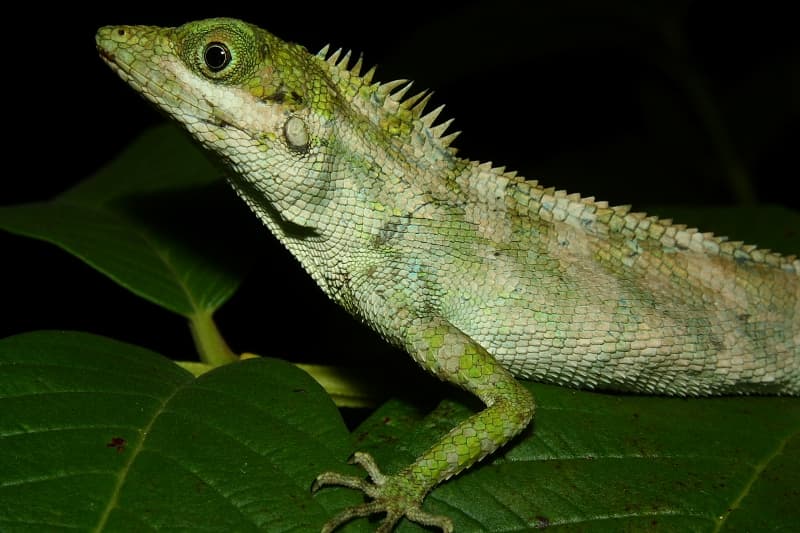
Andaman canopy agama
The Andaman canopy agama, also known as the green crestless forest lizard, is a species of agamid lizard native to the Andaman and Nicobar Islands of India. It is primarily an arboreal species, spending most of its life in the forest canopy and is rarely observed.

Furcifer balteatus
The Furcifer balteatus, also known as the two-banded chameleon or the rainforest chameleon, is a chameleon species native to southeast Madagascar. It is characterized by its green coloration with darker diagonal stripes and paler bands, often featuring a buff-colored diagonal streak, and males possess distinctive horny projections on their heads. This arboreal species inhabits rainforests at elevations between 800 and 1,050 meters.