
Ctenotus leae
Ctenotus leae, commonly known as the Centralian coppertail or orange-tailed finesnout skink, is a species of skink endemic to Australia. This terrestrial lizard inhabits grasslands and deserts across several Australian states and territories. It is characterized by a snout-to-vent length of up to 6 cm and reproduces by laying eggs.
Key Facts
- ›Endemic to Australia.
- ›Found in Queensland, South Australia, Western Australia, and the Northern Territory.
- ›Prefers grassland and desert habitats.
- ›Terrestrial lizard.
- ›Oviparous, typically laying three or four eggs.
- ›Can reach a snout-to-vent length of up to 6 cm.

Centralian Coppertail, Lea's Ctenotus, Orange-Tailed Finesnout Skink
Australia, Queensland, South Australia, Western Australia, Northern Territory
May Attain A Snout-To-Vent Length of 6 cm .
Terrestrial
About Ctenotus leae
Ctenotus leae, also known by common names such as the Centralian coppertail, Lea's ctenotus, and the orange-tailed finesnout skink, is a species of lizard belonging to the subfamily Sphenomorphinae within the family Scincidae. This species is native to Australia.
Description and Habitat
Ctenotus leae is a terrestrial skink that can reach a snout-to-vent length of up to 6 centimeters (approximately 2.4 inches). Its preferred natural habitats include grasslands and deserts, indicating an adaptation to arid and semi-arid environments. The specific name, leae, honors the Rev. T.E. Lea, who provided the holotype specimen to Boulenger.
Distribution and Reproduction
This species is found across several Australian states and territories, including Queensland, South Australia, Western Australia, and the Northern Territory. Ctenotus leae reproduces by laying eggs (oviparous). Typically, a clutch consists of three to four eggs, suggesting a moderate reproductive rate for the species.
Source: Wikipedia ↗
Frequently Asked Questions
What are the common names for Ctenotus leae?
Ctenotus leae is also known by several common names, including the Centralian coppertail, Lea's ctenotus, and the orange-tailed finesnout skink.
Where is Ctenotus leae found in Australia?
This skink species is distributed across the Australian states of Queensland, South Australia, and Western Australia, as well as the internal territory of the Northern Territory.
What type of environment does Ctenotus leae live in?
The preferred natural habitats for Ctenotus leae are grasslands and deserts. It is a terrestrial species, meaning it lives on the ground.
How large does Ctenotus leae get?
Ctenotus leae may attain a snout-to-vent length of up to 6 centimeters (approximately 2.4 inches).
How does Ctenotus leae reproduce?
Ctenotus leae is oviparous, meaning it reproduces by laying eggs. The usual clutch size consists of three or four eggs.
Related Lizards

Agama anchietae
Agama anchietae, commonly known as Anchieta's agama or the western rock agama, is a species of lizard native to southern Africa. It is characterized by its cryptic coloration, a wider head and longer tail in males due to sexual dimorphism, and a diet primarily consisting of insects, particularly ants. This species inhabits diverse environments including deserts, shrublands, and grasslands, and it reproduces by laying eggs.

Alsophylax boehmei
Alsophylax boehmei, formerly considered a subspecies of Altiphylax stoliczkai, is a species of gecko endemic to South Asia. It inhabits arid and mountainous regions, preferring deserts, grasslands, and rocky terrains. This species is oviparous, laying eggs as its primary method of reproduction.
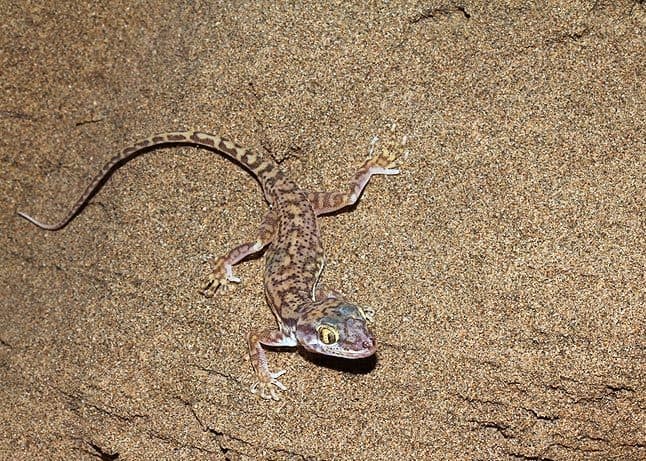
Crossobamon eversmanni
Crossobamon eversmanni, commonly known as the comb-toed gecko, is a species of Asian gecko found in desert, grassland, and shrubland habitats across Iran, Pakistan, and Central Asia. This terrestrial and nocturnal lizard is characterized by its burrowing behavior and oviparous reproduction, with females laying one to two eggs per clutch.