
Eurylepis taeniolatus
Eurylepis taeniolata·Scincidae
Eurylepis taeniolata, also known as the ribbon-sided skink, is a species found across Central, South, and West Asia. This skink is characterized by its elongated body, slender limbs, and a distinctive color pattern of gray-brown with pale dorsolateral stripes that become more prominent anteriorly, and brown rectangular spots posteriorly. It inhabits a variety of arid and semi-arid environments.
Key Facts
- ›Found in Central Asia, South Asia, and West Asia.
- ›Characterized by pale dorsolateral stripes and brown posterior spots.
- ›Possesses an elongated body with slender limbs.
- ›Is the type species of the genus Eurylepis.
- ›Three subspecies are recognized: E. t. arabicus, E. t. parthianicus, and E. t. taeniolata.

Ribbon-Sided Skink, Alpine Punjab Skink, Yellow-Bellied Mole Skink, Parthian Skink
Jordan, Arabian Peninsula, Iraq, Northeastern Iran, Afghanistan, Pakistan, Western and Northern India, Southern Turkmenistan
- Elongated Body With 35 Or More Presacral Vertebrae.
- Relatively Slender Limbs With Lamellae Not Expanded.
- Head Is Somewhat Conical, With A Convex Dorsal Surface In Lateral View.
- Parietal Bone Has Clear Lateral Indentations and the Supratemporal Fontanelle Is Open.
- Scales Are Shiny and Separated By Shallow Sutures.
- Two Loreals Followed By Two Presuboculars.
- Post-Nasal Scales Are Present.
- Palpebral Scales and Superciliaries Are Not Separated By A Groove.
- Four Or Five Pairs of Nuchal Scales, Followed By Broadened Mid-Dorsal Scales and A Broad Row of Fused Mid-Dorsal Scales.
- Large Medial Preanal Scales Overlie A Small Lateral Pair.
- Ear Lobules Are Conspicuous But Do Not Cover the Ear Opening.
- Coloration: Gray-Brown Background With Pale, Broad Dorsolateral Stripes and Brown Rectangular Spots Dominating Posteriorly.
About Eurylepis taeniolatus
Eurylepis taeniolata
Eurylepis taeniolata, commonly known as the ribbon-sided skink, alpine Punjab skink, or yellow-bellied mole skink, is a species of skink native to a broad geographic region encompassing Central Asia, South Asia, and West Asia. It holds significance as the type species for the genus Eurylepis.
Physical Characteristics
The ribbon-sided skink is recognized by its elongated body structure, featuring a high number of presacral vertebrae (35 or more) and relatively slender limbs. The head is somewhat conical, with the dorsal surface appearing convex when viewed from the side. Its scales are notably shiny, separated by shallow sutures. A key diagnostic feature is its coloration, which typically consists of a gray-brown background adorned with pale, broad dorsolateral stripes that are more pronounced towards the anterior of the body. Posteriorly, the pattern is dominated by brown rectangular spots.
Distribution and Habitat
This species is found in a diverse range of countries, including Jordan, Saudi Arabia, Yemen, Iraq, Iran, Afghanistan, Pakistan, various parts of India (such as Kashmir, Gujarat, Rajasthan, Punjab, Himachal Pradesh, and Jammu and Kashmir), and southern Turkmenistan. While specific habitat details are not extensively detailed, its distribution across arid and semi-arid regions suggests an adaptation to such environments.
Taxonomy
Eurylepis taeniolata is classified within the family Scincidae. Three subspecies are recognized: Eurylepis taeniolata arabicus (Szczerbak, 1990), found in Saudi Arabia; Eurylepis taeniolata parthianicus (Szczerbak, 1990), also known as the Parthian skink, which inhabits Turkmenistan, Iran, and Afghanistan; and the nominate subspecies, Eurylepis taeniolata taeniolata Blyth, 1854.
Source: Wikipedia ↗
Frequently Asked Questions
What are the common names for Eurylepis taeniolata?
Eurylepis taeniolata is known by several common names, including the ribbon-sided skink, alpine Punjab skink, and yellow-bellied mole skink. These names reflect its physical characteristics and geographical distribution.
Where is the ribbon-sided skink distributed?
The ribbon-sided skink has a wide distribution across Asia, including countries such as Jordan, Saudi Arabia, Yemen, Iraq, Iran, Afghanistan, Pakistan, India, and Turkmenistan.
What are the distinguishing physical features of Eurylepis taeniolata?
This skink has an elongated body with 35 or more presacral vertebrae and relatively slender limbs. Its head is somewhat conical, and its scales are shiny. The coloration typically features a gray-brown background with pale, broad dorsolateral stripes and brown rectangular spots towards the rear.
Are there different subspecies of Eurylepis taeniolata?
Yes, there are three recognized subspecies of Eurylepis taeniolata. These include Eurylepis taeniolata arabicus, found in Saudi Arabia; Eurylepis taeniolata parthianicus, known as the Parthian skink, from Turkmenistan, Iran, and Afghanistan; and the nominate subspecies, Eurylepis taeniolata taeniolata.
Related Lizards

Ctenophorus fordi
The Mallee dragon (Ctenophorus fordi) is a small lizard native to the arid regions of southern Australia, characterized by its reddish-orange coloration and pale, black-bordered stripes. It inhabits shrubland and hummock grass environments, particularly in Mallee woodlands and spinifex areas, often near vegetated sand dunes. This species is primarily an ant specialist, employing a sit-and-wait strategy to ambush its prey.
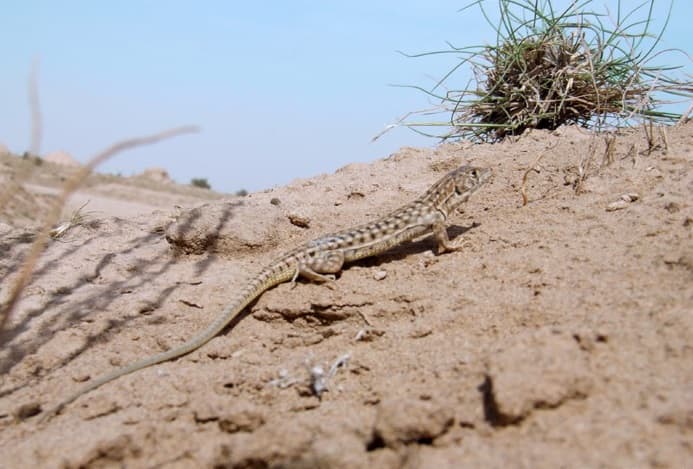
Giant fringe-fingered lizard
The giant fringe-fingered lizard (Acanthodactylus grandis) is a species of lizard belonging to the family Lacertidae, native to Western Asia. This oviparous species is found across several countries in the region, inhabiting arid and semi-arid environments.
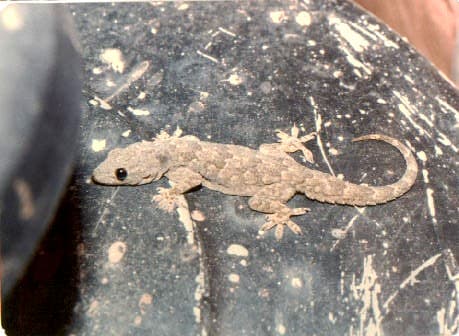
Hemidactylus flaviviridis
Hemidactylus flaviviridis, commonly known as the yellow-belly gecko or northern house gecko, is a widespread gecko species found across parts of Africa, the Middle East, and the Indian subcontinent. These geckos are typically found in human-modified habitats and are known for their adaptability.