
Hemidactylus flaviviridis
Hemidactylus flaviviridis, commonly known as the yellow-belly gecko or northern house gecko, is a widespread gecko species found across parts of Africa, the Middle East, and the Indian subcontinent. These geckos are typically found in human-modified habitats and are known for their adaptability.
Key Facts
- ›Also known as the yellow-belly gecko or northern house gecko.
- ›Native to a broad geographic range including Egypt, Saudi Arabia, India, and parts of Africa.
- ›Found in diverse habitats, often associating with human dwellings.
- ›Scientific classification places it within the family Gekkonidae.
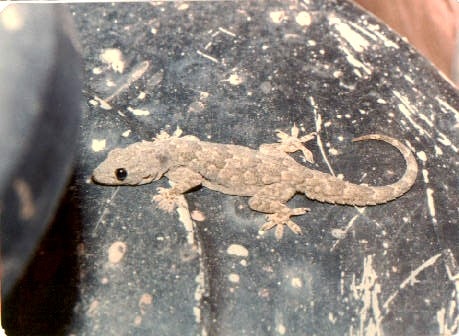
Yellow-Belly Gecko, Northern House Gecko
Egypt, Saudi Arabia, United Arab Emirates, Qatar, Oman, Iraq, Iran, Afghanistan, Bangladesh, Nepal, Pakistan, India, Argentina, Socotra Island, Northern Somalia, Sudan, Ethiopia, Eritrea
About Hemidactylus flaviviridis
Hemidactylus flaviviridis is a species of gecko recognized by its common names, the yellow-belly gecko and the northern house gecko. This species is notable for its extensive geographic distribution, which spans across a significant portion of Africa, the Middle East, and the Indian subcontinent.
Distribution and Habitat
The natural range of Hemidactylus flaviviridis includes countries such as Egypt, Saudi Arabia, the United Arab Emirates, Iran, Afghanistan, Pakistan, and India, extending into parts of Somalia, Sudan, Ethiopia, and Eritrea. It has also been recorded in Argentina. The type locality, the original location from which the species was described, is Massawa Island, Abyssinia. This gecko is highly adaptable and often found in human-modified environments, including houses and buildings, as well as rocky areas and other arid or semi-arid habitats.
Source: Wikipedia ↗
Frequently Asked Questions
What are the common names for Hemidactylus flaviviridis?
Hemidactylus flaviviridis is widely recognized by its common names, the yellow-belly gecko and the northern house gecko. These names often reflect its coloration or its tendency to inhabit human structures.
Where can Hemidactylus flaviviridis be found naturally?
This gecko species has a vast natural distribution. Its range extends across numerous countries including Egypt, Saudi Arabia, Iran, Pakistan, India, and northern Somalia, among others.
What kind of environments does the yellow-belly gecko prefer?
The yellow-belly gecko is adaptable and often found in areas modified by humans, such as houses and buildings. Its habitat can also include rocky areas and other arid or semi-arid environments.
What is the scientific classification of the northern house gecko?
Hemidactylus flaviviridis belongs to the family Gekkonidae, which comprises a diverse group of geckos. Its scientific name, Hemidactylus flaviviridis, follows the standard binomial nomenclature system.
Related Lizards

Ctenophorus fordi
The Mallee dragon (Ctenophorus fordi) is a small lizard native to the arid regions of southern Australia, characterized by its reddish-orange coloration and pale, black-bordered stripes. It inhabits shrubland and hummock grass environments, particularly in Mallee woodlands and spinifex areas, often near vegetated sand dunes. This species is primarily an ant specialist, employing a sit-and-wait strategy to ambush its prey.

Eurylepis taeniolatus
Eurylepis taeniolata, also known as the ribbon-sided skink, is a species found across Central, South, and West Asia. This skink is characterized by its elongated body, slender limbs, and a distinctive color pattern of gray-brown with pale dorsolateral stripes that become more prominent anteriorly, and brown rectangular spots posteriorly. It inhabits a variety of arid and semi-arid environments.
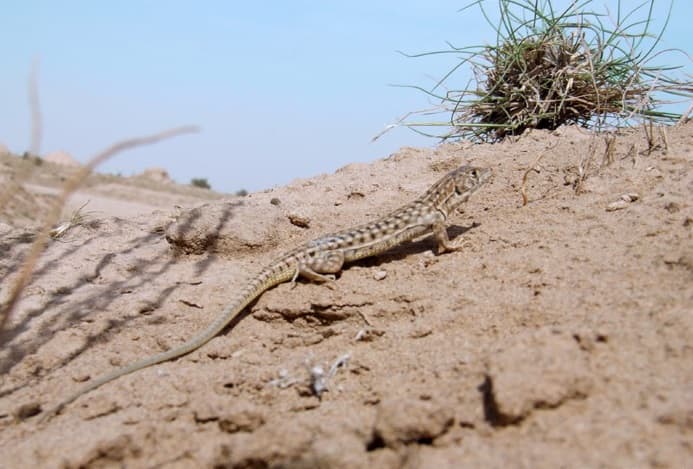
Giant fringe-fingered lizard
The giant fringe-fingered lizard (Acanthodactylus grandis) is a species of lizard belonging to the family Lacertidae, native to Western Asia. This oviparous species is found across several countries in the region, inhabiting arid and semi-arid environments.