
Furcifer rhinoceratus
The rhinoceros chameleon (Furcifer rhinoceratus) is a species of chameleon endemic to the dry forests of Madagascar, distinguished by a prominent horn-like nose, particularly in males. It is a tree-dwelling insectivore, with males defending territories and using their snouts in potential combat. The species is listed as Vulnerable due to habitat loss and degradation.
Key Facts
- ›Males are significantly larger than females, reaching up to 27 cm in length.
- ›Distinctive horn-like projection on the snout is more pronounced in males.
- ›Inhabits dry deciduous forests in western Madagascar.
- ›Feeds on insects, catching them with a rapid flick of its sticky tongue.
- ›Females lay clutches of 4-11 eggs, which hatch after approximately 41 weeks.
- ›Listed as Vulnerable on the IUCN Red List due to threats from logging and cattle grazing.

Rhinoceros Chameleon
Madagascar
- Males Grow Up To 27 cm , About Twice the Size of Females.
- Males Possess A Prominent, Proboscis-Like Snout.
- Females Have A Smaller Snout.
- Small Crest of Triangular, Projecting Scales On Top of the Head.
- Further Crest Runs Part-Way Along the Spine.
- General Coloration Is Grey Or Light Brown With Darker Transverse Bars.
- Snout Is Often Bluish.
- Lips Are Pale.
- A White Line Runs Down Each Side of the Body.
- Females Turn Purple With Black Bands and An Orange Or Red Tail When Carrying Eggs.
Insects
- Usually A Tree-Dweller.
- Catches Insects With A Rapid Flick of Its Sticky Tongue.
- Males Guard Territories.
- Males May Use Their Snouts In Battles With Other Males.
Logging For Cattle Grazing, Charcoal Manufacture, Bush Fires
About Furcifer rhinoceratus
Furcifer rhinoceratus: The Rhinoceros Chameleon
The rhinoceros chameleon, scientifically known as Furcifer rhinoceratus, is a distinctive lizard species endemic to the dry forests of Madagascar. It earns its common name from the prominent, horn-like projection on the snout of the male, which is significantly larger than that of the female. This species is typically arboreal, inhabiting the dry deciduous forests of western Madagascar, with its range historically extending from Ankarafantsika National Park to Soalala.
Description and Biology
Male rhinoceros chameleons can reach an impressive size of up to 27 centimeters (11 inches) in length, roughly twice the size of females. Beyond the characteristic snout, both sexes possess a small crest of triangular scales on their heads and a partial crest along their spine. Their general coloration is a muted grey or light brown, often adorned with darker transverse bars. The snout itself is frequently a bluish hue, complemented by pale lips and a white line running down each flank. When gravid, females undergo a striking color transformation, becoming purple with black bands and a tail that can be orange or red.
As a tree-dweller, the rhinoceros chameleon is an adept hunter, preying on insects. It captures its food with remarkable speed by flicking out its long, sticky tongue. While much about their social interactions and breeding is still undocumented, it is understood that males actively defend their territories. It is speculated that the prominent snout of the male may play a role in combat with rivals. In captivity, females have been observed to lay clutches containing between four and eleven eggs, which require an extended incubation period of approximately forty-one weeks before hatching into miniature versions of the adults.
Conservation Status and Threats
Sadly, the rhinoceros chameleon is classified as 'Vulnerable' on the IUCN Red List of Threatened Species. The primary threats to its survival stem from the destruction and degradation of its specific habitat, the dry deciduous forests. These forests are being extensively logged to make way for cattle grazing and for the production of charcoal. Additionally, bush fires pose a significant risk to the species' population. Although Ankarafantsika National Park offers some protection, rhinoceros chameleons outside of protected areas are more susceptible to these dangers. While the species has always been considered uncommon, there is evidence suggesting a decline in its numbers, and its ability to adapt to altered or degraded environments remains uncertain, though it has been observed near paths and roads, indicating some potential for adaptation.
Source: Wikipedia ↗
Frequently Asked Questions
What is the most distinctive feature of the rhinoceros chameleon?
The most distinguishing feature of the rhinoceros chameleon is its horn-like nose. This proboscis-like snout projects forward above the mouth and is most prominent in males, giving the species its common name.
Where does the rhinoceros chameleon live?
The rhinoceros chameleon is endemic to the dry deciduous forests of western Madagascar. Its known range extends from Ankarafantsika National Park in the northwest to Soalala in the southwest.
What does the rhinoceros chameleon eat?
This species is primarily an insectivore. It catches insects by rapidly flicking out its sticky tongue.
What is the conservation status of the rhinoceros chameleon?
The rhinoceros chameleon is listed as 'Vulnerable' on the IUCN Red List of Threatened Species. Its populations are threatened by habitat destruction and bush fires.
How large do rhinoceros chameleons get?
Male rhinoceros chameleons can grow to about 27 centimeters (11 inches) in total length, making them about twice the size of females. Females have a smaller snout projection compared to males.
What are the breeding habits of the rhinoceros chameleon?
While much is not known about their breeding habits in the wild, in captivity, females lay clutches of four to eleven eggs. These eggs take approximately forty-one weeks to hatch into miniature chameleons.
Related Lizards
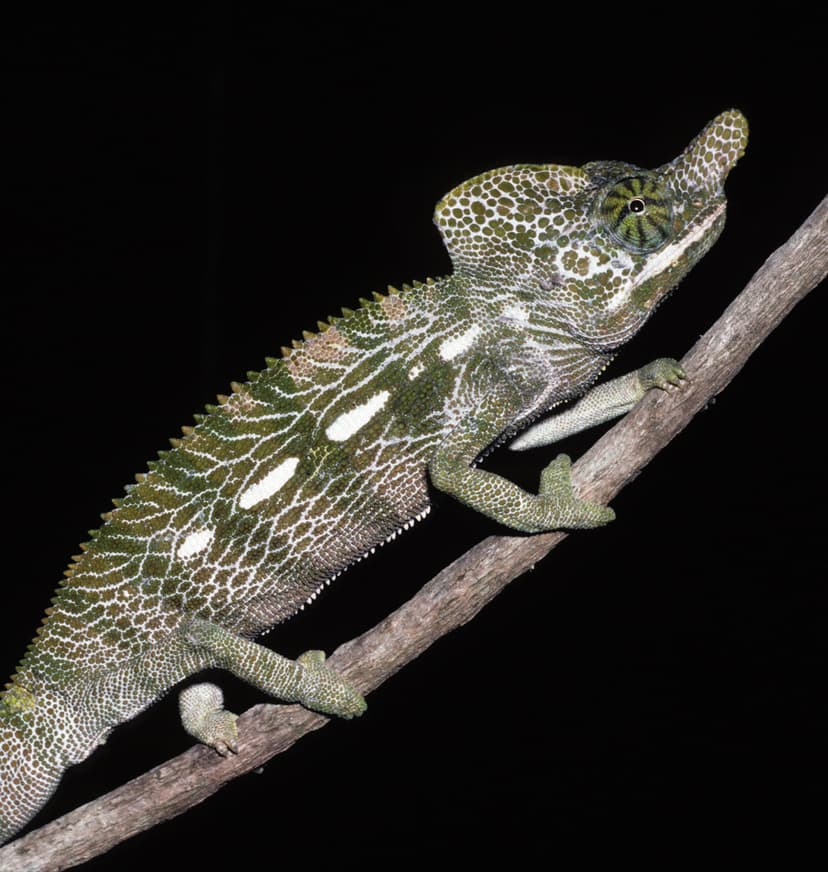
Furcifer labordi
Labord's chameleon (Furcifer labordi) is a chameleon species endemic to the dry and deciduous forests of western Madagascar. This species is notable for its exceptionally short, often one-year life cycle, with adults typically dying after breeding, making it one of the shortest-lived tetrapod vertebrates.

Lygodactylus madagascariensis
The Madagascar dwarf gecko (Lygodactylus madagascariensis) is a small, diurnal gecko species endemic to Madagascar. It inhabits a variety of ecosystems, from rainforests to human-altered gardens, and is characterized by its agile bodies and specialized toe pads for climbing. Conservation efforts are ongoing due to threats like habitat loss and introduced species.
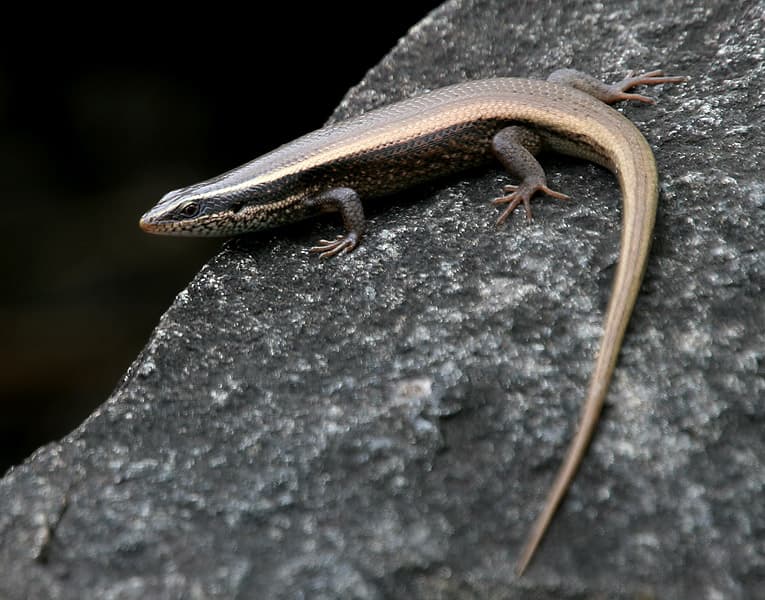
Bronze mabuya
The bronze grass skink, also known as the bronze mabuya or speckled forest skink, is a common but shy, ground-dwelling lizard found across South and Southeast Asia. It inhabits various environments including forests, grasslands, and rocky areas, and is characterized by its cylindrical body, keeled dorsal scales, and distinctive dorso-lateral bands. This skink is an insectivore, active both day and night, and plays a role in its ecosystem by consuming invertebrates.