
Greek algyroides
The Greek algyroides, also known as the Greek keeled lizard, is a small lizard endemic to Greece, found on the Peloponnese Peninsula and several Ionian Islands. It is characterized by large, keeled scales on its back, with males exhibiting more vibrant flank coloration that varies by island population. This species prefers open woods, hedgerows, and farmland margins with partial shade, often hiding among ground cover.
Key Facts
- ›Endemic to Greece, found on the Peloponnese and Ionian Islands.
- ›Possesses large, keeled scales on its back, typical of the Algyroides genus.
- ›Males display distinct flank colors (yellow, blue, or black and white) depending on their island population.
- ›Inhabits open woods, hedgerows, and farmland margins with partial shade.
- ›Females lay a small number of eggs per clutch.
- ›Classified as near Threatened by the IUCN due to habitat loss.

Greek Keeled Lizard
Greece, Peloponnese Peninsula, Ionian Islands
Open Woods, Hedgerows, Farmland Margins, Areas With Shade Or Partial Shade, Damp Areas
- Small Lizard.
- Possesses Large, Keeled Scales On Its Back.
- Males Are More Colorful Than Females.
- Male Flank Coloration Varies By Population: Yellow On Zakynthos, Blue On Kefalonia and Ithaka, Black and White On the Peloponnese Mainland.
Invertebrates
- Basks On Wood Or Tree Trunks In the Late Afternoon.
- Exhibits More Cryptic Behavior In Hotter Summer Months.
- Hides Among Ground Cover Like Brushwood and Leaf Litter.
Habitat Loss
About Greek algyroides
The Greek algyroides, scientifically known as Algyroides moreoticus and commonly referred to as the Greek keeled lizard, is a small reptile endemic to Greece. This species is a member of the Lacertidae family, commonly known as wall lizards.
Distribution and Habitat
The Greek algyroides is found exclusively within Greece, inhabiting the Peloponnese Peninsula and several of the Ionian Islands, including Zakynthos, Kefalonia, Ithaka, and the Strofades. Its preferred habitats are areas offering shade or partial shade, such as open woods, hedgerows, and the margins of farmland. These lizards often seek out damp environments and find shelter among ground cover, including brushwood and leaf litter.
Physical Characteristics and Biology
A defining feature of the Greek algyroides is its possession of large, keeled scales on its back, characteristic of the Algyroides genus. While females are described as inconspicuous and brownish, the males are more colorful. Notably, the flank coloration of males varies significantly between different island populations; those on Zakynthos display yellow flanks, while those on Kefalonia and Ithaka have blue flanks, and males on the mainland Peloponnese exhibit black and white flanks. Behaviorally, Greek algyroides are often observed basking on wood or tree trunks during the late afternoon. During the hotter summer months, they tend to adopt more cryptic behaviors. Reproduction involves females laying a small number of eggs per clutch.
Conservation Status
The Greek algyroides is classified as Near Threatened by the International Union for Conservation of Nature (IUCN). The primary threat contributing to this status is habitat loss, underscoring the importance of conservation efforts for this unique species.
Source: Wikipedia ↗
Frequently Asked Questions
Where is the Greek algyroides found?
The Greek algyroides is exclusively found in Greece. Its distribution includes the Peloponnese Peninsula and the Ionian Islands such as Zakynthos, Kefalonia, Ithaka, and the Strofades.
What are the distinguishing physical features of the Greek algyroides?
This is a small lizard with prominent, large, keeled scales on its back. Males are more colorful than females, with their flank coloration varying geographically, ranging from yellow to blue or black and white.
What kind of habitat does the Greek algyroides prefer?
They are found in areas with shade or partial shade, such as open woods, hedgerows, and the edges of farmland. They tend to favor damp environments and seek refuge among ground cover like brushwood and leaf litter.
What is the conservation status of the Greek algyroides?
The Greek algyroides is currently classified as Near Threatened by the International Union for Conservation of Nature (IUCN). The primary threat to its population is habitat loss.
How does the Greek algyroides behave, especially during different seasons?
They are often seen basking on wood or tree trunks in the late afternoon. During the hotter summer months, their behavior becomes more cryptic, suggesting they are more hidden or less active.
Related Lizards

Chalcides chalcides
The Italian three-toed skink (Chalcides chalcides), also known as the cylindrical skink, is a lizard species characterized by its long, snake-like body, reduced limbs with three-toed feet, and a length of up to 48 cm. It inhabits sunny areas with dense, low vegetation across Italy and North Africa. This diurnal species primarily feeds on insects and gives birth to live young.

European green lizard
The European green lizard is a large lizard found across European mid-latitudes, ranging from Slovenia to the Black Sea coasts. It is typically observed basking on rocks or lawns and seeking shelter in bushes. Males are characterized by a larger head and uniform green coloration with small spots, while females are more slender and often display light bands bordered by black spots.
Peloponnese slowworm
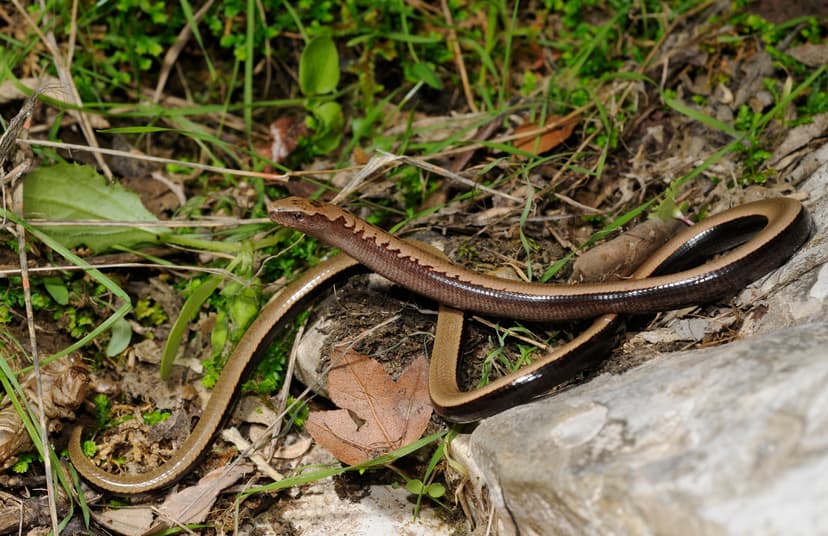
The Peloponnese slow worm (Anguis cephallonica) is a legless lizard endemic to specific regions of Greece, including the Peloponnese peninsula and the Ionian islands of Cephalonia, Ithaca, and Zakynthos. This species is distinguished by a higher number of scale rows around its body and a unique chocolate-brown lateral stripe, and it gives birth to live young.