
Hemidactylus platyurus
Hemidactylus platyurus·Gekkonidae·Not specified in text
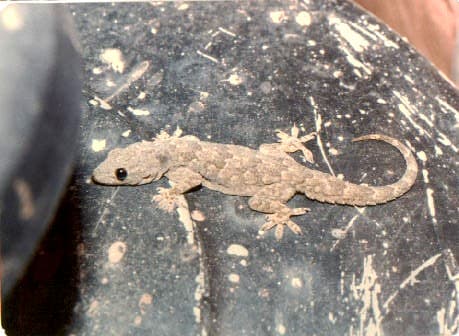
The flat-tailed house gecko (Hemidactylus platyurus) is a species of gecko native to southeastern and southern Asia, also known as the frilled house gecko or Asian house gecko. It is characterized by distinctive skin flaps, or patagia, along its body and limbs, which aid in gliding. This species is commonly found in various terrestrial habitats and is also a frequent inhabitant of human dwellings.
Key Facts
- ›Possesses patagia (skin flaps) on its trunk, tail, and hind limbs used for gliding.
- ›Native to southeastern and southern Asia, with introduced populations in Florida, USA.
- ›Identified by its depressed body, uniform small granules on its back, and a flattened tail with a denticulated edge.
- ›Commonly traded in the pet industry, often misidentified as a generic 'house gecko'.
- ›Males have an uninterrupted series of 34–36 femoral pores.
- ›Can be used as a feeder lizard for certain snake species.

Frilled House Gecko, Asian House Gecko
Bangladesh, India, Nepal, Bhutan, China, Taiwan, Sri Lanka, Thailand, Cambodia, Malaysia, Burma, Vietnam, Indonesia, Philippines, Usa
- Depressed Body
- Patagia On Trunk, Tail, and Femoral Region Used For Gliding
- Snout Longer Than the Distance Between Eye and Ear Opening
- Forehead Concave
- Ear-Opening Small, Oval, Oblique
- Rostral Four-Sided, Not Twice As Broad As High, With Median Cleft Above
- Nostril Bordered By Rostral, First Labial, and Three Nasals
- 9-11 Upper Labials, 7-8 Lower Labials
- Mental Large, Triangular Or Pentagonal
- Two Pairs of Chin-Shields, Median Pair Large and In Contact, Posterior Pair Small and Sometimes Separated From Labials
- Body Covered Above With Uniform Small Granules, Largest On Snout
- Dermal Expansion From Axilla To Groin and Along the Posterior Side of the Hind Limb
- Ventral Scales Cycloid and Imbricate
- Male With 34–36 Femoral Pores
- Tail Depressed, Flat Inferiorly, With Sharp Denticulated Lateral Edge
- Tail Covered Above With Uniform Small Granules, Below With A Median Series of Transversely Dilated Plates
- Limbs Moderate and Depressed
- Digits Strongly Dilated, About Half-Webbed
- 3 To 6 Lamellae Under Inner Digits, 7 To 9 Under Median Digits
- Coloration: Grey Above, Marbled With Darker Grey; Generally A Dark Streak From Eye To Shoulder. Lower Parts White.
- Length of Head and Body: 61 mm
- Tail Length: 66 mm
Insect Prey
Gliding Behavior, Nocturnal Activity, Can Be Difficult To Handle As Pets
About Hemidactylus platyurus
Hemidactylus platyurus: The Flat-Tailed House Gecko
The flat-tailed house gecko, scientifically known as Hemidactylus platyurus, is a common lizard species found throughout southeastern and southern Asia. It is also recognized by common names such as the frilled house gecko or Asian house gecko. This gecko is notable for its unique physical adaptations, including skin flaps, or patagia, along its body and limbs, which it utilizes for gliding. These flaps are an expansion of fat tissue and allow for aerial movement between surfaces.
Physical Characteristics and Identification
Hemidactylus platyurus possesses a depressed body shape, covered dorsally with small, uniform granules. A distinctive feature is the dermal expansion extending from the axilla to the groin, as well as along the posterior side of the hind limb, aiding in its gliding capability. The tail is also depressed, appearing flat on the underside, and features a sharp, denticulated lateral edge. Its ventral scales are cycloid and imbricate. Males can be identified by an uninterrupted series of 34–36 femoral pores. The typical coloration is grey above, often marbled with darker grey, and frequently displays a dark streak running from the eye to the shoulder. The underside is white. Adult specimens typically measure around 61 mm (2.4 inches) in head-and-body length, with the tail adding another 66 mm (2.6 inches).
Distribution and Habitat
The natural range of Hemidactylus platyurus spans a significant portion of Asia, including countries such as India, Nepal, China, Sri Lanka, Thailand, Malaysia, Indonesia, and the Philippines. Over time, this species has also been introduced to other regions, notably Florida in the United States. These geckos are adaptable and can be found in a variety of terrestrial environments, including forests and rocky areas, and are particularly well-known for their tendency to inhabit human dwellings.
In Captivity and Trade
Hemidactylus platyurus is frequently encountered in the pet trade, often identified generically as a 'house gecko.' While they can be maintained in terrariums with adequate misting and insect prey, they are generally not considered easy to handle. In some instances, herpetoculturists use this species as a feeder lizard for certain types of snakes, such as Asian green vine snakes.
Source: Wikipedia ↗
Frequently Asked Questions
What are the distinctive physical features of the flat-tailed house gecko?
The flat-tailed house gecko, or Hemidactylus platyurus, is recognized by its depressed body shape and the presence of skin flaps (patagia) along its sides and limbs. These flaps are derived from expanded fat and assist the gecko in gliding. It also has a flattened tail with a denticulated edge.
Where is the flat-tailed house gecko naturally found?
This species is native to a wide range across southeastern and southern Asia. Its natural distribution includes countries such as India, Nepal, China, Sri Lanka, Thailand, Malaysia, Indonesia, and the Philippines.
Is the Hemidactylus platyurus a common pet?
Yes, Hemidactylus platyurus is frequently encountered in the pet trade, often simply labeled as 'house gecko'. Their unique skin flaps distinguish them from other geckos sold under similar common names.
What is the habitat of the flat-tailed house gecko?
The flat-tailed house gecko inhabits various terrestrial environments across its native range. It is also commonly found in and around human habitations, making it a frequent resident of buildings.
Are there any unique adaptations for gliding in this species?
Indeed, Hemidactylus platyurus exhibits specialized adaptations for gliding. These include patagia, which are extensions of skin supported by fat, located on its trunk, tail, and femoral regions. These structures are crucial for its aerial locomotion.
How can one identify a flat-tailed house gecko?
Key identification features include its depressed body, small granular scales on the back, and a flattened tail that is distinctly flat on the underside with a sharp, denticulated lateral edge. Males possess a series of 34–36 femoral pores.
Related Lizards

Tytler's mabuya
Tytler's mabuya (Eutropis tytleri) is a large skink species endemic to the Andaman Islands in India. It is characterized by its bronzish-brown dorsal coloration and light yellow underside, with a long tail. This adaptable species thrives in various habitats, including forests and human-modified areas, and is known to climb trees.

Gehyra mutilata
Gehyra mutilata, also known as the common four-clawed gecko, is a small, adaptable lizard native to Southeast Asia with a wide distribution across various islands and continents. It is characterized by its delicate, purplish-gray skin that may have golden spots in younger individuals, and a distinctive lack of a claw on its innermost digit. This unobtrusive gecko is often found in human dwellings, woodlands, and rocky areas, where it helps control insect populations.
Hemidactylus flaviviridis
Hemidactylus flaviviridis, commonly known as the yellow-belly gecko or northern house gecko, is a widespread gecko species found across parts of Africa, the Middle East, and the Indian subcontinent. These geckos are typically found in human-modified habitats and are known for their adaptability.