
Podarcis siculus
The Italian wall lizard, or Podarcis siculus, is a common lizard species native to southern and southeastern Europe, known for its adaptability to various environments, from natural habitats to human-modified landscapes. It exhibits significant subspecies variation, often displaying a green or brown back with a white or green belly, and males can be distinguished by larger heads and stronger jaws. This species is oviparous, laying multiple clutches of eggs annually, and its generalized diet contributes to its widespread distribution and success.
Key Facts
- ›Native to southern and southeastern Europe, with introduced populations in North America.
- ›Known for having numerous subspecies, showcasing rapid evolution and adaptation.
- ›Generally has a green or brown back and a white or green belly; males have larger heads.
- ›Oviparous, with females laying 3-4 clutches of eggs per year.
- ›A habitat generalist, thriving in diverse environments including forests, grasslands, and urban areas.
- ›Has a generalized diet of invertebrates, small vertebrates, and a notable amount of plant matter.

Italian Wall Lizard, Ruin Lizard
Italy, Bosnia and Herzegovina, Croatia, France, Montenegro, Serbia, Slovenia, Switzerland, Spain, Turkey, United States, Canada
- Snout-Vent Length Averages 150–250 mm .
- Generally Has A Green Or Brown Back and A White Or Green Belly.
- Coloration and Size Vary Significantly Among Subspecies.
- Some Subspecies Are Melanic, With Hints of Blue On the Back and Belly, Particularly Found In Island Populations.
- Males Have Larger Heads and Stronger Jaws Than Females Due To Sexual Dimorphism.
- Invertebrates
- Small Vertebrates
- Plant Matter
- Mechanically Resistant Foods
- Occasional Cannibalism Reported
- Observed Consuming Dead Small Mammals and Geckos
- Habitat Generalist, Thrives In Diverse Environments.
- Exhibit Rapid Adaptation To New Environments and Ecological Pressures.
- Engage In Social Learning.
- Can Learn To Perform Various Tasks, Including Removing Colored Caps From Food Pods.
- Display Aggression, Particularly Males, Potentially Contributing To High Rates of Missing Toes In Some Populations.
- Modify Anti-Predator Behaviors Based On Predator Scent Cues.
- Gravid Females Exhibit Altered Anti-Predator and Basking Behaviors Compared To Non-Gravid Females.
- Tail-Waving Behavior Observed As A Potential Anti-Predator Mechanism.
- Use Light Polarization For Orientation.
Snakes, Birds, Feral Cats
Competition With Native Species
About Podarcis siculus
Italian Wall Lizard (Podarcis siculus)
The Italian wall lizard, scientifically known as Podarcis siculus, is a highly adaptable reptile native to southern and southeastern Europe, with a significant presence in Italy. Its resilience and ability to thrive in a wide array of environments, from natural landscapes like forests and grasslands to human-altered settings such as rocky areas, farmland, and even urban structures, have contributed to its widespread distribution. The species is also notable for its extensive range of subspecies, showcasing remarkable evolutionary plasticity and rapid adaptation to local conditions.
Physical Characteristics and Variation
Podarcis siculus generally displays a green or brown dorsal coloration with a lighter, often white or green, belly. However, significant variation exists across its numerous subspecies. Some island populations, for instance, exhibit melanic traits with hints of blue. A key physical distinction is sexual dimorphism: males typically possess larger heads and stronger jaws than females, a trait hypothesized to be linked to prey consumption needs and intraspecific aggression.
Diet and Reproduction
This lizard is an opportunistic omnivore with a generalized diet. It primarily feeds on invertebrates, such as arthropods, but also consumes small vertebrates and a notable proportion of plant matter, more so than many related lizards. Males tend to have a more varied diet than females. Podarcis siculus reproduces oviparously, with females laying multiple clutches of eggs annually, typically numbering between 4 to 7 eggs per clutch. Their reproductive season generally spans from May to July.
Behavior and Adaptation
The Italian wall lizard is known for its behavioral adaptability. Studies have demonstrated its capacity for learning, including social learning, and its ability to adapt its anti-predator responses based on olfactory cues. The species exhibits a high degree of intraspecific competition, evidenced by high rates of missing toes in some populations, particularly among males. Furthermore, Podarcis siculus has been a subject of study for rapid evolutionary changes, with populations isolated on islands demonstrating significant shifts in morphology, behavior, and diet in response to environmental pressures, such as relaxed predation and altered food availability.
Source: Wikipedia ↗
Frequently Asked Questions
What is the scientific name for the Italian wall lizard?
The scientific name for the Italian wall lizard is Podarcis siculus. The genus name 'Podarcis' comes from Greek words meaning 'foot' and 'agile', reflecting its quick movements.
Where is the Italian wall lizard found?
Podarcis siculus is native to Italy and other parts of southern and southeastern Europe, including Bosnia and Herzegovina, Croatia, France, Montenegro, Serbia, Slovenia, and Switzerland. It has also been introduced to countries like Spain, Turkey, the United States, and Canada.
What does the Italian wall lizard eat?
The Italian wall lizard has a generalized diet, primarily consisting of invertebrates like arthropods. It also preys on small vertebrates and consumes a greater percentage of plant matter than many related lizards. Males tend to have a more diverse diet than females.
How does the Italian wall lizard reproduce?
Podarcis siculus is oviparous, meaning females lay eggs. They can lay 3 to 4 clutches per year, with each clutch typically containing 4-7 eggs. The number of eggs can vary by population.
Are there different types of Italian wall lizards?
Yes, Podarcis siculus is notable for having a large number of subspecies, with dozens described. These subspecies can show distinct morphological and behavioral differences, often due to geographic isolation and rapid adaptation to specific environments.
What are the main physical characteristics of Podarcis siculus?
Generally, Podarcis siculus has a green or brown back and a white or green belly, though coloration can vary significantly among subspecies. Some island populations exhibit melanic coloration with hints of blue. Males are distinguished by larger heads and stronger jaws compared to females.
What kind of habitats does the Italian wall lizard prefer?
The Italian wall lizard is a habitat generalist and can thrive in a wide range of environments, including forests, grasslands, shrublands, rocky areas, farmland, and even human-modified landscapes. Its ability to tolerate high temperatures contributes to its success in open habitats.
Related Lizards

Italian wall lizard
The Italian wall lizard (Podarcis siculus), also known as the ruin lizard, is a common and adaptable lizard native to southern and southeastern Europe. It is characterized by a green or brown back and a white or green belly, with variations across its numerous subspecies. This species is a habitat and dietary generalist, capable of thriving in diverse environments and consuming a wide range of invertebrates and plant matter, contributing to its extensive geographic distribution.

Trioceros cristatus
The crested chameleon (Trioceros cristatus) is a species native to Central African forests and semi-open wooded areas. Females are typically larger than males, reaching up to 28 cm in total length. This species is currently classified as Least Concern by the IUCN due to its widespread distribution and ability to tolerate disturbed habitats.
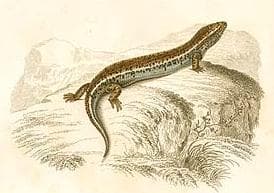
Chalcides ocellatus
The ocellated skink, scientifically known as Chalcides ocellatus, is a agile lizard species found across the Mediterranean and parts of Asia. Adults typically reach 15 to 30 cm in length and are characterized by their cylindrical bodies, small heads, and distinctive ocelli (eye-like spots) which contribute to a wide variety of coloration patterns. Primarily insectivorous, they inhabit diverse environments from farmland to gravel deserts and are known for their 'sand-swimming' ability, though their limbs are not highly adapted for burrowing.