
Large scaled forest lizard (Calotes grandisquamis)
The large-scaled forest lizard (Calotes grandisquamis) is an arboreal, diurnal, and insectivorous agamid lizard native to the evergreen rainforests of India's Western Ghats. It is found in areas ranging from Agumbe to the Agasthyamalai Hills and is distinguished by its scale patterns and forest-dwelling habits.
Key Facts
- ›Found in the evergreen rainforests of India's Western Ghats.
- ›Arboreal, meaning it primarily lives in trees.
- ›Diurnal, active during daylight hours.
- ›Insectivorous, feeding on insects.
- ›Distributed from Agumbe to the Agasthyamalai Hills.

Large Scaled Forest Lizard
India
Evergreen Rainforest
Characterized By Large Scales., Arboreal In Nature.
Insects
Diurnal, Arboreal
About Large scaled forest lizard (Calotes grandisquamis)
The large-scaled forest lizard, scientifically known as Calotes grandisquamis, is a species of agamid lizard found in the dense evergreen rainforests of India's Western Ghats. This lizard is characterized by its arboreal lifestyle, meaning it predominantly lives in trees, and is diurnal, actively foraging and moving during daylight hours.
Habitat and Distribution
The natural habitat of Calotes grandisquamis is restricted to the evergreen rainforests of the Western Ghats, a mountain range on the western coast of the Indian subcontinent. Its distribution spans from the Agumbe region in the north to the Agasthyamalai Hills in the south, indicating a preference for moist, forested environments.
Diet and Behavior
As an insectivorous species, the large-scaled forest lizard's diet consists mainly of insects. Its arboreal nature suggests adaptations for climbing and navigating through tree branches and foliage. Being diurnal, it is most active during the day, likely engaging in activities such as basking, hunting, and territorial interactions within its forested environment.
Taxonomy
The species belongs to the family Agamidae, a diverse group of lizards commonly known as draconic lizards or garden lizards. The specific epithet grandisquamis refers to its notably large scales, a distinguishing physical characteristic.
Source: Wikipedia ↗
Frequently Asked Questions
What is the scientific name of the large-scaled forest lizard?
The scientific name of the large-scaled forest lizard is *Calotes grandisquamis*.
Where is the large-scaled forest lizard found?
This lizard is found in the evergreen rainforests of the Western Ghats of India, with its distribution extending from Agumbe to the Agasthyamalai Hills.
What does the large-scaled forest lizard eat?
The large-scaled forest lizard is insectivorous, meaning its diet consists primarily of insects.
Is the large-scaled forest lizard a tree-dwelling species?
Yes, the large-scaled forest lizard is arboreal, indicating that it lives in trees and is adapted to an arboreal lifestyle.
When is the large-scaled forest lizard most active?
The large-scaled forest lizard is diurnal, which means it is active during the daytime.
Related Lizards

Indian chameleon
The Indian chameleon (Chamaeleo zeylanicus) is a slow-moving, arboreal lizard native to South Asia, including India, Sri Lanka, and Pakistan. It is characterized by its long, sticky tongue for catching prey, independently moving eyes, and the remarkable ability to change skin color, primarily for communication and thermoregulation rather than camouflage. Its unique physical features include a bony casque on its head, bifurcated feet, and a prehensile tail.
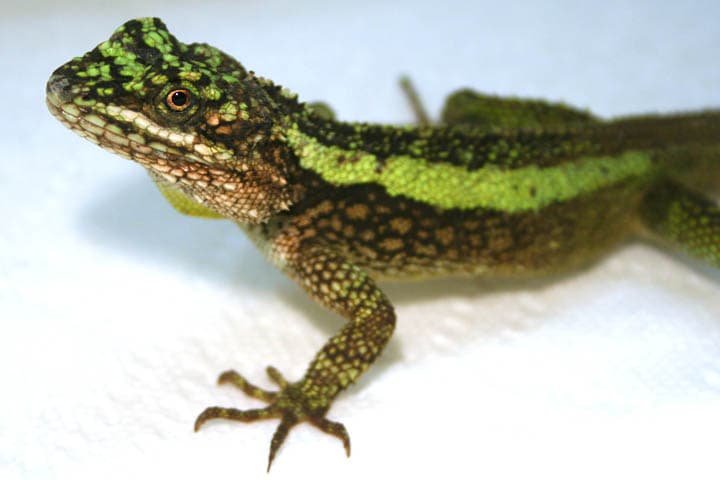
Japalura tree dragon
The Japalura tree dragon (Diploderma splendidum) is an agamid lizard native to the Yangtze River Basin of southwestern China, known for its green striped appearance and its popularity as an international pet. This species inhabits temperate, humid lowland jungles and has a diet that is primarily insectivorous, though it may occasionally consume plant matter. Its distinctive physical characteristics include rugose scales, a nuchal crest, and a coloration often featuring yellow spots and streaks on a dark brown head and body.

Smallwood's anole
Smallwood's anole, also known as the green-blotched giant anole, is a lizard species native to Cuba. It primarily inhabits dry forest and coastal scrub areas, where it can be found perching on tree trunks and branches. This anole is characterized by its insectivorous diet and a snout-to-vent length typically measuring between 3 to 4 inches.