
Paralaudakia stoliczkana
Paralaudakia stoliczkana, commonly known as the Mongolia rock agama, is a species of lizard native to parts of China, Mongolia, and Kyrgyzstan. It inhabits shrublands, forests, and deserts and is characterized by its oviparous reproduction. The species is currently classified as least concern by the IUCN.
Key Facts
- ›Native to western China, Mongolia, and Kyrgyzstan.
- ›Inhabits shrubland, forest, and desert environments.
- ›Reproduces by laying eggs (oviparous).
- ›Population is considered stable.
- ›Classified as 'Least Concern' by the IUCN Red List.
- ›Threatened by mining, trapping, and hunting.

Mongolia Rock Agama
China, Mongolia, Kyrgyzstan
Mining, Trapping, Hunting
About Paralaudakia stoliczkana
Paralaudakia stoliczkana, more commonly recognized as the Mongolia rock agama, is a species of lizard belonging to the Agamidae family. This species is indigenous to several regions in Central Asia, specifically found in the Xinjiang and Gansu provinces of China, the western territories of Mongolia, and parts of Kyrgyzstan. Its natural habitat encompasses a variety of environments, including shrublands, forests, and desert areas, indicating a degree of adaptability to different ecological conditions.
Taxonomy and Etymology
The specific name, stoliczkana, honors the Moravian zoologist Ferdinand Stoliczka, acknowledging his contributions to the field of herpetology. The species is recognized as having two distinct subspecies: Paralaudakia stoliczkana altaica and Paralaudakia stoliczkana stoliczkana. Historically, it has been described under different genera, including Stellio and Agama, before its current classification within the Paralaudakia genus.
Reproduction and Conservation
Paralaudakia stoliczkana reproduces by laying eggs, classifying it as oviparous. While the exact population numbers are not precisely known, the species is considered to have a stable population. It benefits from its occurrence within at least one protected area, which aids in its conservation. The International Union for Conservation of Nature (IUCN) Red List currently assesses the species as 'Least Concern,' suggesting it is not facing an imminent threat of extinction. However, the species is subject to threats from mining activities, as well as trapping and hunting, which are utilized for both medicinal purposes and as a food source both locally and internationally.
Source: Wikipedia ↗
Frequently Asked Questions
What is the scientific name for the Mongolia rock agama?
The scientific name for the Mongolia rock agama is Paralaudakia stoliczkana. It was originally described under the genus Stellio and later reclassified.
Where can Paralaudakia stoliczkana be found?
Paralaudakia stoliczkana is naturally found in the Xinjiang and Gansu provinces of China, the western regions of Mongolia, and Kyrgyzstan. It has also been observed in protected areas.
What kind of habitats does Paralaudakia stoliczkana prefer?
This lizard species prefers natural habitats that include shrubland, forest, and desert environments. It is adapted to a variety of arid and semi-arid landscapes.
How does Paralaudakia stoliczkana reproduce?
Paralaudakia stoliczkana is oviparous, meaning it reproduces by laying eggs. The specifics of their nesting or egg-laying behavior are not detailed, but egg-laying is their primary reproductive method.
What is the conservation status of Paralaudakia stoliczkana?
The International Union for Conservation of Nature (IUCN) Red List classifies Paralaudakia stoliczkana as 'Least Concern.' This indicates that the species is not currently facing an immediate threat of extinction.
What are the main threats to Paralaudakia stoliczkana?
The primary threats to Paralaudakia stoliczkana include mining activities, trapping, and hunting. These human-related pressures can impact local populations.
Is Paralaudakia stoliczkana used by humans?
Yes, Paralaudakia stoliczkana is utilized both locally and internationally for medicinal purposes and as a food source. This usage contributes to some of the threats it faces.
Related Lizards

Anolis leachii
Anolis leachii, also known as the Antigua Bank tree anole or Leach's anole, is a lizard species endemic to the Caribbean, specifically Antigua and Barbuda. This arboreal species is characterized by its bright green coloration that fades to greyish-brown on its tail, and a grey to brown head with yellowish-orange dewlaps. It inhabits various environments, from forests and shrublands to human-disturbed areas like pastures and farms, provided vertical perching surfaces are available.
Boettger's lizard
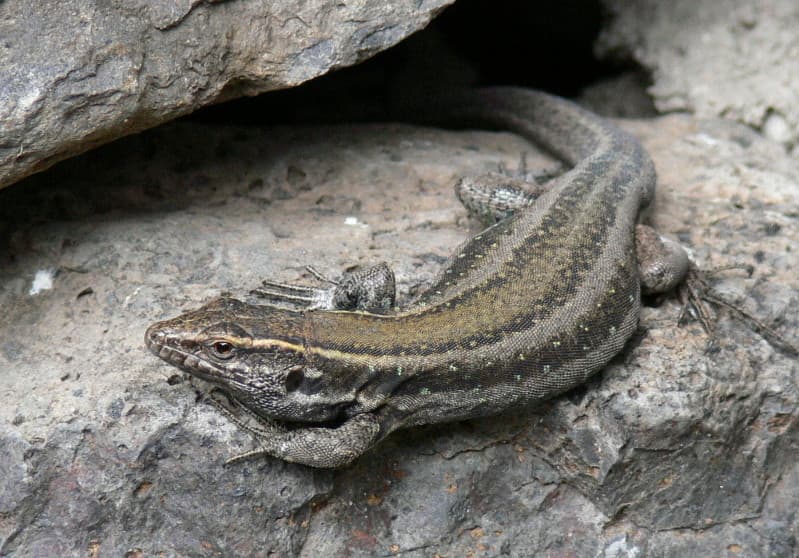
Boettger's lizard (Gallotia caesaris) is a species of wall lizard endemic to the western Canary Islands, specifically El Hierro and La Gomera. This oviparous reptile inhabits rocky areas, shrubland, and forests, and is known for its capacity to lay multiple clutches of eggs per year. It is closely related to the Gallotia galloti species found on neighboring islands.

Florida worm lizard
The Florida worm lizard, also known as the graveyard snake or thunderworm, is a unique amphisbaenian species found primarily in Florida. It is characterized by its limbless, worm-like body, reduced eyes, and a shovel-shaped snout adapted for burrowing. This species inhabits forest and shrubland environments, spending most of its life underground and emerging only during heavy rains.