
Paroedura lohatsara
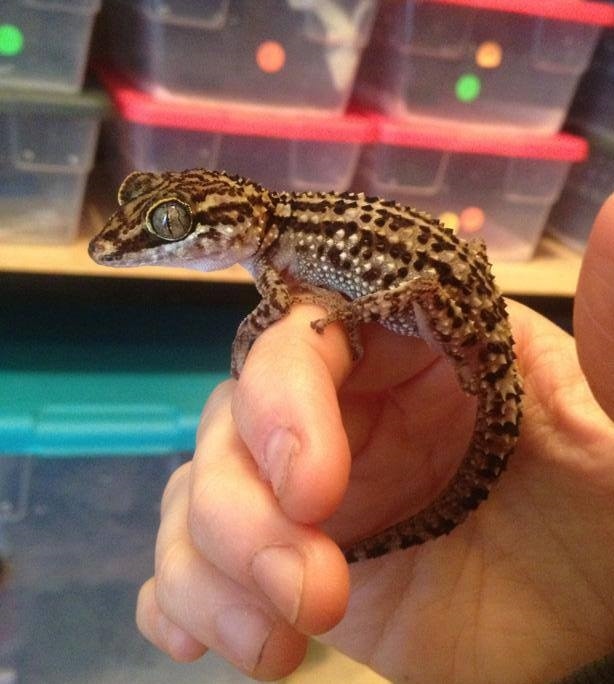
Paroedura lohatsara is a critically endangered gecko species native to a single mountain range in northern Madagascar. These small to medium-sized geckos are characterized by their brown coloration with black speckling, which can form longitudinal bands in adults, and a distinct banded pattern in juveniles. Primarily ground-dwelling but also found on boulders and low tree branches, they are nocturnal and face significant threats from habitat destruction.
Key Facts
- ›Native to northern Madagascar, found on a single mountain range.
- ›Adults reach an approximate length of 5-6 inches (12.7-15.2 cm).
- ›Coloration shifts from banded juveniles to speckled adults.
- ›Primarily nocturnal and terrestrial, but also climbs low branches and boulders.
- ›Listed as critically endangered on the IUCN Red List.
- ›Females lay eggs in clutches of two, with incubation lasting 90-100 days.
Madagascar
Forest, Boulder Habitats, Low Tree Branches
- Small To Medium-Sized Geckos.
- Adults Are Brown With Black Speckling, Sometimes Forming Longitudinal Bands.
- Juveniles Have Wide Transverse Bands of Black and White, and An Orangey Tail.
- Adult Length Is Approximately 5-6 Inches .
- Toe Pads Allow For Adhesion and Climbing.
Insects, Other Small Invertebrates
- Mainly Nocturnal, Active At Night.
- Primarily Terrestrial, Found On the Ground, Boulders, and Low Branches.
- Shy Temperament.
- Sexual Maturity Reached Around One Year of Age.
Habitat Destruction, Deforestation, Logging, Human Encroachment
About Paroedura lohatsara
Paroedura lohatsara is a species of gecko native to northern Madagascar, specifically found on a single mountain range. These geckos are notable for their size, reaching up to approximately 6 cm (2.4 inches) in body length, and their distinctive coloration that changes with age. While juveniles display prominent black and white transverse bands and an orangey tail, adults develop a brown base color with black speckling that can sometimes form longitudinal bands.
Habitat and Behavior
These geckos are primarily terrestrial, inhabiting the ground, boulders, and the lowest branches of trees. They are considered nocturnal, with both juveniles and adults being active at night. Their physical adaptations, including toe pads, allow them to adhere to surfaces and climb, though their preference shifts towards foliage as they mature and gain weight.
Conservation Concerns
Paroedura lohatsara faces significant threats due to its restricted geographic range and the ongoing destruction of its forest habitat. It is listed as critically endangered on the IUCN Red List, primarily because of deforestation driven by logging and human encroachment. While not currently protected under CITES, efforts are underway in captivity in the United States to maintain a genetic resource for the species, potentially aiding in conservation efforts against extinction.
Reproduction
Sexual maturity is typically reached around one year of age. Females lay eggs in clutches of two. In captive environments, successful hatching of these eggs occurs between 90 and 100 days when maintained at specific temperature and humidity levels, typically around 80°F (27°C) and 80% humidity.
Source: Wikipedia ↗
Frequently Asked Questions
What is the average size of Paroedura lohatsara?
Adult Paroedura lohatsara generally reach an approximate length of five to six inches (12.7 to 15.2 cm). Juvenile coloration is quite different from adults, featuring black and white bands down their bodies.
What is the habitat of Paroedura lohatsara?
This species is native to northern Madagascar and has been observed in old-growth forests within Montagne des Français. They are found on the ground, on boulders, and in the lowest branches of trees.
What is the conservation status of Paroedura lohatsara?
Paroedura lohatsara is listed as critically endangered on the IUCN Red List. This is due to its limited range and the ongoing destruction of its forest habitat, primarily from deforestation.
How do Paroedura lohatsara reproduce?
Females lay eggs in clutches of two. Sexual maturity is reached at approximately one year of age. In captivity, eggs hatch between 90 and 100 days when kept at 80°F (27°C) and 80% humidity.
What are the distinctive physical features of Paroedura lohatsara?
Juveniles have brownish heads with black and white bands and an orangey tail. As they mature, they develop a lighter base color with black spotting, which may retain a semblance of striping or form longitudinal bands.
Is Paroedura lohatsara protected by international law?
Currently, Paroedura lohatsara is not protected under CITES. However, it is listed as critically endangered by the IUCN due to significant threats to its natural habitat.
Related Lizards

Satara gecko
The Satara gecko is a species of gecko endemic to the Western Ghats of India, specifically described from Chalkewadi in Maharashtra. It inhabits lateritic rock outcrops, often found under boulders in areas with significant windmill and tourism activity. A distinctive characteristic of the Satara gecko is its 'S'-shaped body posture.

Harran fringe-toed lizard
The Harran fringe-toed lizard (Acanthodactylus harranensis) is a critically endangered lizard species endemic to southeastern Anatolia, specifically known from the ancient ruins of Harran, Turkey. It is characterized by its relatively large, stout body, a tail longer than its body, and distinctive dorsal stripes or spots. This species inhabits rocky areas with sparse steppe vegetation and is threatened by increasing tourism and habitat degradation.

Varanus mitchelli
Mitchell's water monitor (Varanus mitchelli) is a semiaquatic monitor lizard native to northern Australia, distinguished by orange or yellow neck stripes and dark spots on its back. It inhabits swamps, lagoons, and rivers, often found near water and in trees. This critically endangered species primarily feeds on small terrestrial and aquatic prey.