
Podarcis raffonei
The Aeolian wall lizard (Podarcis raffonei) is an endangered lizard species endemic to Italy, found exclusively in the Aeolian Islands. It inhabits Mediterranean-type shrubland and rocky shores, facing significant threats from competition with the invasive Italian wall lizard, which has reduced its distribution and potentially led to hybridization.
Key Facts
- ›Endemic to the Aeolian Islands in Italy.
- ›Classified as endangered by the IUCN due to small populations and limited habitat.
- ›Natural habitats include Mediterranean shrubland and rocky shores.
- ›Faces severe competition and hybridization with the invasive Italian wall lizard (Podarcis siculus).
- ›The largest population is found on the Capo Grosso peninsula of Vulcano island.
- ›Overall population is estimated between 2,000 – 2,500 mature individuals.

Aeolian Wall Lizard, Raffone's Wall Lizard
Italy
- Dorsal Color Patterns Are Typically Brown, But Can Shift Seasonally To Green, Even In Pure Individuals.
- Hybrids Or Introgressed Forms With Podarcis Siculus Show Altered Dorsal Color Patterns.
- Can Undergo Seasonal Color Changes, Shifting From Brown To Green.
- Competition With Invasive Italian Wall Lizard
- Hybridization With Invasive Italian Wall Lizard
- Vulnerability To Random Events and Demographic Fluctuations Due To Small Populations
About Podarcis raffonei
The Aeolian Wall Lizard (Podarcis raffonei)
The Aeolian wall lizard, scientifically known as Podarcis raffonei and sometimes called Raffone's wall lizard, is a distinct species of lizard native to Italy, specifically found within the Aeolian Islands. This species belongs to the family Lacertidae, commonly known as wall lizards.
Habitat and Distribution
The natural habitats of P. raffonei are confined to Mediterranean-type shrubby vegetation and rocky shores. Its geographic range is extremely limited, with populations found only on four specific locations within the Aeolian Islands: Strombolicchio, a small islet off Salina, another off Filicudi, and various areas on Vulcano. This restricted distribution makes the species particularly vulnerable.
Conservation Concerns
Podarcis raffonei is currently assessed as endangered by the IUCN. The total population is estimated to be between 2,000 and 2,500 mature individuals, occupying a surface area of less than 5,525 square meters. A significant threat to its survival is the presence of the invasive Italian wall lizard (Podarcis siculus). This competing species not only occupies the same rocky and shrubby habitats but also interbreeds with P. raffonei, leading to hybridization and a reduction in the pure species' distribution. Field observations have indicated a rapid increase in hybrid or introgressed forms, complicating conservation efforts. The species' extremely small and fragmented populations are highly susceptible to random events and population fluctuations.
Etymology
The specific name, raffonei, honors Dr. Antonia Raffone, the wife of Antonino Trischitta, who collected the holotype specimen of the lizard.
Source: Wikipedia ↗
Frequently Asked Questions
Where is the Aeolian wall lizard found?
The Aeolian wall lizard is found in four specific locations within the Aeolian Islands of Italy. These include the islet of Strombolicchio, a small islet off Salina, another off Filicudi, and parts of Vulcano island.
What is the conservation status of Podarcis raffonei?
Podarcis raffonei is assessed as endangered by the IUCN. This status is due to its very limited habitat and small, fragmented populations, making them highly vulnerable.
What are the main threats to the Aeolian wall lizard?
The primary threat to the Aeolian wall lizard is competition and interbreeding with the non-native Italian wall lizard (Podarcis siculus). This invasive species competes for the same habitats and has significantly reduced the distribution of P. raffonei.
What is the habitat of the Aeolian wall lizard?
The natural habitats for Podarcis raffonei are characterized by Mediterranean-type shrubby vegetation and rocky shores. These are the specific environments where the species can be found in the Aeolian Islands.
How large are the populations of Podarcis raffonei?
The total population of mature individuals for Podarcis raffonei is estimated to be between 2,000 and 2,500. These lizards are found in very small and fragmented populations, with the largest concentration on the Capo Grosso peninsula of Vulcano.
What is the specific name 'raffonei' in honor of?
The specific name, raffonei, is in honor of Dr. Antonia Raffone. She is the wife of Antonino Trischitta, who collected the holotype specimen of the species.
Related Lizards

Anatololacerta oertzeni
Anatololacerta oertzeni, commonly known as the rock lizard, is a species of lizard found in Greece and Turkey. It inhabits a variety of Mediterranean-type environments, including shrubland, rocky areas, and pastures.
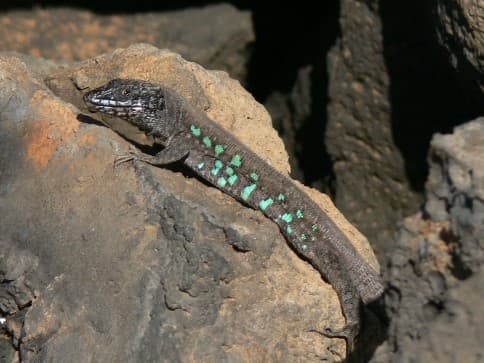
Atlantic lizard
The Atlantic lizard (Gallotia atlantica) is a species of lizard belonging to the family Lacertidae. It is native to the eastern Canary Islands, specifically Lanzarote and Fuerteventura, and their associated smaller islands. Its natural habitats are diverse, ranging from temperate forests and shrublands to rocky shores and sandy areas, as well as agricultural and garden environments.

Maltese wall lizard
The Maltese wall lizard (Podarcis filfolensis) is a species of lizard found in Malta and the Pelagian Islands of Italy. It inhabits Mediterranean-type shrubland, rocky areas, shores, arable land, pasture, and rural gardens. Distinguishing features vary by subspecies, with males generally exhibiting brighter colors than females and juveniles.