
Ptychozoon lionotum
Ptychozoon lionotum, also known as the smooth-backed gliding gecko or Burmese flying gecko, is a species of gecko native to Southeast Asia. Characterized by its ability to glide, this gecko inhabits forests and is found across several countries in the region. Its specific features and behaviors are adapted for arboreal life and gliding locomotion.
Key Facts
- ›Native to Southeast Asia, including Myanmar, Thailand, Malaysia, India, and Bangladesh.
- ›Possesses gliding membranes along its body to aid in arboreal locomotion.
- ›Found in forested environments, indicating an arboreal lifestyle.
- ›The species is characterized by its smooth back, distinguishing it from some related gliding geckos.
- ›Type locality for the species is Pegu, Myanmar.

Smooth-Backed Gliding Gecko, Burmese Flying Gecko
Myanmar, Thailand, Malaysia, India, Bangladesh
Possesses Gliding Membranes Along Its Body., Characterized By A Smooth Back.
Capable of Gliding Between Trees.
About Ptychozoon lionotum
Ptychozoon lionotum: The Smooth-Backed Gliding Gecko
Ptychozoon lionotum, commonly referred to as the smooth-backed gliding gecko or the Burmese flying gecko, is a species of gecko recognized for its arboreal adaptations and gliding capabilities. This lizard is native to the diverse ecosystems of Southeast Asia, with documented populations found in countries such as Myanmar, Thailand, Malaysia, India, and Bangladesh.
Habitat and Distribution
The natural range of Ptychozoon lionotum encompasses a significant portion of Southeast Asia. It has been recorded in southern Myanmar, across various provinces in Thailand including Ramri and Phang Nga, as well as in Western Malaysia. The species' presence extends to parts of India and Bangladesh, with its type locality specifically identified as Pegu in Myanmar. Ptychozoon lionotum primarily inhabits forested environments, where its specialized features are most advantageous for survival.
Physical Characteristics and Adaptations
A defining characteristic of Ptychozoon lionotum is its smooth back, which differentiates it from some of its related gliding gecko species. More notably, the species possesses specialized skin flaps and membranes along its body. These anatomical features are crucial for its ability to glide, allowing it to navigate through the forest canopy by leaping from trees and controlling its descent to reach other branches or the ground.
Behavior and Lifestyle
As an arboreal species, Ptychozoon lionotum spends most of its life in trees. Its gliding ability is a key behavioral trait that aids in locomotion, escape from predators, and potentially in hunting. While specific details regarding its diet, reproduction, and lifespan are not extensively detailed, its adaptations point towards a life spent high above the forest floor.
Source: Wikipedia ↗
Frequently Asked Questions
Where can Ptychozoon lionotum be found?
Ptychozoon lionotum is distributed across Southeast Asia. Its known range includes southern Myanmar, various provinces in Thailand, Western Malaysia, and parts of India and Bangladesh.
What are the common names for Ptychozoon lionotum?
This species is commonly known as the smooth-backed gliding gecko or the Burmese flying gecko. These names refer to its physical characteristics and gliding ability.
What kind of habitat does Ptychozoon lionotum prefer?
Ptychozoon lionotum is found in forested regions. Its arboreal nature means it typically resides in trees, utilizing its gliding ability to move between them.
What is notable about Ptychozoon lionotum's physical appearance?
A key distinguishing feature of Ptychozoon lionotum is its smooth back. It also possesses skin flaps or membranes along its body which aid in gliding.
Related Lizards
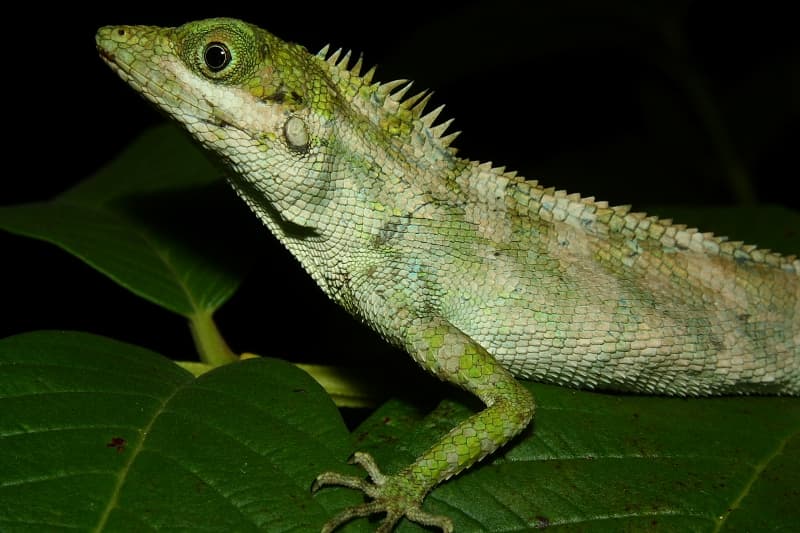
Andaman canopy agama
The Andaman canopy agama, also known as the green crestless forest lizard, is a species of agamid lizard native to the Andaman and Nicobar Islands of India. It is primarily an arboreal species, spending most of its life in the forest canopy and is rarely observed.

Chamaeleo zeylanicus
The Indian chameleon (Chamaeleo zeylanicus) is a slow-moving, arboreal lizard native to South Asia, including India, Sri Lanka, and Pakistan. It is distinguished by its unique prehensile tail, independent eye movement, and the remarkable ability to change skin color, primarily for communication and thermoregulation, rather than camouflage. This species possesses a long, sticky tongue to capture prey from a distance.

Furcifer balteatus
The Furcifer balteatus, also known as the two-banded chameleon or the rainforest chameleon, is a chameleon species native to southeast Madagascar. It is characterized by its green coloration with darker diagonal stripes and paler bands, often featuring a buff-colored diagonal streak, and males possess distinctive horny projections on their heads. This arboreal species inhabits rainforests at elevations between 800 and 1,050 meters.