
Stenodactylus sthenodactylus
Stenodactylus sthenodactylus·Gekkonidae
Stenodactylus sthenodactylus, also known as Lichtenstein's short-fingered gecko or the elegant gecko, is a lizard species belonging to the Gekkonidae family. It is commonly found across North Africa, the Middle East, and parts of East and West Africa, preferring semi-arid to hyperarid environments. This species is characterized by its widespread presence and is known for its adaptability to arid terrains.
Key Facts
- ›Found in the Middle East and across North, East, and parts of West Africa.
- ›Inhabits semi-arid to hyperarid regions.
- ›First described by Hinrich Lichtenstein in 1823.
- ›Belongs to the Gekkonidae family of geckos.
- ›Widespread and common, though not abundant.

Lichtenstein's Short-Fingered Gecko, Elegant Gecko
Middle East, North Africa, West Africa, East Africa
Semi-Arid, Hyperarid
About Stenodactylus sthenodactylus
Stenodactylus sthenodactylus, also identified as Lichtenstein's short-fingered gecko or the elegant gecko, is a species of lizard that belongs to the Gekkonidae family. This reptile is widely distributed across a significant portion of Africa and the Middle East.
Geographic Range and Habitat
The natural habitat of Stenodactylus sthenodactylus extends across the Middle East, encompassing countries such as Israel, Jordan, Egypt, Syria, and Saudi Arabia. Its range also covers much of North Africa, with marginal occurrences in West Africa, specifically Mali, and extends into northern East Africa, including Sudan, South Sudan, Djibouti, Eritrea, Kenya, and Ethiopia. The species is predominantly found in semi-arid to hyperarid environments, indicating a preference for dry, arid landscapes.
Taxonomy and Discovery
This gecko species was first formally described by Hinrich Lichtenstein in 1823. At the time of its initial description, it was given the scientific name Ascalabotes sthenodactylus. This classification was established by Lichtenstein in a catalogue of duplicate specimens from the Zoological Museum of Berlin, based on specimens collected by Friedrich Wilhelm Hemprich and Christian Gottfried Ehrenberg during their expeditions in Egypt and Nubia.
Population Status
While Stenodactylus sthenodactylus is considered widespread and commonly encountered within its habitat, it is not found in abundant numbers. Its presence is noted across its extensive range, but populations are not dense.
Source: Wikipedia ↗
Frequently Asked Questions
What is Stenodactylus sthenodactylus commonly known as?
Stenodactylus sthenodactylus is commonly known as Lichtenstein's short-fingered gecko or the elegant gecko. These common names reflect its discoverer and some of its physical characteristics.
Where is Stenodactylus sthenodactylus found geographically?
This species has a broad geographic distribution. It is found in the Middle East (including Israel, Jordan, Egypt, Syria, and Saudi Arabia), across North Africa, marginally in West Africa (Mali), and in northern East Africa (Sudan, South Sudan, Djibouti, Eritrea, Kenya, and Ethiopia).
What kind of habitat does Stenodactylus sthenodactylus prefer?
Stenodactylus sthenodactylus is associated with semi-arid to hyperarid areas. These are typically dry environments that receive very little rainfall.
When was Stenodactylus sthenodactylus first described?
The species was first described in 1823 by Hinrich Lichtenstein. Its original scientific name at the time of its description was Ascalabotes sthenodactylus.
What family does Stenodactylus sthenodactylus belong to?
Stenodactylus sthenodactylus belongs to the family Gekkonidae, which is the family of geckos. This places it among a diverse group of lizards known for their unique adaptations.
Related Lizards
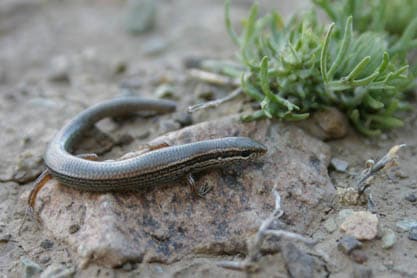
Ablepharus pannonicus
The Asian snake-eyed skink (Ablepharus pannonicus) is a species of skink native to a wide range across Asia and parts of the Middle East. It is characterized by its snake-like appearance and is found in diverse arid and semi-arid environments.

Acanthodactylus longipes
The long fringe-fingered lizard (Acanthodactylus longipes) is a species of lizard belonging to the Lacertidae family, native to northwestern Africa. It is characterized by its fringe-like scales on its toes, which aid in locomotion on sandy substrates. This oviparous species is found across a wide range of arid and semi-arid environments within the region.
Asian snake-eyed skink
The Asian snake-eyed skink (Ablepharus pannonicus) is a species of skink native to a wide range across Western and Central Asia, as well as parts of the Middle East. It is characterized by its small size and its distribution across various arid and semi-arid environments.