
Tropiocolotes nattereri
Natterer's gecko (Tropiocolotes nattereri) is a small lizard species belonging to the Gekkonidae family, native to northeastern Africa and Western Asia. It inhabits arid environments such as deserts, rocky areas, and shrublands. A distinctive feature is its reproduction, where females lay a single egg per clutch but can produce multiple clutches annually.
Key Facts
- ›Native to northeastern Africa and Western Asia.
- ›Found in desert, rocky areas, and shrubland habitats.
- ›Reproduction is oviparous, with a clutch size of only one egg.
- ›Females can lay two or more clutches per year.
- ›Named in honor of Austrian ornithologist Johann Natterer.

Natterer's Gecko
Egypt, Israel, Jordan, Saudi Arabia
About Tropiocolotes nattereri
Natterer's Gecko (Tropiocolotes nattereri)
Natterer's gecko, scientifically known as Tropiocolotes nattereri, is a species of lizard belonging to the Gekkonidae family. This reptile is indigenous to the northeastern regions of Africa and parts of Western Asia, with documented populations in Egypt, Israel, Jordan, and Saudi Arabia.
Habitat and Distribution
The preferred natural habitats for Tropiocolotes nattereri are arid and semi-arid environments. These include deserts, rocky terrains, and shrublands, where they can be found at elevations reaching up to 1,600 meters (approximately 5,200 feet). The species' range is thus defined by these specific ecological niches.
Reproduction
Tropiocolotes nattereri is oviparous, meaning it reproduces by laying eggs. A notable characteristic of its reproductive strategy is the small clutch size, with females laying only a single egg per clutch. Despite this, individual females are capable of laying two or more such clutches annually, ensuring reproductive success within their populations.
Etymology
The specific epithet, "nattereri," was chosen in honor of the Austrian ornithologist Johann Natterer. This naming convention serves to acknowledge his contributions to the scientific understanding of the natural world.
Source: Wikipedia ↗
Frequently Asked Questions
What is the scientific name for Natterer's gecko?
The scientific name for Natterer's gecko is Tropiocolotes nattereri. This binomial nomenclature is used to classify the species within the animal kingdom.
Where can Natterer's gecko be found?
Tropiocolotes nattereri is naturally found in northeastern Africa and Western Asia. Its geographic range includes countries such as Egypt, Israel, Jordan, and Saudi Arabia.
What kind of habitats does Natterer's gecko prefer?
This species prefers natural habitats that include desert environments, rocky areas, and shrubland. They can be found at elevations up to 1,600 meters (5,200 feet).
How does Natterer's gecko reproduce?
Tropiocolotes nattereri is oviparous, meaning it reproduces by laying eggs. A notable aspect of its reproduction is that each female lays only one egg per clutch.
Does Natterer's gecko lay multiple eggs at once?
No, Natterer's gecko has a very small clutch size, with only one egg laid per clutch. However, females are capable of laying two or more clutches throughout the breeding year.
Who is Natterer's gecko named after?
The specific epithet 'nattereri' is in honor of Johann Natterer, an Austrian ornithologist. The species was named to commemorate his contributions to the field.
Related Lizards

Ptyodactylus ragazzii
Ragazzi's fan-footed gecko, scientifically known as Ptyodactylus ragazzii, is a species of lizard found across a wide range of northern Africa. It inhabits rocky desert, shrubland, and savanna environments, and is characterized by its nocturnal and crepuscular activity patterns. This oviparous lizard is notable for laying multiple clutches of two eggs per year.
Acanthodactylus cantoris
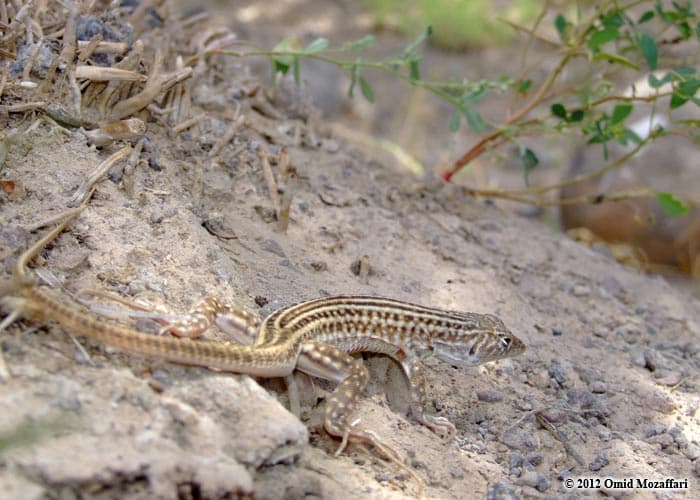
The Indian fringe-fingered lizard (Acanthodactylus cantoris) is a terrestrial species endemic to Asia, primarily found in sandy desert and shrubland habitats. It is characterized by its acutely pointed snout, keeled dorsal scales, and strong digital denticulations. This oviparous lizard burrows in the sand for protection and its young have distinctive white longitudinal lines on a blackish background.

Agama anchietae
Agama anchietae, commonly known as Anchieta's agama or the western rock agama, is a species of lizard native to southern Africa. It is characterized by its cryptic coloration, a wider head and longer tail in males due to sexual dimorphism, and a diet primarily consisting of insects, particularly ants. This species inhabits diverse environments including deserts, shrublands, and grasslands, and it reproduces by laying eggs.