
Yarkand toad-headed agama
The Yarkand toad-headed agama (Phrynocephalus axillaris) is a species of lizard native to arid regions of Central Asia. It is characterized by its toad-like head and is well-adapted to desert environments, inhabiting areas with sandy or rocky substrates.
Key Facts
- ›Native to China, Mongolia, Tibet, and Turkestan.
- ›Inhabits desert environments at altitudes ranging from 100 to 3,200 meters.
- ›The species is oviparous, laying two to five eggs per clutch.
- ›Its scientific name, Phrynocephalus axillaris, reflects its toad-like head shape.
- ›Belongs to the Agaminae subfamily within the family Agamidae.

Yarkand Toadhead Agama
China, Mongolia, Tibet, Turkestan
Characterized By A Toad-Like Head Shape.
About Yarkand toad-headed agama
The Yarkand toad-headed agama, scientifically designated as Phrynocephalus axillaris, is a species of lizard belonging to the Agaminae subfamily within the family Agamidae. This reptile is a native inhabitant of arid regions across Central Asia, with its natural range encompassing China, Mongolia, Tibet, and Turkestan.
Habitat and Adaptations
This species shows a strong preference for desert environments. It is typically found at elevations ranging from 100 to 3,200 meters (approximately 330 to 10,500 feet) above sea level. Its physiology and behavior are well-suited to these arid conditions, allowing it to thrive where many other species cannot.
Reproduction
The Yarkand toad-headed agama reproduces by laying eggs, a characteristic known as being oviparous. Female agamas lay clutches consisting of two to five eggs, ensuring the continuation of the species within its challenging habitat.
Source: Wikipedia ↗
Frequently Asked Questions
What is the Yarkand toad-headed agama?
The Yarkand toad-headed agama, scientifically known as Phrynocephalus axillaris, is a species of lizard. It is part of the Agaminae subfamily and is native to several countries in Central Asia.
Where does the Yarkand toad-headed agama live?
This lizard species is found in China, Mongolia, Tibet, and Turkestan. Its preferred natural habitat is desert regions.
What kind of environment does the Yarkand toad-headed agama prefer?
The Yarkand toad-headed agama thrives in desert environments. It can be found at altitudes ranging from 100 to 3,200 meters above sea level.
How does the Yarkand toad-headed agama reproduce?
The Yarkand toad-headed agama is oviparous, meaning it lays eggs. Each clutch typically contains two to five eggs.
What does the name 'Yarkand toad-headed agama' refer to?
The name 'toad-headed' refers to the distinctive, flattened, and broad shape of the lizard's head, which resembles that of a toad. 'Yarkand' likely refers to the region where it was first described or is commonly found.
Related Lizards
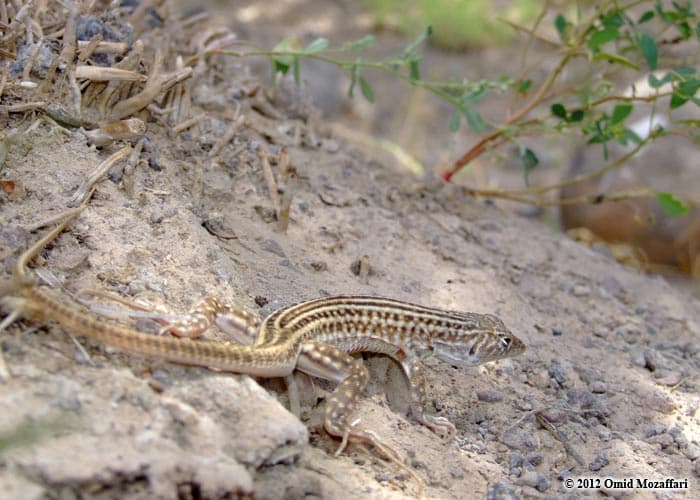
Acanthodactylus cantoris
The Indian fringe-fingered lizard (Acanthodactylus cantoris) is a terrestrial species endemic to Asia, primarily found in sandy desert and shrubland habitats. It is characterized by its acutely pointed snout, keeled dorsal scales, and strong digital denticulations. This oviparous lizard burrows in the sand for protection and its young have distinctive white longitudinal lines on a blackish background.
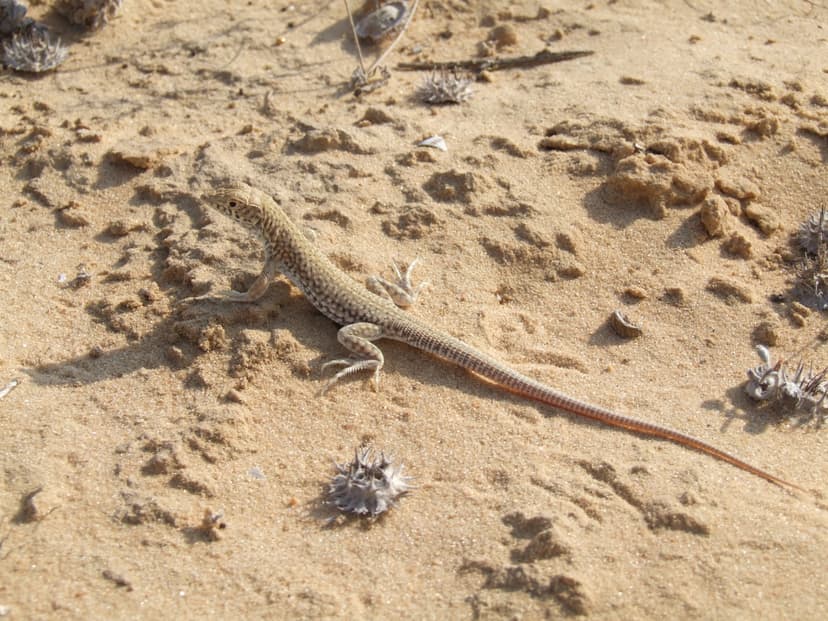
Acanthodactylus scutellatus
The Acanthodactylus scutellatus, commonly known as the Nidua fringe-fingered lizard, is a small lizard species endemic to northern Africa and the Middle East. It is recognized by its unique ventral scale arrangement and its adeptness at burrowing in loose sand for shelter. This diurnal species breeds in late winter, with females laying clutches of 3-6 eggs in the spring.

Agama anchietae
Agama anchietae, commonly known as Anchieta's agama or the western rock agama, is a species of lizard native to southern Africa. It is characterized by its cryptic coloration, a wider head and longer tail in males due to sexual dimorphism, and a diet primarily consisting of insects, particularly ants. This species inhabits diverse environments including deserts, shrublands, and grasslands, and it reproduces by laying eggs.