
Zonosaurus madagascariensis
The Madagascar girdled lizard, scientifically known as Zonosaurus madagascariensis, is a commonly found lizard species native to Madagascar and several surrounding islands. It inhabits a variety of environments, including open and degraded forests, plantations, and shrublands. This oviparous reptile can reach a total length of up to 30 cm.
Key Facts
- ›Native to Madagascar and nearby islands like Nosy be, Grande Glorieuse, and Cosmoledo.
- ›Inhabits diverse habitats including forests, plantations, and shrubland.
- ›Reaches a total length of up to 30 cm.
- ›Classified as oviparous, meaning it reproduces by laying eggs.
- ›Populations on Cosmoledo and Grande Glorieuse are recognized as subspecies Zonosaurus madagascariensis insulanus.

Madagascar Girdled Lizard, Madagascar Plated Lizard
Madagascar, Nosy Be, Grande Glorieuse, Cosmoledo
Open Humid Forest, Degraded Humid Forest, Plantations, Shrubland
Grows To 30 cm Total Length.
About Zonosaurus madagascariensis
Madagascar Girdled Lizard (Zonosaurus madagascariensis)
The Madagascar girdled lizard, scientifically identified as Zonosaurus madagascariensis, is a reptile species belonging to the Gerrhosauridae family. This lizard is a relatively common inhabitant of Madagascar and is also found on several outlying islands, including Nosy Be, Grande Glorieuse, and Cosmoledo. Its presence extends to various habitat types, often favoring or tolerating environments altered by human activity.
Habitat and Distribution
Zonosaurus madagascariensis occupies a range of ecological niches. It is frequently encountered in open and degraded humid forests, typically found at mid and low altitudes. The species also adapts well to plantations and, on islands such as Cosmoledo, can be found in open shrubland environments. This adaptability allows it to thrive in diverse landscapes across its native range.
Physical Characteristics and Reproduction
This species is characterized by its ability to reach a total length of approximately 30 centimeters (12 inches). As an oviparous lizard, Zonosaurus madagascariensis reproduces by laying eggs. Populations inhabiting Cosmoledo and Grande Glorieuse have been recognized as a distinct subspecies, Zonosaurus madagascariensis insulanus.
Source: Wikipedia ↗
Frequently Asked Questions
Where is the Madagascar girdled lizard found?
The Madagascar girdled lizard is found in Madagascar and on some outlying islands, including Nosy Be, Grande Glorieuse, and Cosmoledo. Subspecies are specifically recognized on Cosmoledo and Grande Glorieuse.
What kind of habitats does Zonosaurus madagascariensis prefer?
This lizard is found in a range of habitat types. These include open and degraded humid forests at mid and low altitudes, as well as plantations. On islands like Cosmoledo, it can be found in open shrubland.
How large can a Madagascar girdled lizard get?
The Madagascar girdled lizard typically grows to a total length of approximately 30 cm (12 inches).
How does Zonosaurus madagascariensis reproduce?
Zonosaurus madagascariensis is an oviparous species, meaning that it reproduces by laying eggs.
Are there different subspecies of Zonosaurus madagascariensis?
Yes, populations found on Cosmoledo and Grande Glorieuse are recognized as a distinct subspecies, Zonosaurus madagascariensis insulanus.
Related Lizards

Teira dugesii
The Madeiran wall lizard (Teira dugesii) is a common species endemic to the Madeira Archipelago, Portugal, notable for its variable coloration that often camouflages it with its surroundings. It inhabits a wide range of environments, from coastal areas to altitudes of 1,850 meters, and has also become naturalized in the Azores. This lizard is characterized by its small size, easily shed tail, and insectivorous-herbivorous diet.
Trioceros ellioti
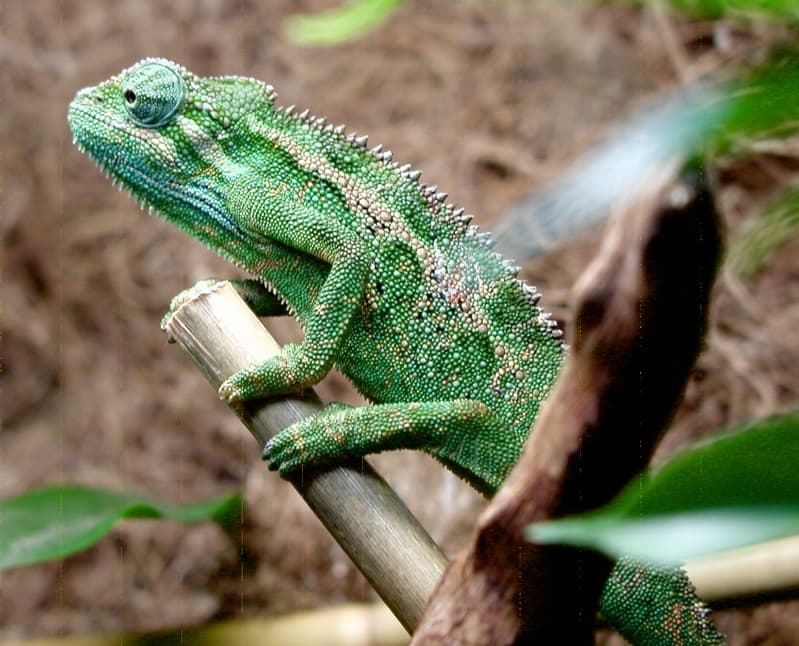
Trioceros ellioti, commonly known as Elliot's chameleon, is a species of lizard native to Africa. It inhabits diverse environments from forests to grasslands at moderate altitudes. This chameleon is characterized by its viviparous or ovoviviparous reproductive strategy.

Acanthodactylus schreiberi
Schreiber's fringe-fingered lizard (Acanthodactylus schreiberi) is a species endemic to Cyprus, inhabiting sandy shores, pastures, and plantations. This oviparous lizard is named in honor of Austrian zoologist Egid Schreiber. Its primary threat is habitat loss due to development.