
Ailurops
Diprotodontia·Unknown
The Ailurops, commonly known as bear cuscuses, are a genus of arboreal marsupials belonging to the family Phalangeridae. Found exclusively in Indonesia on Sulawesi and nearby islands, their isolation is thought to have led to their unique morphological divergence. Little is currently known about their specific ecological status.
Key Facts
- ›Bear cuscuses belong to the genus Ailurops and the family Phalangeridae.
- ›They are native to Sulawesi and several smaller islands in Indonesia.
- ›These marsupials are primarily arboreal, meaning they live in trees.
- ›Their geographic isolation on Sulawesi is believed to be a factor in their distinctiveness.
- ›The genus is sometimes placed in its own subfamily, Ailuropinae.

Bear Cuscus
Indonesia
Arboreal
Arboreal Marsupials
Morphological Divergence Due To Isolation
About Ailurops
The genus Ailurops, commonly referred to as bear cuscuses, comprises a group of arboreal marsupials belonging to the family Phalangeridae. These unique animals are found exclusively in Indonesia, inhabiting the island of Sulawesi and several smaller neighboring islands that form part of the Wallacea region. Their geographic isolation on Sulawesi is hypothesized to be a key factor in their distinct morphological development compared to other members of the Phalangeridae family.
Taxonomy and Distribution
While some scientists classify all populations under a single species, A. ursinus, others recognize A. melanotis as a separate species. The genus itself is considered distinct, with some authorities placing it within its own subfamily, Ailuropinae. The known species are the Talaud bear cuscus (Ailurops melanotis), found on Salebabu Island in the Talaud Islands, and the Sulawesi bear cuscus (Ailurops ursinus), which inhabits Sulawesi, Peleng Island, Muna Island, Butung Island, and the Togian Islands.
Ecology and Behavior
Bear cuscuses are characterized by their arboreal lifestyle, indicating they spend most of their lives in trees. However, detailed information regarding their specific ecological status and behaviors remains scarce. Almost nothing is known about their population dynamics, feeding habits, or reproductive cycles, making them a subject of mystery within the broader study of marsupials.
Source: Wikipedia ↗
Frequently Asked Questions
What are bear cuscuses?
Bear cuscuses are marsupials belonging to the genus Ailurops. They are known for being arboreal and are found in specific islands of Indonesia.
Where are Ailurops found?
The genus Ailurops is found exclusively in Indonesia, primarily on the island of Sulawesi and some smaller adjacent islands within the Wallacea region.
What is the habitat of bear cuscuses?
Bear cuscuses are arboreal marsupials, indicating that their natural habitat is in trees within the forests of Sulawesi and surrounding Indonesian islands.
Are there different species of Ailurops?
Yes, the genus Ailurops is understood to contain at least two species: Ailurops melanotis (Talaud bear cuscus) and Ailurops ursinus (Sulawesi bear cuscus). However, some scientists consider all populations to be a single species.
What is unique about the Ailurops genus?
The genus Ailurops is distinct within the Phalangeridae family, with some authorities classifying it in its own subfamily, Ailuropinae. Their isolated evolution on Sulawesi is thought to have contributed to their unique morphology.
Related Marsupials
Acrobates
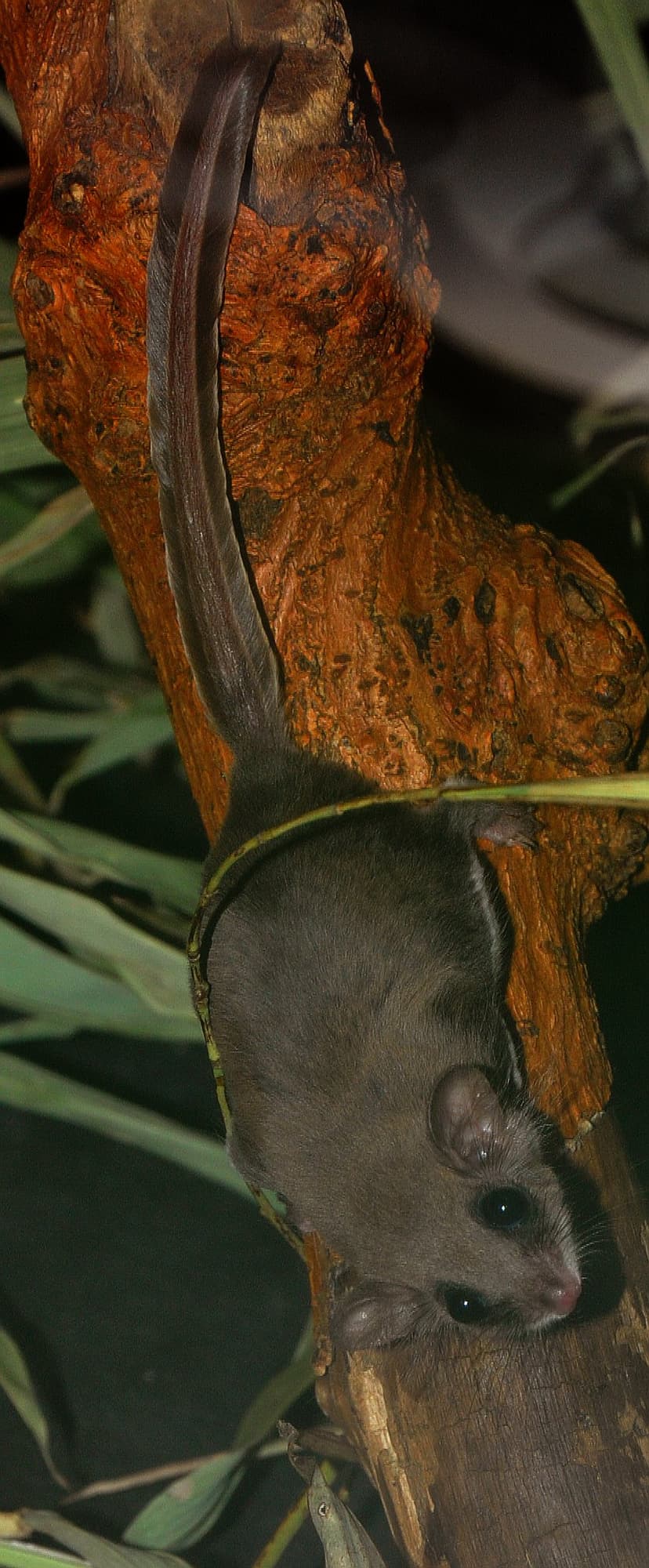
The feathertail glider (Acrobates pygmaeus) is the world's smallest gliding mammal, native to eastern Australia. It is distinguished by its feather-shaped tail and its remarkable ability to climb smooth surfaces, even glass. This nocturnal marsupial is an omnivore, feeding on nectar, pollen, and insects, and is known for its unique adaptation of torpor during cold weather.

Caluromys
Caluromys, commonly known as woolly opossums, are a genus of three species belonging to the order Didelphimorphia. These marsupials are characterized by their woolly fur and are found in the diverse ecosystems of Central and South America. They are primarily arboreal and are known for their omnivorous diet.

Antechinus
Antechinus are a genus of small, mouse-like marsupials endemic to Australia, characterized by their bristly fur. They inhabit forests, woodlands, and grasslands, with most species found along the eastern coast. A distinctive feature of Antechinus is their unusual reproductive strategy, where males experience mass mortality after a short mating period, while females can reproduce multiple times.