
Aconcagua
Tectonic uplift due to subduction of the Nazca Plate beneath the South American Plate, formerly a stratovolcano.
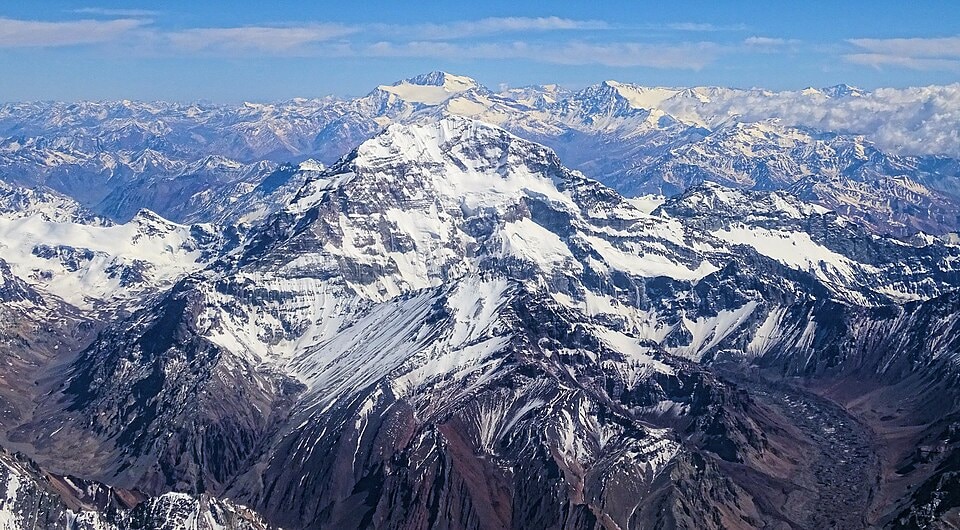
Aconcagua is the highest mountain in the Americas and the highest peak outside of Asia, located in the Andes mountain range in Mendoza Province, Argentina. It is a significant peak for mountaineers worldwide, often referred to as the highest non-technical mountain, though its extreme altitude presents considerable challenges and risks.
Key Facts
- ›Highest mountain in the Americas, Western Hemisphere, and Southern Hemisphere.
- ›Second-most topographically prominent peak in the world.
- ›Part of the seven Summits, the highest mountains on each continent.
- ›Formed by tectonic forces resulting from the subduction of the Nazca Plate beneath the South American Plate.
- ›Considered the highest non-technical mountain, though extreme altitude causes altitude sickness.
- ›Records approximately three deaths per year, earning it the nickname 'Mountain of Death'.
Aconca-Hue, Ackon Cahuak, Anco Cahuac, Janq'U Q'Awa
Argentina
Lavas, Breccias, Pyroclastics, Carbonates, Limestones, Turbidites, Evaporates
Alpine
Aconcagua River
About Aconcagua
Aconcagua stands as the undisputed monarch of the Andes, holding the distinction of being the highest mountain in the Americas, the highest peak outside of Asia, and the loftiest summit in both the Western and Southern Hemispheres. Located in Mendoza Province, Argentina, this colossal peak is a prominent feature of the Principal Cordillera and a significant destination for mountaineers and adventurers from around the globe.
Geological Formation and History
The dramatic rise of Aconcagua is a testament to powerful geological forces, primarily the subduction of the Nazca Plate beneath the South American Plate. This process, which occurred millions of years ago, transformed Aconcagua from an active stratovolcano into the towering mountain it is today. While volcanic activity ceased during the Miocene epoch, the tectonic shifts continued to uplift the landmass, shaping the mountain's current form. The rocks on its flanks are predominantly volcanic in origin, including lavas, breccias, and pyroclastics, interspersed with sedimentary deposits from an ancient shallow sea.
Climbing and Mountaineering Significance
From a mountaineering perspective, Aconcagua presents a unique challenge. The standard route from the north is often described as the highest non-technical mountain in the world, meaning it typically does not require ropes or specialized climbing equipment. However, this accessibility belies the extreme dangers posed by its immense altitude. At nearly 7,000 meters, the atmospheric pressure is significantly reduced, leading to severe altitude sickness for most climbers. This, combined with harsh weather conditions, contributes to the mountain's reputation as the 'Mountain of Death,' with an average of three fatalities per year. Despite these risks, summit success rates are estimated between 30% and 40%, drawing approximately 75% foreign climbers annually, with the United States, Germany, and the United Kingdom being the most represented nationalities.
Cultural and Historical Context
Beyond its physical grandeur, Aconcagua holds deep cultural and historical significance. For the Inca civilization, it was a sacred mountain, a site for religious rituals and sacrifices, including human sacrifices. Archaeological discoveries on its slopes have uncovered the remains of individuals from the elite social class, along with offerings, underscoring its spiritual importance. The first recorded ascent was made in 1897 by Swiss guide Matthias Zurbriggen, as part of a British expedition, marking a new era of exploration for this formidable peak.
Tourism and Environmental Protection
Aconcagua is protected within Aconcagua Provincial Park, highlighting efforts to preserve its natural environment. The park manages the influx of climbers and tourists, with base camps like Plaza de Mulas serving as vital hubs for expeditions. Efforts are also in place to manage waste and mitigate the environmental impact of climbing activities, with waste being flown out by helicopter each season.
Source: Wikipedia ↗
Frequently Asked Questions
What is the elevation of Aconcagua?
Aconcagua has a summit elevation of 6,967.15 meters (22,858.1 feet) above sea level. This extreme altitude means atmospheric pressure at the summit is roughly 40% of that at sea level, posing significant challenges for climbers.
Where is Aconcagua located?
Aconcagua is situated in the Principal Cordillera of the Andes mountain range, within Mendoza Province, Argentina. It is located 112 kilometers (70 miles) northwest of the city of Mendoza and approximately 15 kilometers (9.3 miles) from the Argentine-Chilean border.
What is the geological origin of Aconcagua?
Aconcagua was formed by the subduction of the Nazca Plate beneath the South American Plate. It was once an active stratovolcano, but tectonic shifts during the Miocene period halted volcanic activity and led to its uplift.
Who made the first recorded ascent of Aconcagua?
The first recorded ascent of Aconcagua was achieved on January 14, 1897, by Swiss guide Matthias Zurbriggen. He was part of a British expedition led by Edward FitzGerald.
Is Aconcagua technically difficult to climb?
From the north via the normal route, Aconcagua is considered technically straightforward and is often described as the highest non-technical mountain. However, the extreme altitude and severe weather conditions present significant dangers.
What are the dangers of climbing Aconcagua?
The primary danger on Aconcagua is altitude sickness due to the extreme elevation. Hypothermia is also very common due to the cold weather conditions. The mountain has earned the nickname 'Mountain of Death' due to the number of fatalities it records annually.
What is the mythological or cultural significance of Aconcagua?
For the Incas, Aconcagua was considered a sacred mountain, with places of worship and sites for sacrifices, including human sacrifices, built upon its slopes. Archaeological discoveries have revealed the remains of individuals from the highest social class, along with offerings.
Related Mountain ranges

Accursed Mountains
The Accursed Mountains, also known as Prokletije, are a rugged mountain range in coastal Southeast Europe, forming the southernmost subrange of the Dinaric Alps. This range is notable for its dramatic glacial karst topography, rich biodiversity, and being one of the southernmost glacial masses in Europe. Its challenging terrain and unique geological formations have made it a subject of both scientific interest and local legend.

Adirondack Mountains
The Adirondack Mountains are a prominent massif in Northeastern New York State, forming a circular dome of ancient rocks uplifted by relatively recent geological processes. This region is significant for its extensive natural resources, recreational opportunities, and unique ecological transition zone, encompassing over 100 peaks and thousands of lakes and rivers within the vast Adirondack Park.

Aberdare ranges
The Aberdare Range is a significant mountain range in west-central Kenya, running north to south and forming part of the eastern rim of the Great Rift Valley. It is a vital water catchment area for Nairobi and for the Tana River, which generates a substantial portion of Kenya's electricity. The range is renowned for its diverse ecosystems, abundant wildlife, and as a protected area within Aberdare National Park.